
Industrial & Manufacturing Marketing Articles
AI Search and Manufacturing Content Marketing—How They Influence Engineers and Technical Buyers
AI search and manufacturing content marketing are now connected in ways many industrial marketers still underestimate. I am not talking about using AI to write blog posts or do keyword research. I am talking about how engineers and technical buyers are using AI-assisted search, Google’s AI Overviews, and other generative tools in the supplier evaluation process.
That matters because early research behavior is changing. Buyers want to do more of the work themselves before they ever contact sales. Gartner reported in March 2026 that 67% of B2B buyers prefer a rep-free experience.
That should get the attention of every manufacturer still treating website content as a digital brochure instead of a sales and credibility asset.
At the same time, the 2026 State of Marketing to Engineers report shows that engineers and technical buyers are experimenting with generative AI but are not surrendering their trust to it. The three charts below from the report show the influence of AI searches and the trustworthiness of the information.
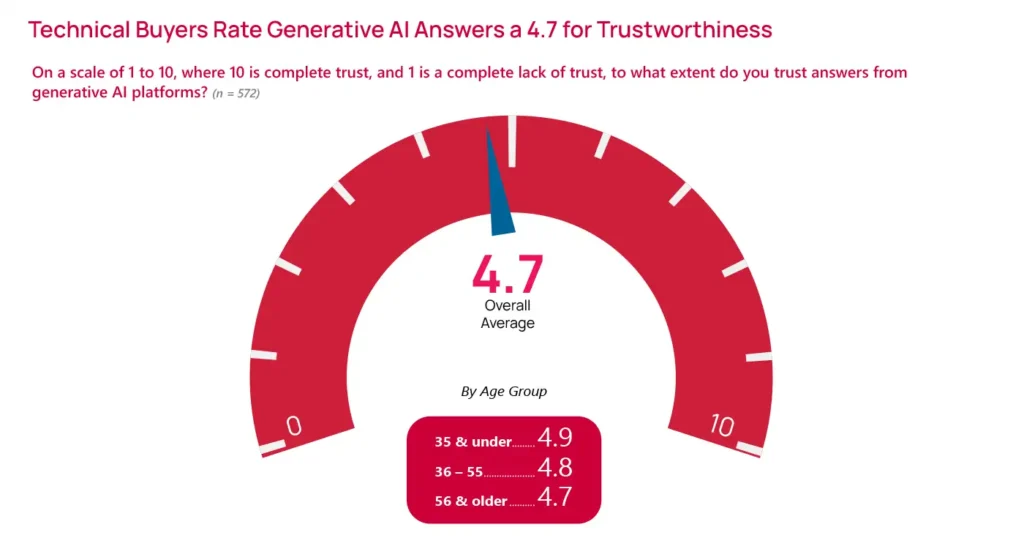
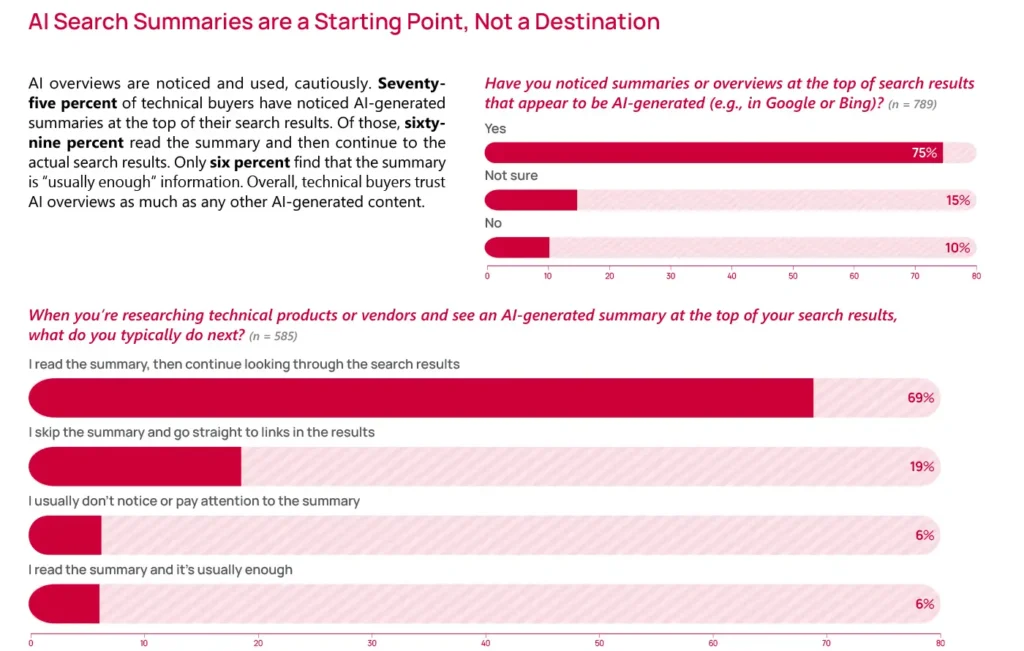
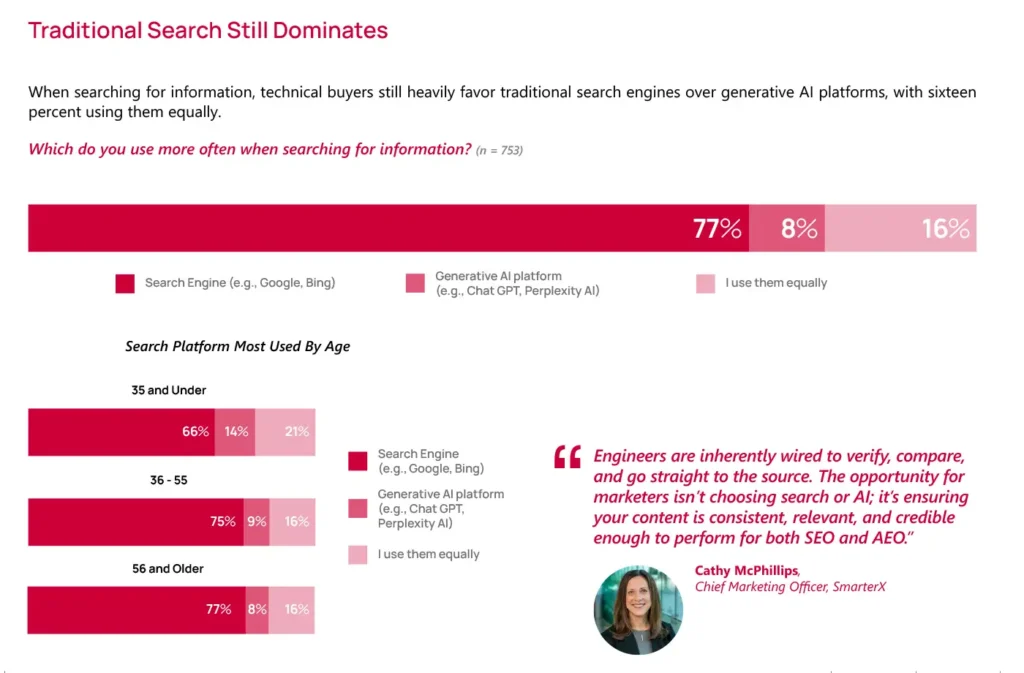
That tells me something important. AI search is influencing how engineers discover information, frame questions, and shortlist suppliers. But it is not removing the need for technically credible, customer-focused content. If anything, it is increasing the need for it.
AI Search and Manufacturing Content Marketing–How Engineers and Technical Buyers are Using Them
The real story is not that engineers suddenly trust AI. They do not. The story is that AI is becoming part of the research workflow.
The same report shows that only 31% of respondents now say they “never” use generative AI tools to help evaluate vendors or research products and services, down from 42% last year.
That is a meaningful shift. It tells me that more technical buyers are at least testing these tools during early research and comparison.
But they are still behaving like engineers have always done. They verify. They compare. They go back to the source material. They look for inconsistencies. They want proof.
That is why I do not think manufacturers should panic about AI search. I also do not think they should ignore it.
Engineers may use AI to simplify complex topics, compare options, or get a quick summary. Then they move into a more deliberate validation process. That is where your website content, technical pages, and broader Manufacturing Content Marketing strategy start doing the heavy lifting.
Why Google AI Overviews Matter, Even When They Do Not Answer Everything
Google’s own documentation makes it clear that AI features like AI Overviews and AI Mode are part of the evolving search experience, and that site owners should approach them by continuing to create useful content for people rather than trying to game the system.
Google also says success in AI search experiences comes from creating unique, satisfying content that serves users well, especially as people ask longer, more specific questions and follow-up questions.
That is a critical point for manufacturers.
Google’s AI Overviews may still shape the first impression and influence which topics buyers explore next, but they are also contributing to fewer clicks and less organic traffic for many websites.
As I discussed in my earlier article, SEO for Manufacturers in the Age of AI: How Google’s Search Generative Experience is Reshaping Search Results, this is part of the growing trend toward zero-click results.
Search Engine Journal cited Similarweb data showing that zero-click searches increased from 56% to 69% between May 2024 and May 2025, and another SEJ report noted that about 60% of searches already ended without a click.
That does not mean website content matters less. It means it has to work harder. When engineers and technical buyers do click through, they are further into evaluation mode and more likely to quickly judge your credibility based on the quality, specificity, and usefulness of the page they land on.
This is where too many manufacturers lose momentum. They focus on whether AI will mention them. They should focus just as much on whether the destination page is strong enough to earn the trust of human visitors once they land on it.
AI Search is Influencing Website Content, Not Just Blog Content
This is where I think the conversation needs to get sharper.
Many industrial marketers still treat content marketing as a synonym for blogging. That was already too narrow. AI search makes that limitation even more obvious.
If engineers and technical buyers are using AI search to ask more specific questions, compare options faster, and move deeper into self-directed research, then the entire website needs to improve. Not just the blog.
Google’s guidance on helpful, reliable, people-first content supports this broader view. The emphasis is not on content volume. It is on content that genuinely helps people complete a task, answer a question, or make a decision.
In practical terms, AI search is raising the bar for manufacturing website content. Thin pages, vague claims, and generic copy were already weak. Now they are even weaker because buyers can compare answers more quickly and move on.
A more strategic Manufacturing Content Marketing approach should improve the quality of the whole content ecosystem, including core website pages that support supplier evaluation.
What Manufacturing Content Marketing Should Do Now
I believe manufacturers need to think less about “content output” and more about “content usefulness.”
That means creating content that reflects how engineers and technical buyers actually research. It means building a connected system of pages and assets that support discovery, validation, and decision-making.
That system may include educational blog posts, but it should also include application pages, comparison pages, technical FAQs, industry-specific solution pages, design or selection guides, case studies, and expert-driven insights. In many cases, those pages will do more to support real buying decisions than another generic top-of-funnel article.
Search Engine Journal recently said that the strategies most likely to survive AI-driven search are those that move beyond chasing rankings and focus on real visibility, relevance, and authority.
I agree with that. Industrial marketers should stop focusing solely on ranking a blog post and start considering whether their broader content footprint helps technical buyers evaluate suppliers with confidence.
That also means involving technical SMEs more directly. AI search is not making expertise less important. It is making expertise easier to test. The more your content reflects real-world engineering questions, practical application knowledge, and specific answers, the better positioned you are.
Manufacturers that treat Manufacturing Content Marketing as a strategic system rather than a stream of disconnected blog posts will be in a stronger position as AI search continues to reshape buyer behavior.
Why Credibility and Specificity Matter More Today
A reality I have seen for years in industrial marketing—Engineers do not want fluff. They want clarity, relevance, and proof.
AI may accelerate discovery, but it does not lower or erase skepticism. That has several implications for content.
First, vague claims are a liability. Words like “innovative,” “leading,” and “world-class” do not help technical buyers evaluate fit. Specific application guidance does.
Second, original expertise matters. If your content could have been written about any supplier in your category, it is too generic.
Third, proof matters. Technical buyers are more likely to trust pages that include certifications, performance criteria, industry context, use cases, data, examples, and clear technical reasoning.
Fourth, consistency matters. AI systems draw from what is said about a company across the web, while buyers themselves move across search results, vendor websites, publications, forums, and other sources.
If your messaging is unclear, inconsistent, or shallow, that weakness becomes easier to spot.
What Manufacturers Should Do
I would not advise manufacturers to chase every AI trend. I would advise them to tighten their fundamentals and raise the quality of their content.
Start by auditing your core website pages, not just your blog. Look for thin product pages, weak solution pages, outdated technical resources, and FAQs that add little value. Review whether your content actually answers buyers’ questions at different stages of the evaluation process.
Then look at your broader content strategy. Are you publishing content that helps engineers define problems, compare approaches, assess fit, and justify decisions internally? Or are you still producing disconnected articles built around shallow keyword targets?
AI search is not replacing manufacturing content marketing. It is exposing a weak strategy faster.
The manufacturers that will benefit most are the ones that build credible, technically useful content across the entire website and support it with a disciplined content marketing strategy. That is the right response, not because AI is trendy, but because engineers and technical buyers are changing how they research.
If your content is not keeping up with that shift, you risk losing visibility and credibility before your sales team ever has a chance.
Set up an initial call with me, and let’s talk about how to strengthen your manufacturing content marketing and website content for AI-influenced search.
