There is quite a bit of confusion among my industrial clients about the terms Inbound Marketing and Content Marketing. For many, the two are synonymous and it is just a matter of semantics. IMO, Content Marketing goes well beyond Inbound Marketing.
The classic definition of Inbound Marketing focuses on the top of the sales funnel (ToFU) and is built on the principle of being found in search engines and social media, attracting traffic and converting visitors into leads with relevant content. All worthwhile goals and takes a lot of hard work to accomplish them. However, you are likely to be very disappointed if your industrial marketing stayed focused only on ToFU.
I prefer the broader definition of Content Marketing because it addresses every phase of the buyer’s journey, both before and after the sale. I found a very fitting football analogy by Joe Pulizzi (@juntajoe) – the Founder of the Content Marketing Institute and the author of the books Managing Content Marketing and Get Content Get Customers, in a blog post Joe wrote, “If content marketing were a football field, inbound marketing would get you to the 35-yard line. Definitely critical, but hard to score from that distance.”
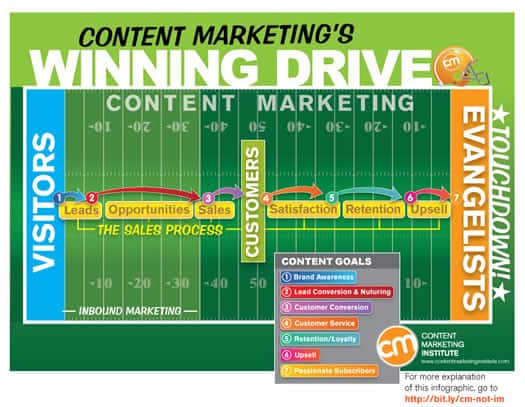
I couldn’t agree more with that statement. In a twist of irony, I along with many Houstonians and football pundits across the nation believe that the Houston Texans’ inability to score more touchdowns rather than settling for field goals when in the Red Zone was one of their chief downfalls this year. Oh well!
In all fairness to Brian Halligan (@bhalligan) – CEO and Co-founder of HubSpot who is credited with popularizing the term Inbound Marketing, he has broadened his definition to put more focus on the middle of the funnel (MoFu). In several articles that I have read, he is reported as saying, “Inbound marketing 2.0 will transform the middle of the funnel. The next wave is not around the top of the funnel and getting found by more people, but in improving the conversion from the top to the middle and the bottom of the funnel.”
Now we are getting a lot closer to what content marketing should be. Many B2B marketers also agree and believe in the power of Content Marketing. The BtoB Magazine’s 2012 B2B Content Marketing: Ready for Prime Time report found that 34% of the respondents are “very” or “fully” engaged with content marketing as compared to only 18% last year. This chart from the same report illustrates the key drivers of Content Marketing.

That doesn’t mean that manufacturers are jumping on the Content Marketing bandwagon en masse. Many are still sitting on the fence. For more on this, read my post, “Are Manufacturers Turning a Deaf Ear to Content Marketing?” The comments left by others provide additional insights.
For more ideas on how Content Marketing can help your industrial sales, refer to some of my posts on this topic.
- The Real Value of Content Marketing for Industrial Companies
- Content Can Differentiate Industrial Companies When There’s Parity in Value Propositions
- Industrial Content Marketing is Not Just for SEO
- How Manufacturers Use 3D CAD Models and 2D CAD Drawings as Sales Enablers
Let me hear your thoughts on how Content Marketing has helped drive industrial sales for your company.

Leave a Reply to Edwin Vlems Cancel reply