Category: B2B E-Mail Marketing

  • Industrial Lead Generation – MQL vs SQL

    Industrial Lead Generation – MQL vs SQL

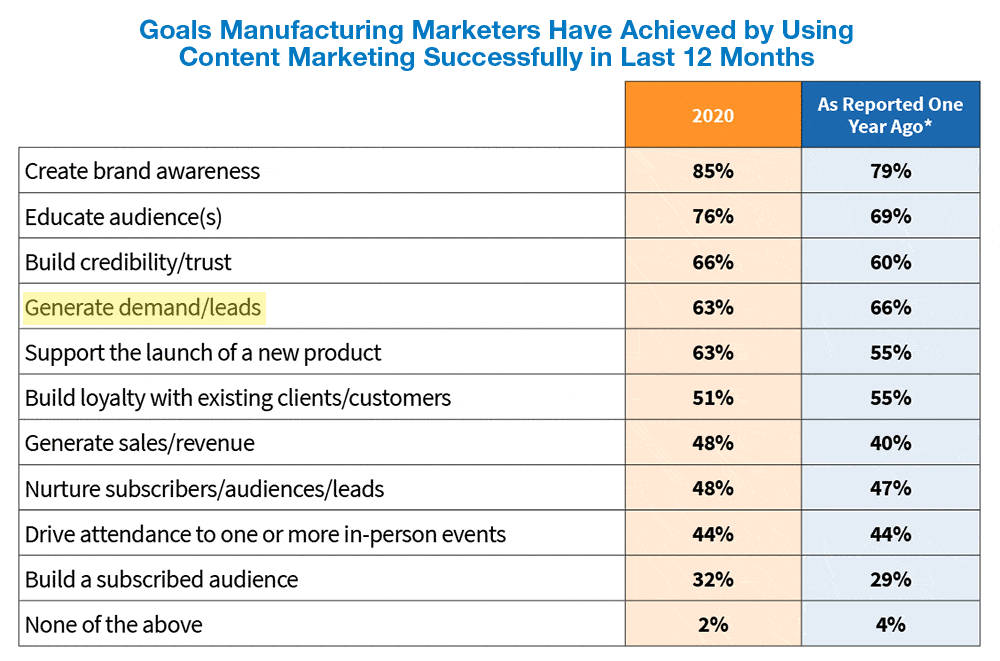
    Industrial lead generation is an important, if not the #1 goal of industrial marketers. Sure, there are other objectives of manufacturing content marketing as can be seen in this chart from the Manufacturing Content Marketing 2020 research report published by the Content Marketing Institute.

    Even though “Generate demand/leads” is at #4, generating high quality leads is closely related to the top three goals.

    Industrial lead generation with manufacturing content marketing

    Industrial lead generation is complicated

    Your Sales team and more importantly, upper management want Marketing to generate leads that turn into RFQs/RFPs and sales opportunities.

    Here’s where things begin to get complicated and start to fall apart. Not all leads are created equal, especially in long sales cycles with many stakeholders involved as is typical in industrial sales.

    No, this post is not about quantity vs quality of leads.

    MQL and SQL definitions

    I’ll approach the definitions from the perspective of industrial content marketing since most manufacturing marketers are using this inbound marketing strategy to successfully generate leads these days.

    A Marketing Qualified Lead (MQL) is someone who has shown some interest in your content and may even be willing to give up their basic contact information in exchange for gaining access to more valuable content. These are top of the funnel (ToFU) leads.

    A Sales Qualified Lead (SQL) is someone who has shown an interest in your product or service and not just in consuming your content. These prospects are further along in their buying journey. These are middle of the funnel (MoFU) leads who may be ready to have a conversation with your sales team.

    The biggest mistake made by Marketing is that they tend to hand off MQLs to Sales to qualify and close. Marketing’s job doesn’t end with generating MQLs. There is a lot more work to be done.

    It is critical to understand the differences between a Marketing Qualified Lead (MQL) and a Sales Qualified Lead (SQL). Otherwise, you’ll reinforce the biggest complaint that I’ve heard from Sales, “Marketing generates crappy leads.”

    Converting MQLs into SQLs

    So how do you turn MQLs into SQLs? The conversion doesn’t happen in one magical step, it’s a process that begins long before you start a content marketing program for lead generation.

    Let me back up a bit first.

    BANT in industrial lead generationSalespeople have been using the BANT (Budget, Authority, Needs, and Timing/Timeframe) method for qualifying leads successfully for a long time. It is an efficient system without wasting time on prospects who don’t have the budget and/or the authority to make a buying decision.

    However, that strategy is not as effective today when industrial buyers prefer to remain invisible or anonymous for a large part of their buying journey.

    Let me give you an example to illustrate this point.

    Let’s say you are a manufacturer of industrial components, your part must be “designed in” by a Design Engineer before the Purchasing Department can issue a PO or send out a request for RFQ/RFP. The Design Engineer is the specifier who has no buying authority, but you are not going to get to the RFQ stage unless s/he specifies your part first. Such a lead wouldn’t fit into the neat definitions of BANT. (For more on this, see BANT May Not Work in Qualifying Leads for Industrial Sales).

    How SAL brings together Sales and Marketing

    Actually, there is one critical step between MQL and SQL. I refer to it as SALSales Accepted Leads (There are other acronyms for the same thing). SAL bridges the gap between MQLs and SQLs.

    You can find many articles online about Sales and Marketing alignment. I’ll stick with the approach of using manufacturing content marketing.

    SAL - role in industrial lead generation

    SAL is a three-letter word that is the key step in achieving Sales and Marketing alignment. How you ask? It would take up thousands of words to describe the entire process. Here are key talking points.

    • The two have to work together to come up with a unified definition of a qualified lead
    • Sales agrees to take follow-up action on these leads
    • Sales provides feedback to Marketing to refine these definitions and scores over time
    • This makes for a closed-loop lead generation system
    • Without SAL, Sales and Marketing will continue to point fingers at each other when things don’t go right

    Refer to my post, SAL is the Glue that Binds Sales and Marketing in Lead Generation for additional details.

    BTW, I had published that post back in 2010 and it is still the second most popular posts among the 300+ posts that I have published here. Shows you the lasting power of industrial blogging.

    Email automation for nurturing MQLs into SQLs

    As I’ve mentioned earlier, the conversion is a process and not something you can accomplish in one fell swoop. Once again Sales and Marketing have to work in tandem to come up with a uniform definition of a qualified lead and scoring criteria.

    Industrial email marketing continues to be the most effective way to nurture engineers and technical professionals by feeding them relevant content that will move them forward in their purchase decision in a logical manner. Content must address the challenges faced by various stakeholders at different stages of their buying journey.

    Note, I’m not referring to email blasts or as it is commonly known as “batch and blast.” You need to carefully segment your list, create supporting content assets for lead nurturing, send out personalized emails and measure the results. That’s the only way you’ll convert MQLs into real SQLs.

    Some call it “drip” marketing whereas others refer to it as email automation. You’ll need some form of marketing technology to make this process efficient and effective. To learn more about industrial email marketing, refer to article “Why Email Marketing for Manufacturers is the Cornerstone of Industrial Marketing.”

    This post should give you a good understanding of MQLs vs SQLs and their respective roles in industrial lead generation.

  • Why Email Marketing for Manufacturers is the Cornerstone of Industrial Marketing

    Why Email Marketing for Manufacturers is the Cornerstone of Industrial Marketing

    Email marketing for manufacturers continues to perform well, but there are some serious challenges to overcome. It is a mixed bag of good and bad news. Keep reading for all the details based on research conducted by highly respected and independent third-party sources Reading Time: 4 minutes

    Email marketing for manufacturers continues to be very effective for reaching engineers and technical professionals. Year after year, manufacturers have successfully used email marketing despite all the talk about social media. There are good reasons for it being a core component of a good industrial marketing strategy.

    According to Thomas ™ For Industry (ThomasNet), “Email is the single most important channel for industrial marketers in terms of ROI.”

    Here are some more mind-boggling statistics on B2B and industrial email marketing.

    • Email generates $38 for every $1 spent, which is an astounding 3,800% ROI (DMA)
    • 82% of manufacturing marketers use email to distribute content (CMI)
    • 96% of engineers will at least consider an email in front of them (Engineering.com)
    • Nearly 50% of engineers subscribe to two to three e-newsletters (IEEE/GlobalSpec)
    • 83% of B2B companies use e-newsletters as part of their content marketing program (HubSpot)

    With those kinds of numbers, you can be assured that email marketing for manufacturers is as relevant as ever.

    Manufacturers use email for lead nurturing and content distribution

    If you are a manufacturer of complex engineered systems, you deal with long sales cycles that involve multiple touchpoints with a variety of stakeholders. Nurturing leads is critical to your success for converting top of the funnel leads into sales opportunities. Similarly, email is a very popular method for content distribution.

    Email for manufacturers in lead nurturing

    Email marketing for manufacturers in content distribution

    Combine videos with email marketing

    81% of manufacturing marketers use videos in their content marketing. This is followed closely by email newsletters at 74% (Source: Manufacturing Content Marketing 2020). Why not combine the two for a powerful 1-2 punch?

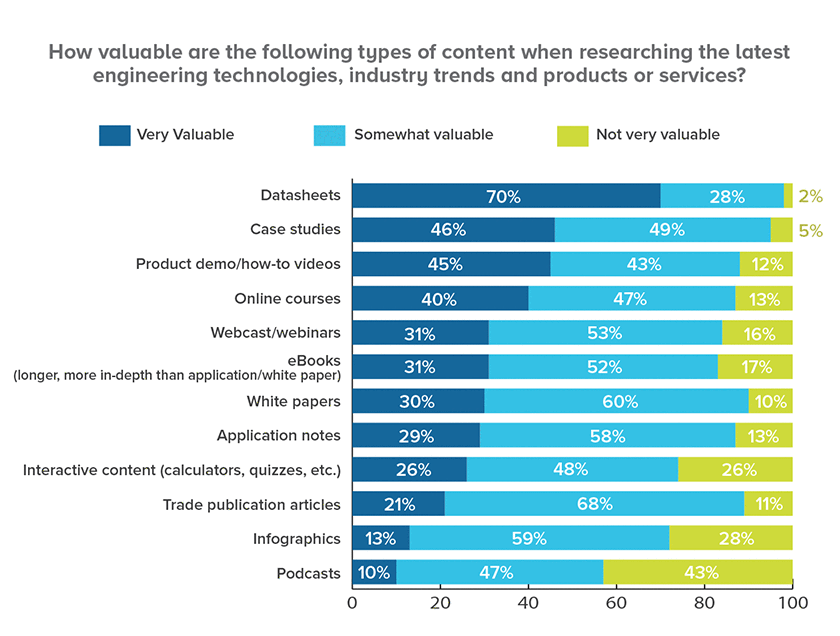
    The 2019 Smart Marketing for Engineers® survey reported that 88% of engineers found Product demo/how-to videos to be Somewhat to Very Valuable when doing their research. The interesting part about this statistic is that there are differences among countries and age groups.

    Engineers in South America and India/Asia/Russia place more value on case studies than their peers in the U.S. and Canada. Engineers under 35 and between 46-55 are more likely to value product demo/how to videos. It is important for manufacturers to win the mindshare of younger engineers as they take on more decision-making roles.

    Using videos in email marketing for manufacturers

    Email marketing for manufacturers is an integral part of the mix

    Email marketing is an integral part of industrial content marketing. That doesn’t mean you have to rely on it 100% of the time. In the past, I’ve written about how manufacturers use a combination of push and pull strategies in industrial marketing.

    My thoughts were based on the annual survey, Trends in Industrial Marketing conducted by IEEE GlobalSpec.

    • 81% of industrial marketers use both push/outbound (email, tradeshows) and pull/inbound (corporate websites, online catalogs) marketing initiatives
    • 60% of the companies use email marketing to in-house lists

    Industrial marketing mix for manufacturers

    Challenges remain in email marketing for manufacturers

    Stats are great but take those numbers with a healthy grain of salt. Plenty of challenges remain for manufacturers to overcome to get their emails opened and actually engage with engineers and industrial buyers.

    The old ways of “batch and blast” don’t work well and 100% promotional or salesy emails won’t cut it either.

    Junk email filtering has become much more sophisticated over the years, so getting your emails into the inboxes is a huge problem. It is a known fact that open and click rates from emails have been declining over the years.

    Average email campaign stats in 2019 for the manufacturing industry according to MailChimp are as follows:

    • Average Open Rate: 19.82% compared to 21.33% for all industries
    • Average Click Rate: 2.18% compared to 2.62% for all industries

    How do engineers interact with email newsletters when they receive them? The chart below is from the same report, 2019 Smart Marketing for Engineers® report.

    NOTE: These numbers are based only on e-newsletters that engineers have subscribed to and trust.

    How engineers interact with email marketing for manufacturers

    Based on my own experiences working with industrial companies, I can say email marketing for manufacturers does work, but it isn’t easy and there are some serious challenges to overcome if you want to get results.

  • Making Email the Foundation of Industrial Content Marketing

    You may think email marketing is dead or passé with all the talk about social media. However, that is far from the reality that I see every day, working with manufacturers and engineering companies, especially when it comes to industrial content marketing.

    Engineers and industrial professionals do read emails, provided you’ve earned their trust with valuable content and can get through their spam filters. According to the research report “How Engineers Find Information 2018” published by engineering.com, 95% of engineers will consider an email in their inbox.

    You can read about this in my earlier post, Industrial Email Marketing for Engaging Engineers and Technical Professionals.

    Email should be an important component of industrial content marketing

    Given the above findings, it makes a lot of sense in making email marketing a key component of your overall industrial content marketing strategy. My opinion is corroborated by independent research findings.

    (more…)