Category: Manufacturing Marketing

  • Building a Data-Driven Marketing Culture in Manufacturing

    Building a Data-Driven Marketing Culture in Manufacturing

    Gone are the days when leaders relied solely on business intuition to drive their organizations forward. Today, high-stakes decisions are guided by accurate figures, and companies increasingly leverage data analytics to optimize operations. Building and maintaining a data-driven culture is essential for creating a competitive advantage.

    The Importance of Data-Driven Marketing in Manufacturing

    Manufacturing has traditionally focused on making production more efficient and meeting stringent quality standards. Nowadays, integrating data analytics into marketing strategies has introduced a new element. Manufacturers now better understand other factors that are more influential in improving business outcomes outside production and quality control.

    Precision Marketing

    Instead of a generalized approach, data analytics helps segment customers into behavior, preferences and purchasing pattern groups. This allows companies to develop informed strategies about when and where to engage with customers. When the right message is delivered at the right time, the relevance helps get better results with less waste of resources.

    Personalized Customer Experience

    Personalization for each customer is a significant factor since 71% already expect customized experiences from businesses. Data in personalized marketing adjusts what every individual sees or gets, like showing the most relevant products on a website or offering the support people need. When done right, these personalized campaigns can raise engagement rates and improve customer loyalty since the audience feels genuinely valued.

    Improved Budget Allocation 

    Every dollar counts, especially for budget-conscious companies. A data-driven marketing culture saves resources by providing specific details where ROI is best maximized. Once the marketing strategies that work are highlighted, resources can be rerouted to high-performing channels. This also helps identify which underperforming campaigns can be cut and which areas to shift the budget. 

    Forecasted Market Demands

    Previous sales information, customer behavior and seasonal cycles can help predict future demand more accurately. Take these details and tailor upcoming product campaigns to promote solutions to the right audience at the right time. For example, if data shows consistently rising demand every third quarter, this information can be used by the sales team to prepare to close more deals.

    How to Implement a Data-Driven Culture

    As with any major change, adopting a new culture requires broad support across departments. A shift in behavior and mindset can only be considered successful when individuals at all levels of the organization are open to and engaged with the transition.

    1. Gain Executive Buy-In

    Every forward step begins with pioneering leaders who drive change. Senior executives must champion the shift to data-driven decision-making, providing the vision, funding and organizational alignment required for long-term success. A strong top-down leadership commitment sets the tone for companywide adoption. 

    2. Audit Current Data Capabilities

    Since information is the backbone of a data-driven marketing culture, it’s best to create a system that makes it more accessible across the organization. Departments might suffer from siloed materials kept compartmentalized from one division to another. 

    Evaluate the current data infrastructure, marketing platforms and analytic tools. Identify what type of customer, sales and production information are already being collected, how accessible and organized it is and where gaps exist. This step helps prioritize technology upgrades or integrations, such as customer relationship management (CRM) or marketing automation. 

    3. Provide Employee Training and Data Literacy

    Employees must possess the necessary skills so they can interpret and utilize the data at their disposal effectively. Extracting meaningful insights from raw numbers takes an analytic mind and a keen eye for trends and patterns before competitors can act on them. Training workers to make faster, evidence-based decisions and to communicate insights across teams, such as marketing, production and sales, helps inform future actions. Without basic data literacy, valuable insights can go unused or misinterpreted, leading to mistakes that drain resources. 

    4. Define Clear Marketing Objectives and KPIs

    Numerical data provides evidence of whether or not goals are being met. Before that, clear metrics and key performance indicators (KPIs) should also be defined in measurable terms to ensure the success of data-driven marketing initiatives can be accurately evaluated.

    Aligning marketing with business objectives ensures that the proposed strategies support broader organizational goals, such as sales growth, lead generation or market expansion. Regularly tracking KPIs also helps identify changes in customer acquisition cost, conversion rates or campaign ROI, providing a clear picture of what’s working and what isn’t. This prevents further resource waste.

    Clear metrics also drive accountability across teams by holding marketing departments responsible for results. Establishing standardized KPIs enables the team to effectively communicate its impact on how it influences sales, finance and production functions.

    5. Encourage Cross-Department Collaboration

    A data-driven marketing culture requires insights from across departments — engineering, production, finance and sales. Collaboration allows marketing to access real-time demand forecasts, inventory levels and product life cycle information to tailor campaigns accurately.

    The goal is for data from various sources to be integrated into one unified system that lets marketing teams access it more easily. Ensure that the information stored is automatically updated so only accurate data drives product campaigns.

    6. Invest in the Right Tools and Technology

    When choosing tools and technology, organizations shouldn’t limit themselves to current capabilities. Instead, they should prioritize scalability — selecting platforms that can grow alongside the company’s expansion.

    Tools that enable real-time data collection and analysis offer immediate insights, supporting faster decision-making. Many manufacturing marketers benefit from using CRM systems that are integrated with enterprise resource planning (ERP) platforms and predictive analytics software rather than relying on separate tools for individual tasks. A unified system with a broad range of features improves performance tracking while reducing the need to train staff on multiple tools with different functions.

    7. Run Small-Scale Data-Driven Campaigns 

    Before launching a full-blown data-driven campaign, start by running smaller, low-risk pilot marketing initiatives like targeting a specific customer segment based on past purchase behavior. For example, companies can entice previous buyers of their product with a discount or promotion on compatible replacement parts or supplies related to the product. Track the results closely. These early, information-backed successes can help win support from other departments and show the value of using data before scaling up.

    8. Create a Feedback Loop

    Set up a system to review what worked and what didn’t after every campaign. Collect insights from customer responses, sales figures and web traffic. A manufacturer might notice a spike in quote requests after an ad launches on a specific website compared to others. That feedback can guide future messaging or ad placement. 

    Sharing this data builds trust and transparency across the whole team. A high-trust environment generates 76% more team engagement and leads to smarter marketing decisions going forward. 

    9. Scale and Standardize Best Practices

    When a campaign proves successful, turn it into a repeatable model. Create templates, guides or checklists so other teams can use the same methods. For example, if an email campaign yields strong leads, document the strategy so sales or regional teams can reuse it. Standardization avoids reinventing the wheel and keeps messaging consistent across the company.

    Once successful patterns emerge, formalize the processes into playbooks, templates and standard operating procedures. Standardization helps scale efforts and reduce inefficiencies in marketing execution across teams or regions.

    10. Foster a Culture of Curiosity and Accountability

    About 52% of managers note that curiosity is especially valuable when analyzing information critical in seeking patterns, trends and solutions. Encourage employees to dig into particulars and ask why something worked or didn’t. Review progress regularly and highlight wins — like when data leads to a big sale or faster turnaround. 

    This could mean recognizing a marketer who used analytics to cut customer acquisition costs or a coordinator who discovered which days of the week perform better than others when sending emails. Celebrating outcomes motivates teams and makes statistics and figures part of the company’s everyday thinking.

    Turn Insights Into Industry Advantage

    Major changes can feel overwhelming, but very few initiatives offer more strategic value than building a culture rooted in data-driven decision-making. Unlike guesswork or one-off strategies, using data to expand marketing reach and increase revenue relies on existing information that often reveals repeatable patterns. A top-down acceptance from head executives to departments and cultivating a work environment that encourages and rewards these initiatives lets manufacturers strengthen their marketing efforts and lay the foundation for sustainable growth.

  • What Manufacturing Marketing Strategies Are Most Effective for Technical Audiences?

    What Manufacturing Marketing Strategies Are Most Effective for Technical Audiences?

    While writing this blog, I Googled my title—What Manufacturing Marketing Strategies Are Most Effective for Technical Audiences?—and saw an AI Overview as part of Google’s Search Generative Experience (SGE).

    Google AI Overview (SGE)

    This is a prime example of how AI-driven overviews are reshaping the way your technical audience searches for answers. Instead of sifting through multiple search results, they get a summarized answer instantly—reducing the likelihood of clicking through to your website.

    If your content doesn’t provide more value than the AI-generated response, you may never get a visitor, even if your page ranks. And that’s assuming it even appears in Google’s search results at all—a growing challenge as AI-generated answers push organic rankings further down the page.

    Even though SGE is still evolving, it is having an impact on manufacturing content marketing. I have written two blogs on this topic that may interest you.

    1. SEO for Manufacturers in the Age of AI: How Google’s Search Generative Experience is Reshaping Search Results
    2. Could Generative AI Revolutionize Your Industrial SEO Strategy?

    So, how can manufacturers ensure their marketing efforts cut through this noise and reach the right audience? The key lies in industry-specific, data-driven marketing strategies that engage technical buyers at every stage of their complex buying journey.

    Let’s explore the most effective manufacturing marketing strategies that deliver results where AI-generated overviews fall short.

    Why Manufacturing Marketing Strategies Must Be Industry-Specific

    The manufacturing sector is not like other B2B markets. Industrial buyers, engineers, plant managers, MRO and procurement professionals, and executives do not make impulse purchases. Instead, they rely on in-depth research, peer recommendations, and data-driven decision-making before selecting a supplier or product.

    The Problem with Generic B2B Marketing Approaches

    Many generalist marketing agencies assume that what works in other B2B industries will work for manufacturers. That’s rarely the case. Engineers and technical professionals expect detailed specifications, performance data, and real-world applications, not just marketing fluff.

    A 2023 GlobalSpec survey found that 87% of engineers prefer content that includes detailed technical data and specifications before making a purchasing decision (GlobalSpec). Yet, most manufacturing websites and marketing materials fail to provide the depth of information technical buyers need.

    Manufacturing websites are chock full of spec sheets, case studies, customer testimonials, and online resource libraries. However, they often lack a clearly articulated value proposition, which differentiates them from the competition. Without this, their audience may have little reason to start a conversation with the sales team. (Read my blog, Content Can Differentiate Industrial Companies When There’s Parity in Value Propositions).

    What an Industry-Specific Approach Looks Like

    Effective manufacturing marketing strategies prioritize:

    • Technical content that educates buyers rather than just promoting products
    • SEO optimized for niche, long-tail technical keywords that AI-generated results often overlook
    • Omnichannel engagement, combining content, trade shows, and direct sales efforts

    Instead of taking a one-size-fits-all B2B approach, manufacturers need a strategic roadmap that aligns marketing efforts with the realities of technical sales cycles.

    The Role of Manufacturing Content Marketing in Educating and Engaging Engineers

    Content marketing is a pivotal tool for educating and engaging technical audiences in the manufacturing sector. Manufacturers must develop a well-crafted content marketing strategy to engage with engineers and other technical professionals.

    Current Landscape of Manufacturing Content Marketing

    I will cite several key findings from the Manufacturing Content Marketing Benchmarks, Budgets, and Trends: Outlook for 2025, published by the Content Marketing Institute (CMI).

    Recent research indicates that while content marketing is widely adopted in the manufacturing industry, there’s room for improvement in effectiveness. Specifically:

    • 67% of manufacturing marketers rate their content strategy as only moderately effective.
    • A mere 20% consider their strategies to be very effective.

    These findings suggest a need for more targeted and impactful content marketing approaches.

    Manufacturing marketing strategies effectiveness

    Key Strategies for Effective Manufacturing Content Marketing

    To overcome these hurdles and better engage technical audiences, manufacturers should consider the following strategies:

    1. Developing a Documented Content Strategy: With only 37% of manufacturing marketers having a documented content marketing strategy, formalizing this process can provide clarity and direction.
    2. Creating High-Quality, Relevant Content: Given that 66% of marketers struggle with producing content that prompts the desired actions, focusing on quality and relevance is essential. This includes:
      • Technical Articles and White Papers: Providing detailed insights into products and technologies.
      • Case Studies: Showcasing real-world applications and success stories.
      • Video Content: Utilizing demonstrations and tutorials to convey complex information visually.
    3. Leveraging Data and Analytics: Incorporating data-driven insights can refine content strategies. This involves:
      • Audience Analysis: Understanding the target audience’s specific needs and pain points.
      • Performance Metrics: Regularly measuring content effectiveness to refine future efforts.
    4. Enhancing Distribution Channels: Expanding beyond traditional platforms can increase content reach. While 85% of manufacturing marketers find value in LinkedIn, exploring other channels like YouTube (40%) and Facebook (31%) can diversify audience engagement.
    5. Integrating AI Tools: With 76% of manufacturing marketers already utilizing generative AI tools, these technologies can aid in content creation and optimization, leading to more personalized and efficient marketing efforts. No AI can’t replace human expertise (at least not yet); it can be a time-saver.

    The Power of Account-Based Marketing (ABM) for Manufacturing Lead Generation

    Account-Based Marketing (ABM) is a powerful strategy that helps manufacturers target and engage high-value accounts rather than casting a wide net with generic lead-generation tactics.

    The 2024 Global Account-Based Marketing Benchmark Report by Momentum ITSMA and Demandbase indicates that 81% of organizations report higher ROI with ABM compared to other marketing activities.

    ABM is most effective for manufacturers when integrated with a broader, strategic marketing approach. This is where the expertise of a Fractional CMO for manufacturers can make a difference—helping manufacturers structure and execute an ABM strategy that delivers real results.

    Manufacturing Marketing Strategies for Driving Long-Term Success

    Short-term marketing wins are helpful, but sustained success with manufacturing marketing requires a long-term strategy.

    Manufacturing sales don’t happen overnight because of the long and complex sales cycles. Hoping for better results while continuing the old ways of prospecting and generating leads just won’t cut it anymore.

    Gartner’s B2B Buying: How Top CSOs and CMOs Optimize the Journey report indicates that 75% of B2B buyers now prefer a rep-free sales experience, highlighting an increasing inclination towards self-service in the purchasing process.

    Given these developments, it’s crucial for manufacturing marketing strategies to adapt accordingly, ensuring they provide comprehensive, easily accessible information that empowers buyers to make informed decisions independently.

    Key Pillars of Long-Term Manufacturing Marketing Success

    1. Thought Leadership and Industry Authority

    • Engineers and industrial buyers trust brands that demonstrate expertise in their field.
    • The 2025 Manufacturing Marketing report from CMI that I cited earlier also found at least half of manufacturing marketers predict increased investment in thought leadership content (50%) in 2025.

    2. SEO and Digital Visibility

    • A strong SEO strategy that considers SGE ensures manufacturers are discovered organically.
    • High-authority content marketing improves search rankings and builds credibility.

    3. Trade Shows and In-Person Events

    While digital marketing is critical, trade shows and in-person events remain key to industrial marketing strategies.

    • The 2023 Manufacturing Marketing Insights said, “Sixty percent reported using in-person events.”
    • A mix of digital engagement before and after events enhances ROI from trade show participation.

    4. Digital and Traditional Media Integration

    Manufacturers often underestimate the power of blending traditional and digital marketing efforts.

    • Print media, when combined with digital campaigns, can increase brand recall.
    • A mix of email campaigns, retargeting ads, banner ads, and industry publication placements keeps manufacturers visible across multiple touchpoints.

    Reaching technical buyers requires more than content—it demands a strategic, data-driven approach tailored to manufacturing sales cycles.

    Whether you’re looking to refine your manufacturing content marketing, create more targeted technical content, or build a long-term marketing roadmap, we can help. Schedule an exploratory call today.

  • Marketing Strategy for Manufacturers—3 Key Components of a Well-defined Roadmap for Driving Sustainable Growth

    Marketing Strategy for Manufacturers—3 Key Components of a Well-defined Roadmap for Driving Sustainable Growth

    In today’s globally competitive industrial markets, a well-defined marketing strategy for manufacturers is crucial to sustainable growth and, in some cases, survival. Unlike a simple checklist of tactics, a robust strategy serves as a comprehensive roadmap, guiding every marketing effort towards long-term business goals.

    Without this strategic roadmap, manufacturers risk wasting resources on disjointed actions that fail to deliver meaningful results. By focusing on the right components, such as competitor analysis and digital optimization, manufacturers can create a robust framework for success.

    In this blog, I’ll outline the three key components of an effective marketing strategy for manufacturers, drawing from my 35+ years of experience working with manufacturers and industrial companies.

    Understanding the Core of a Marketing Strategy for Manufacturers

    Why a Customized Marketing Strategy for Manufacturers is Essential for Sustainable Growth

    In the manufacturing sector, it’s common for companies to jump straight into implementing marketing tactics—be it launching a new ad campaign, updating their website, or creating content—without first establishing a cohesive strategy. This approach often leads to fragmented efforts that yield inconsistent results, as no clear roadmap guides these actions toward a unified business objective.

    A marketing strategy is more than just a to-do list of tasks; it’s a comprehensive plan that aligns marketing efforts with long-term business goals. It ensures that every action, from content creation to digital outreach, serves a purpose within the broader context of the company’s growth objectives.

    The importance of having a documented marketing strategy cannot be overstated. According to a survey conducted by the Content Marketing Institute, “only 32% of manufacturing marketers have a documented content marketing strategy, a figure that has remained stagnant year over year. Without a clear strategy, many marketers end up creating content merely to respond to ad hoc requests, leading to fragmented efforts that fail to achieve meaningful results.” (Source).

    This highlights a significant gap in the industry where marketing efforts often lack direction and coherence, ultimately limiting their effectiveness.

    By taking the time to develop a well-defined marketing strategy, manufacturers can ensure that their marketing efforts are not just reactive but proactive, driving towards clear, measurable objectives that contribute to sustainable growth. This strategic approach provides the foundation needed to make informed decisions, allocate resources efficiently, and stay competitive in an increasingly complex market.

    To learn more about the importance of documenting a marketing strategy for manufacturers, see my earlier post, “Industrial Marketing Strategy Must Be Documented for the Best Results.”

    Industrial Marketing Strategy: Building the Foundation for Success

    Key Elements of an Effective Industrial Marketing Strategy

    An industrial marketing strategy is not just a collection of isolated tactics; it’s a carefully structured plan that aligns every marketing effort with your overarching business objectives. This strategic alignment ensures that all actions contribute to a cohesive and impactful marketing campaign, rather than spending valuable resources on disjointed initiatives.

    However, even well-structured strategies can have pitfalls if they are not properly aligned with business goals. Gartner underscores this: “A common marketing strategy structure, which nests business objectives, marketing objectives, marketing initiatives, and related measurements, might appear tidy and organized but often masks underlying problems.” (Source).

    This approach can lead to wasted resources and misalignment with the true goals of the business, hindering the overall success of the marketing efforts.

    In an effective Industrial Marketing Strategy, each component must be deliberately crafted to support the others, ensuring a seamless transition from one strategy phase to the next. For example, a key element such as competitor analysis for online presence becomes more than just a benchmarking exercise—it impacts your brand positioning, highlights gaps in the market, and identifies opportunities where your company can stand out.

    By thoroughly analyzing competitors’ digital footprints, you gain insights into what works and what doesn’t in your industry. This foundation is crucial for ensuring that your Industrial Marketing Strategy is well-organized and deeply aligned with your business objectives, avoiding the common pitfalls highlighted by Gartner.

    In this way, your strategy becomes a living document that guides all marketing efforts, ensuring that every initiative is purposeful and contributes to your company’s long-term growth and success.

    One of the common problems I have seen working with manufacturers is their inability to step back and write content from the customer’s perspective. My deep understanding of how engineers and technical buyers navigate their complex buying journey allows me to craft customized content for each stage of the buying process.

    I’ll create a value proposition that differentiates your brand and resonates with your target audience, even when there is parity in the value propositions.

    Leveraging AI in Developing a Digital Marketing Strategy for Manufacturers

    How AI Enhances the Digital Marketing Strategy for Manufacturers

    In our rapidly changing digital world, AI (Artificial Intelligence) has become an invaluable tool for manufacturers looking to refine and optimize their marketing strategies. While the core elements of an industrial marketing strategy remain rooted in understanding the market, competition, and customer needs, AI can enhance these efforts by providing deeper insights and greater precision.

    AI-driven tools can assist in the early stages of strategy development, particularly in areas such as customer segmentation, predictive analytics, and content optimization. For instance, AI can analyze vast amounts of data to identify patterns in buyer behavior, allowing you to segment your audience more effectively. This means that your marketing efforts can target precisely, ensuring that each piece of content resonates with the specific needs and challenges of different segments within your target audience.

    AI can also play a crucial role in optimizing your digital presence by enhancing the user experience on your website. As discussed in my previous blog, “AI for Industrial Website Design: Revolutionizing User Experience and Lead Generation in Manufacturing,” AI can significantly improve how potential customers interact with your brand online.

    From personalized content recommendations to intuitive navigation, AI-powered websites can lead to higher engagement and more qualified leads.

    However, it’s essential to recognize that while AI is a powerful tool, it should not replace the foundational elements of a well-defined marketing strategy. Instead, AI should be viewed as a complement to human expertise and experience—one that amplifies effectiveness by providing actionable insights and automating repetitive tasks.

    Integrating AI into your digital marketing strategy for manufacturers allows you to stay ahead of industry trends, continuously refine your approach, and ultimately drive more impactful results.

    Key Takeaways

    Developing a robust marketing strategy is crucial for manufacturers looking to achieve sustainable growth in today’s competitive industrial markets. It’s important to differentiate between a well-structured strategy and a mere list of tactics.

    A strategy provides a comprehensive roadmap that aligns every marketing effort with long-term business goals, ensuring that resources are used effectively and results are measurable.

    Incorporating essential components such as competitor analysis and brand positioning within an Industrial Marketing Strategy helps manufacturers build a solid foundation for success. Leveraging AI can further enhance this strategy by providing valuable insights and optimizing digital efforts, but it should always complement, not replace, human expertise and experience.

    By focusing on these key components and utilizing tools like AI, manufacturers can create a marketing strategy that drives growth, enhances brand differentiation, and ensures a competitive edge in the marketplace.

    Ready to transform your marketing efforts into a powerful engine for sustainable growth? Start by exploring our Industrial Marketing Strategy—Your Roadmap to Success. This page will guide you and help you make an informed decision. But why wait? Let’s discuss how we can tailor a strategy specifically for your business. Whether you want to enhance your digital presence, leverage AI, or need expert guidance, I’m here to help.

  • How to Craft Compelling Manufacturing Content that Resonates with Engineers and Attracts Industrial Buyers

    How to Craft Compelling Manufacturing Content that Resonates with Engineers and Attracts Industrial Buyers

    When it comes to creating manufacturing content for engineers, it is crucial to understand their unique needs and challenges. Engineers are problem solvers by nature, and they seek content that provides practical solutions to their work-related issues.

    It is important to focus on the value proposition of your product or service when writing compelling content for industrial buyers.

    Know thy audience

    Without understanding their unique needs and challenges, one can’t create compelling manufacturing content for engineers. By identifying their challenges, you can create content that resonates with your target audience and addresses their specific needs.

    I cannot emphasize this point enough. I recently wrote a whole post on this topic. See Industrial Marketing Challenges: Identifying Roadblocks and Developing Effective Solutions.

    Take the time to understand your target audience. What are their job functions, responsibilities, pain points, and their roles in the buying decision? You can then tailor your content to provide the most value by understanding their needs.

    Create manufacturing content that addresses their pain points

    One common pain point in the manufacturing industry is the need for efficient production processes. Engineers are constantly looking for ways to streamline their operations and reduce costs. By addressing this pain point in your content, you can provide valuable insights and solutions that will attract the attention of engineers and industrial buyers.

    Another challenge is staying up to date with the latest technologies and trends. With advancements in automation, artificial intelligence, and data analytics, engineers are constantly seeking information on incorporating these technologies into their operations. By providing content that educates and informs on these topics, you can position yourself as a trusted source of industry knowledge.

    Engineers and industrial buyers also want to work with reliable suppliers and partners they trust. They look for companies that understand their unique needs and can provide high-quality products and services. By showcasing your expertise and highlighting your track record of success, you can build trust and attract industrial buyers to your brand. So earning their trust with content that is more about them and less about you will go a long way towards your success with manufacturing content marketing.

    Crafting compelling and informative manufacturing content

    Once you have identified your target audience’s pain points and challenges, it is time to craft compelling and informative content that addresses these issues. Here are some tips to help you create content that resonates with engineers and industrial buyers:

    • Use storytelling: Engineers and industrial buyers are humans too! They are more likely to engage with content that tells a story. Obviously, I’m not referring to fairytales (😊). Use real-world examples, case studies, and success stories to illustrate how your products or services have helped other companies overcome challenges and achieve success. There are ways to write success stories without violating NDAs.
    • Provide actionable insights: Your content should inform and provide actionable insights that engineers and industrial buyers can implement in their operations. Whether it’s a step-by-step guide, best practices, or tips, make sure your content provides practical value.
    • Communicate clearly: When targeting a technical audience, providing value through informative and educational content is essential. Simplify complex concepts without dumbing down the content. How-to videos are great for this. It’s okay to use industry-standard jargon and acronyms sparingly.
    • Optimize for search engines (SEO): Your content needs to be easily discoverable to attract industrial buyers. Optimize your content for search engines by incorporating relevant keywords, writing informative meta descriptions, and ensuring your content is properly formatted and structured. My take on this is to write for human visitors first and let the search engines follow. Not the other way around. Another thing to remember is that conversion is not automatic; just because someone found your content and visited your site or blog doesn’t mean they’ll become a lead. (See Industrial Marketing is Not Just for ToFU).

    Different strokes for different folks

    So what kinds of content should you create? One thing is for sure, one size fits all won’t cut it. You need to use different formats to target various stakeholders in the buying decision and the stage of the buying journey.

    Instead of writing hundreds of words describing every content format, let me make you a shortlist of commonly used manufacturing content.

    • Product datasheets
    • Blog posts (Published on your own blog, as well as guest posts in industry portals)
    • In-depth technical articles
    • Whitepapers and e-Books
    • Case studies and application notes
    • How-to videos
    • Content for webinars

    What content do engineers prefer in making work-related decisions? This chart from the report Manufacturing Content Marketing – Insights for 2023, published by the Content Marketing Institute, is a good reference.

    manufacturing content used in the past 12 months

    For parts and components manufacturers, I suggest creating content that I refer to as sales enablers. They convert very well. Read my earlier post, Using CAD and BIM Files in Manufacturing Content Marketing.

    There are other types of manufacturing content I have used with good results because they help move the buyer forward in their buying journey. They are:

    • Online product configurators
    • “How to Order” part number builders
    • Parametric part number search applications
    • Valve sizing programs
    • Online maintenance data management, tracking legacy installations, and managing spare parts inventory
    • Online interactive and real-time design tools
    • Cross-reference guides
    • Evaluation and engineering kits

    One final thought, what about using Generative AI for creating manufacturing content? Ah, it’s a hot topic worthy of a few blog posts. Whatever your opinion is about using AI in content marketing, you can’t escape it. Stay tuned. I’ll publish posts soon, where I’ll share my thoughts and personal experiences using AI.

    Okay, now that you’ve reached the end of this post and I thank you for it, it’s time to summarize. Crafting compelling content that resonates with engineers and attracts industrial buyers is essential for successful manufacturing marketing. Get to know your target audience well, especially their pain points, and use different formats for different roles and stages of the buying journey. Earn their trust with relevant educational content that is technically accurate and up-to-date.

    Need help crafting compelling manufacturing content? Let’s talk.

  • Industrial Marketing Challenges: Identifying Roadblocks and Developing Effective Solutions

    Industrial Marketing Challenges: Identifying Roadblocks and Developing Effective Solutions

    As an experienced industrial marketer with 35+ years of hands-on experience, I have witnessed first-hand the unique challenges manufacturing marketers face. In this article, I’ll discuss the most common ones and suggest practical solutions to overcome them. Manufacturers and industrial companies can achieve their marketing objectives by understanding and overcoming these roadblocks.

    Let’s look at some of the unique challenges in manufacturing marketing.

    Lack of industry-specific knowledge

    The manufacturing industry presents a set of distinct challenges that marketers must navigate. First, the target audience in industrial marketing is often niche and specialized. Unlike consumer marketing, where the target audience is broad and diverse, industrial marketers must reach a specific group of professionals with industry-specific knowledge and expertise. This requires a deep understanding of the industry and the ability to communicate effectively with professionals in those fields.

    Without a deep understanding of the industry and the challenges faced by engineers and technical professionals, manufacturing marketers may struggle to effectively communicate the unique value proposition of their offerings and engage with the target audience.

    To overcome this roadblock, marketers need to learn about their target industries and the challenges engineers face in their daily work. I understand that not every marketer is an engineer. So how do you gain this expertise and knowledge?

    One of the best ways is learning from your in-house Subject Matter Experts (SMEs). Do some basic online research and reading before you approach an SME. They are busy doing what they do best, and that is not marketing. You don’t want to waste their time by being unprepared.

    Try attending industry events and meetings and talking to external experts. Attend related webinars to understand what others in your industry are discussing and the challenges they are trying to overcome.

    I’m not saying it will be easy, especially at first. Give yourself time to thoroughly understand the industry so you can effectively tailor marketing messaging to connect with the target audience on a deeper level.

    Read my earlier post, Effective Industrial Content Marketing Requires Working Closely with Subject Matter Experts (SMEs).

    Limited marketing budget and resources

    Another significant roadblock in industrial marketing is the limited budget and resources. With limited funds, executing some of your more ambitious marketing plans can be challenging. However, this challenge can be overcome through strategic planning and prioritization.

    One effective solution is to focus on targeted marketing efforts that reach the niche audience most likely to be interested in your marketing message. Note I did not say “Product Promotions.”

    Of course, your marketing goals should align closely with business goals, meaning you need to help increase sales and revenues at the end of the day. However, making your marketing overly “salesy” is a sure turnoff.

    “51% said they are challenged with creating valuable content instead of sales-oriented content as well as with overcoming the traditional marketing and sales mindset.”

    (Source: Report published by the Content Marketing Insitute).

    Overcoming the challenge of reaching a niche target audience

    Reaching a niche target audience is a common roadblock in industrial marketing. Unlike consumer marketing, where mass media channels can be used to reach a broad audience, industrial marketers need to identify the specific platforms and channels where their target audience is active. This can be challenging, as the industrial sector often has its own unique communication channels and platforms.

    Try leveraging industry-specific publications, attending trade shows and conferences, and utilizing online platforms catering to manufacturing industry professionals.

    Don’t just rely on organic SEO for your audience to find your content. Remember, industrial buyers are not searching every day for engineered systems and components. Use other channels to drive your audience back to your industrial website and blog.

    By understanding the communication habits of the target audience, marketers can develop a targeted approach that ensures their message reaches the right people at the right time.

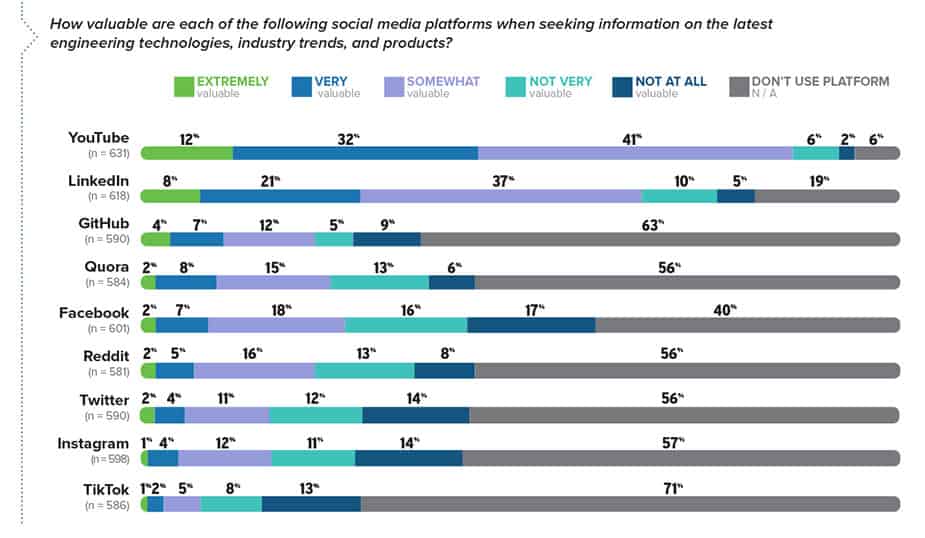
    Here’s a handy chart showing social media channels engineers use for work-related purposes. (Source: 2023 State of Marketing To Engineers, published by TREW Marketing and GlobalSpec)

    social media channels in industrial marketing

    Buyer personas: The specifier vs. the functional buyer

    Here’s something unique and different in industrial or manufacturing marketing. As a manufacturer of industrial components, you have to deal with two different types of buyers—Specifiers and Functional Buyers.

    A specifier is often a staff engineer tasked with gathering all the specs and ensuring they meet the design requirements.

    The Purchasing Department is the functional buyer that issues the RFQ or the PO only to suppliers on the Approved Vendor List (AVL) or whose parts are specified in the bill of materials (BOM).

    Unless the specifier “designs in” your part, you will not likely get that RFQ or a PO. The specifier may not have the final buying authority but ignore him/her at your peril.

    Consider creating an online library of 2D/3D CAD files. This is a proven manufacturing marketing strategy for parts manufacturers. See my earlier post, Using CAD and BIM Files in Manufacturing Content Marketing, for more on this topic.

    Building trust and credibility in the industrial sector

    Building trust and credibility is crucial for success in industrial marketing. Industrial buyers typically make decisions based on a combination of technical specifications, reputation, and trust in the supplier. This presents a unique challenge for marketers, as they must promote the features and benefits of their products or services and, at the same time, establish trust and credibility in the industry.

    This is probably the biggest challenge faced by manufacturing marketers that I’ve seen. You can’t build strong relationships based on earned trust with short-term marketing campaigns.

    A good solution to this challenge is to focus on thought leadership and educational content. Marketers can position themselves as trusted advisors in the industry by providing valuable insights and expertise through blog posts, whitepapers, and webinars. This approach helps build trust with potential buyers and establishes the company as a credible source of information and expertise.

    See How Industrial Marketing for Manufacturers Helps in Building New Relationships.

    Leveraging digital marketing strategies for manufacturing marketing

    Today’s buyers are in self-serve and self-select mode. Leveraging digital marketing strategies is essential for success in this environment.

    Your digital marketing strategy should include search engine optimization (SEO) to improve visibility in search engine results, paid advertising campaigns targeted at industry-specific keywords (I’ve seen my clients have limited success with PPC), advertising on industry portals, and social media marketing to engage with industrial professionals.

    Additionally, email marketing can be a highly effective strategy for nurturing leads and maintaining relationships with existing customers. By providing valuable content and personalized messaging, industrial companies can stay top-of-mind and drive repeat business.

    Utilizing content marketing to overcome industrial marketing challenges

    Industrial content marketing plays a crucial role in overcoming industrial marketers’ challenges. Manufacturers can attract and engage their target audience by creating and distributing relevant and valuable content. This can include blog posts, case studies, industry reports, and educational resources.

    Your content must convey that you understand their challenges and can provide effective solutions. Don’t produce content that is nothing more than thinly disguised product features. It must be more about them and less about you.

    While industrial marketing presents its own set of challenges, you can overcome them with the right strategies and tactics. Manufacturers can drive success and achieve their marketing objectives by understanding the unique characteristics of the manufacturing industry, identifying roadblocks, and implementing effective solutions.

    Let’s talk if you are facing some of these challenges and need help with industrial and manufacturing marketing. I’ll first listen to your concerns and then try to provide tailored marketing solutions to address your specific needs instead of serving up cookie-cutter theories. Together, we can overcome challenges and pave the way for your success in industrial marketing.

  • The Power of Digital Marketing for Manufacturers: Strategies and Tactics

    The Power of Digital Marketing for Manufacturers: Strategies and Tactics

    I am often asked to explain the differences between digital marketing for manufacturers and B2B marketing. I don’t assume anything and start from the basics. You may already know some of this stuff.

    As a manufacturer, you are always looking for ways to grow your business and increase your bottom line. One of the most effective ways to achieve these goals is through digital marketing. In this article, I will share some strategies and tactics that can help you leverage the power of digital marketing for your manufacturing company.

    Differences between digital marketing for manufacturers and B2B marketing

    When it comes to marketing, there are several differences between digital manufacturing marketing and B2B marketing.

    One of the fundamental differences between digital marketing for manufacturers and B2B marketing lies in their target audience. Industrial digital marketing caters to the needs of manufacturers and suppliers of industrial products and services. It involves creating content that speaks to this specific target audience’s unique challenges and needs. In contrast, B2B marketing targets businesses in a wide array of industries, including technology, healthcare, finance, and more.

    While B2B marketing focuses on selling products or services to other businesses, digital marketing for manufacturers is a more specific type of B2B targeting the industrial sector. Industrial digital marketing involves promoting products and services such as machinery, equipment, and materials used in the manufacturing industry.

    Another key difference between the two is the target audience. B2B marketing often targets decision-makers, such as CEOs or managers, while digital marketing for manufacturers targets engineers, procurement personnel, and other technical professionals involved in the buying process. As such, the messaging and content used in each type of marketing may differ to appeal to each specific target audience.

    In short, while digital marketing for manufacturers and B2B marketing share some similarities, they are two distinct concepts with different applications and target audiences. Understanding these differences is essential for businesses to develop effective marketing strategies catering to their needs and goals. Industrial marketing is a subset of the broader B2B marketing, but they are not the same.

    The specifier vs. the functional buyer

    Here’s something unique in industrial or manufacturing marketing. You may be dealing with two different types of buyers—Specifiers and Functional Buyers. Let’s say you are a manufacturer of industrial components or parts. A specifier, often a staff engineer, is tasked with gathering all the specs and making sure they meet the design requirements.

    The Purchasing Department is the functional buyer that issues the RFQ or the PO. They do so only to suppliers on the Approved Vendor List (AVL) or whose parts are specified in the bill of materials (BOM).

    Unless the specifier “designs in” your part, you will not likely get to the RFQ or a PO. The specifier may not have the final buying authority but ignore him/her at your peril.

    Consider creating an online library of 2D/3D CAD files. This is a proven manufacturing marketing strategy for parts manufacturers. See my earlier post, Using CAD and BIM Files in Manufacturing Content Marketing, for more on this topic.

    Why digital marketing is important for manufacturing companies

    In today’s digital age, consumers increasingly turn to the internet to research products and make purchasing decisions. This trend is no different in the manufacturing industry. As a result, manufacturers with a strong digital presence are more likely to be found by potential industrial buyers and generate more leads. Digital marketing for manufacturers is also more cost-effective than traditional marketing methods, such as print ads and trade shows.

    Understanding the manufacturing audience

    Understanding your audience is essential to market your industrial products or engineering services effectively. Your target audience may include engineers, procurement managers, or other decision-makers in the manufacturing industry. Understanding their pain points, needs, and preferences can help you create targeted marketing programs that resonate with them. Each stakeholder will have different content needs as they move forward in their buying journey.

    Developing a marketing strategy for manufacturing companies

    Developing a marketing strategy is important before you start your digital marketing efforts. Your marketing strategy should include your business goals, target audience, marketing channels, and budget. This plan will guide your marketing efforts and help you stay on track.

    Notice that a marketing strategy is not the same as a list of marketing tactics. This is a common mistake or an area of confusion. Since manufacturing content marketing is the most significant component of industrial marketing today, let’s focus on that. 88% of manufacturing marketers said they used content marketing successfully to achieve various goals – Source: 2022 Manufacturing Content Marketing, published by the Content Marketing Insitute (CMI).

    Key tactics for successful manufacturing marketing

    Several strategic tactics can help you succeed with digital marketing for your manufacturing company. These include:

    • Search engine optimization (SEO): Optimizing your website for search engines can help you rank higher in search results and drive more traffic to your site. (Keep in mind, a visit to conversion is not automatic).
    • Industrial content marketing: This is by far the most effective marketing strategy for manufacturers in the current environment where industrial buyers are in self-select and self-serve mode (It is difficult to reach invisible and anonymous buyers with cold calling and email blasts).
    • Email marketing: Email marketing is very much alive despite all the buzz about social media. It continues to be the most effective way to reach engineers and industrial professionals. Targeted email marketing is very different from “batch and blast” emails of the past. (51 percent of engineers prefer their initial salesperson interaction to be by email. Eighty-nine percent of engineers subscribe to at least one newsletter, while 54 percent subscribe to at least three newsletters. Source: 2023 State of Marketing To Engineers).
    • Video marketing: Video marketing is very popular with the industrial audience. Videos were the top content type produced and the top area of content marketing investment in 2022. The top three types of content created in the last 12 months were videos (86%), short articles/posts (83%), and virtual events/webinars/online courses (70%). Videos also were the content type manufacturing marketers said produced the best results. (Source: The CMI report cited earlier).
    • Social media: You must be realistic about social media and manufacturing marketing. Most engineers and technical professionals tend to be passive participants in social media. I’m not suggesting you ignore it, but use it judiciously to promote new content, be it blog posts, how-to videos, events, or announcements. LinkedIn is the organic social media platform that manufacturing content marketers used the most for distributing content (93%), followed by Facebook (86%) and YouTube (80%). (Source: CMI report).
    • Pay-per-click (PPC) advertising: This tactic is contentious. I’ve heard some of my clients complain loudly that it is a “money pit” that produces minimal results. 51 percent of engineers avoid paid search ads at all costs (Source: 2023 State of Marketing To Engineers). In my experience working with industrial companies, PPC can work if you manufacture and sell standard industrial products and consumables. However, if you make custom-engineered systems, PPC is an expensive tactic for driving traffic.

    Measuring the success of your industrial digital marketing efforts

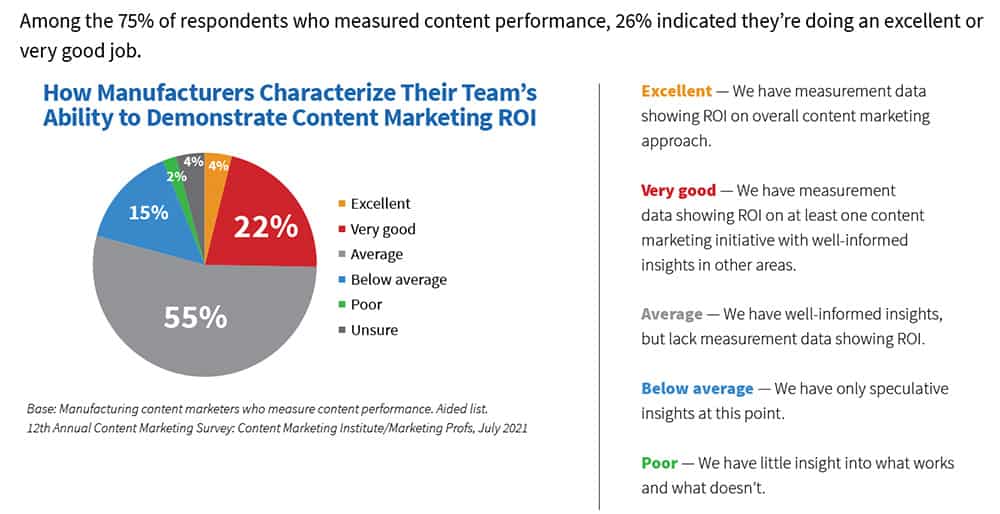
    Measuring the success of your digital marketing efforts is critical to understanding what’s working and what’s not. Unfortunately, it is often ignored other than a cursory look at Google Analytics to measure website traffic, email open and click rates, and other top-of-the-funnel statistics. You won’t know if your marketing strategy and tactics are working or not if you don’t measure. So take the guesswork out of the equation when it comes time to refine your strategy and/or abandon certain tactics that fail to produce results.

    This chart from the CMI report illustrates the problem of lack of measuring for proving marketing’s ROI.

    Benefits of working with a manufacturing marketing company

    Digital marketing is an ever-evolving field, and staying up-to-date on the latest trends and technologies can be challenging. Working with a specialized manufacturing marketing agency can help you stay ahead of the curve and ensure your digital marketing efforts are effective. In addition, an experienced manufacturing marketing expert can provide valuable insights into the latest strategies, tactics, and tools to help you reach your goals.

    You can maximize your digital marketing ROI by leveraging the agency’s specialized expertise, resources, and technology. With the right industrial marketing agency, you can create a robust digital presence that drives results for your business.

    To summarize this long post, digital marketing is a powerful tool for manufacturers to connect with their target audience of engineers and technical professionals and grow their businesses. Following the strategies and tactics I’ve provided in this post, you can develop an effective digital marketing strategy and use proven tactics that drive results for your manufacturing company.

    Let’s talk if you have questions about getting started or need to improve your digital marketing for manufacturers.

  • 6 Innovative Manufacturing Marketing Strategies

    6 Innovative Manufacturing Marketing Strategies

    Manufacturers have unique marketing challenges that other businesses don’t face. As a result, they must develop innovative manufacturing marketing strategies to reach their target audience to succeed. Engineers and technical professionals are two key audiences that manufacturers need to focus on. This blog post will discuss six innovative marketing strategies that manufacturing companies can use in their own marketing efforts.

    Understanding marketing strategies is vital if you’re a manufacturer looking to stay ahead of the competition and grow your sales. As technology advances and your customer base evolves, remaining relevant in today’s competitive global markets requires creative problem-solving and up-to-date marketing approaches.

    “58 percent of engineers said that the competitive landscape is global and competes 24/7.” (Source: 2021 Pulse of Engineering Survey published by GlobalSpec)

    Social media for manufacturing marketing

    That’s why I have gathered six innovative ways manufacturers can beef up their current manufacturing marketing strategy to remain competitive in their rapidly and ever-changing industries. Here’s my recommended list:

    1. Focus on trust-building through educational content
    2. Utilize modern social media channels for outreach
    3. Provide proof of concept to overcome skepticism
    4. Invest in video marketing to explain complex concepts and provide after-sales support
    5. Effective use of online advertising and PPC to reach targeted audiences
    6. Maintain top-of-mind awareness with email marketing and newsletters

    In this post, I will discuss each manufacturing marketing strategy and share my thoughts on implementing them to help you improve your industrial marketing.

    Provide Educational Content

    Create content that educates potential customers about your products, manufacturing processes, and how your products can help them solve their problems. Sometimes raising awareness of the problem is necessary before you can sell your solution. (See Problem-centric Industrial Marketing).

    Providing educational content about your complex engineering solutions is an invaluable step in the marketing process. It creates awareness for potential customers and educates them on the problem they are trying to solve.

    With educational material breaking down the more technical aspects of what you offer, customers can better understand how you may help them, allowing them to make informed buying decisions before investing in your products and services.

    Leverage Social Media

    Use social media platforms to share news and updates about your company and its products and promote new content. Engage with customers and potential customers when and where they hang out.

    Leveraging social media for manufacturing marketing is essential for businesses to reach engineers and industrial professionals. However, engineers tend to be passive participants on social media platforms, resulting in lower engagements from them compared to other industries.

    As such, manufacturers should have realistic expectations regarding engineers’ interactions on their social media channels since this audience likes to read and watch but rarely comment or share. With a well-assembled suite of content and valuable resources, engineers can become long-time brand followers since you allow them to access the helpful information they need and can use it in their daily work.

    Social media for manufacturing marketing

    (Source: 2023 State of Marketing to Engineers published by TREW Marketing & GlobalSpec)

    Utilize Testimonials and Case Studies

    When it comes to emphasizing the value of your product or service, case studies provide engineers with much-needed assurance to get over any skepticism they may have.

    Case studies are real-life stories from actual users and serve as proof of concept. Keep it simple—stick with a proven formula of a problem statement, the solution provided, and the results delivered. Try to be as specific as possible by adding statistics and quantifying results. Case studies are powerful tools that help you build credibility and trust with specifiers and key decision-makers.

    Testimonials have lost some of their value over time because people have lost faith in them since some of them are simply unbelievable. You can make yours more authentic and impactful by using video testimonials.

    Testimonials and case studies are both hard to come by because of restrictions from NDAs and customers unwilling to be seen as endorsing a vendor. However, there are ways to overcome some of the hurdles if you cannot name names.

    Use both judiciously to demonstrate the value of your product or service and show that you can deliver on your promises.

    Invest in Video Marketing

    Investing in video marketing can be highly beneficial for manufacturers. How-to videos are a great way to showcase the unique features of your products or services and how customers can use them.

    Adding how-to videos provide easy-to-follow steps on using your product and help to make complex concepts much easier to understand. As a result, they will increase visitor engagement.

    Additionally, this type of content is particularly effective for MRO professionals and field personnel, who can access these how-to videos anytime and gain the information they need 24/7. It is an easy way to provide after-sales support and increase brand loyalty.

    “Videos were the top content type produced as well as the top predicted area of content marketing investment for 2022. 86% of respondents [manufacturing content marketers] used videos for content marketing purposes in the last 12 months.”

    How-to videos used in manufacturing marketing

    (Source: Manufacturing Content Marketing – Insights for 2022 published by the Content Marketing Institute (CMI)).

    Focus on Targeted Digital Ads

    When advertising online, be sure to target specific audiences interested in what you offer rather than just casting a wide net without considering who will find it most useful/valuable. These advertisements will not only help you reach a more specific and receptive audience that is interested in what you are offering, it will also help to avoid wasting resources on users who are unlikely to convert.

    This is another area where you need to have realistic expectations. Online ads will raise brand awareness and drive traffic to your site from what I refer to as “curious clicks,” but don’t expect a high conversion rate.

    Many of my manufacturing clients complain about PPC ads being a waste of good money. They work well for selling industrial consumables like desiccants and spare parts but are ineffective if you manufacture custom-engineered systems. Therefore, these factors should all be considered when deciding whether paid advertising would benefit your company.

    Email Marketing and Newsletters

    Email marketing and newsletters do work even in this day and age of social media. These two tactics are very effective in maintaining top-of-mind awareness. But, of course, you don’t have to take my word for it. I’ll let the findings from CMI’s survey convince you.

    “The top four owned-media platforms that manufacturing marketers used in the last 12 months were their organization’s website, email newsletters, email, and blogs.”

    The use of newsletters in manufacturing marketing

    Still not convinced? Here’s one more chart. This one is from the 2023 State of Marketing to Engineers study I cited earlier.

    “Eighty-nine percent of engineers subscribe to at least one newsletter, while 54 percent subscribe to at least three newsletters.”

    Newsletter subscriptions by engineers

    Okay, that’s my short list of 6 manufacturing marketing strategies you can deploy. Your industry is constantly evolving, so focusing on putting your company in front of the right audience via digital marketing tools is essential.

    Ultimately, focus on the target audience’s needs when deciding how your message should be conveyed and create a solid and well-rounded online presence. Remember, if potential customers aren’t regularly exposed to what you do, they will forget you even exist.

    If the thought of putting in all this time and effort in strategy and implementation seems overwhelming, or if you need help developing an effective marketing strategy for the manufacturers, don’t hesitate to reach out to industrial marketing professionals who can guide you. Contact me and let me know how I can help.