Category: digital marketing

  • Digital Marketing for Manufacturers—How to Leverage Content Marketing, Organic SEO, and Social Media

    Digital Marketing for Manufacturers—How to Leverage Content Marketing, Organic SEO, and Social Media

    Digital marketing for manufacturers is crucial as they face increasing competitive pressures. External forces, such as cheaper international competitors, and internal challenges, like the need to do more with less due to budget cuts, are pushing manufacturers to rethink their marketing approach.

    Yet, despite these pressures, only 32% of manufacturing marketers have a documented content marketing strategy. Without a strategy in place, too many manufacturers create content simply to respond to ad hoc requests, leading to scattered efforts and missed opportunities.” (Source).

    Content, SEO, and social media all play vital roles, but without a well-thought-out strategy, they lack the cohesive power to drive real results. Here’s a formula based on my 35+ years of experience in industrial marketing:

    Strategy + Implementation + Measurement = Success With Digital Marketing for Manufacturers

    Starting with a clear, documented strategy ensures that all your digital marketing efforts—content marketing, SEO, or social media—align with your business goals. If you’re unsure where to begin, our Fractional CMO service can help you develop a strategic roadmap to guide your digital marketing initiatives.

    For more insights, check out my previous blog: Stop the Shotgun Marketing Approach! and Marketing Strategy for Manufacturers—3 Key Components.

    Understanding Digital Marketing for Manufacturers

    Digital marketing for manufacturers involves using online channels to connect with industrial buyers, engineers, and other key decision-makers. From building awareness with potential customers to converting leads into sales, digital marketing enables manufacturers to target specific audiences in ways that traditional methods can’t.

    For example, strategies like industrial content marketing, SEO, and social media increase visibility and help nurture long sales cycles typical in the industrial sector. Manufacturers can stay ahead of their competition by optimizing digital platforms for customer interaction, lead generation, and reaching new markets.

    When combined with a robust strategy, these tactics drive higher-quality leads that are more likely to convert into paying customers.

    Industrial content marketing is not just about creating technical content. You must focus on using content to create true differentiation, address the questions of various stakeholders at different stages of their decision-making journey and set the table for your sales team to have productive conversations.

    This chart is from the 2023 Insights for Manufacturing Content Marketers, which illustrates this point.

    digital marketing for manufacturers – Content quality vs quantity

    Finding New Customers Through Strategic Digital Marketing for Manufacturers

    Manufacturers are increasingly turning to digital marketing for lead generation. In-person events have indeed come back strong after the pandemic, and manufacturers are investing in them once again. However, the chart below shows that digital marketing channels still occupy the top spots.

    In-person events for manufacturing content marketing

    Using tools like search engine optimization (SEO) and targeted online advertising, manufacturers can connect with prospects who are actively searching for solutions. Digital marketing makes pinpointing niche markets and targeting specific buyer personas easier.

    For instance, a manufacturer specializing in industrial butterfly valves can use SEO to rank for long-tail keywords that match the precise needs of engineers in the oil and gas industry. With the help of generative AI tools, finding these niche keywords has become even more efficient, ensuring you reach the right audience.

    Here’s additional proof of the importance of digital marketing channels. Gartner expects that by 2025, 80% of B2B sales interactions between suppliers and buyers will occur in digital channels. (Source).

    You’ve probably read that engineers and industrial professionals are passive participants in social media channels. So, How do manufacturers use social media?

    Sixty-seven percent of respondents said their organization would invest in social media/community building in 2023, up from 40% the previous year. (Source: The CMI Report cited earlier). Instead of writing more words, I’ll let these two charts tell the story.

    Social media channels used in digital marketing for manufacturers
    Decline in Facebook ads for manufacturers

    Achieving Digital Marketing Success in the Manufacturing Industry

    Manufacturers must focus on measurable outcomes and data-driven strategies to succeed in digital marketing. Each marketing effort should have a clear objective: increasing web traffic, generating leads, or improving conversion rates.

    Additionally, integrating marketing automation tools can help track leads, offer personalized content, and score prospects for better lead nurturing. These tools ensure that the marketing team aligns with sales objectives, creating a smoother journey from lead generation to sales qualification.

    Another option is Account Based Marketing (ABM) which can produce excellent results for some manufacturers. It may not be the best fit across the board. For more on ABM, read my earlier post, How Manufacturers Can Win Big with Account Based Marketing (ABM) and Industrial Content Marketing.

    Planning Your Digital Marketing Budget Effectively

    How much should manufacturers budget for digital marketing? According to the 2023 Insights for Manufacturing Content Marketing report, approximately one in four manufacturing marketers reported that their organization spends 25% to 49% of their total marketing budget on content marketing.

    For smaller manufacturers, this might include a mix of content creation, SEO, and paid campaigns, while larger companies might invest more heavily in automation and advanced analytics.

    Keep in mind that digital marketing isn’t a one-size-fits-all solution. A tailored digital marketing strategy based on your company’s unique goals will help you allocate resources effectively.

    Choosing Between In-House and Outsourced Digital Marketing Teams

    Many manufacturing companies wonder whether to handle digital marketing in-house or outsource to an agency. Both approaches have their pros and cons:

    • In-house teams offer more direct control but require long-term investments in specialized talent and tools.
    • Outsourcing offers access to a broader skill set and scalability without the overhead of hiring full-time staff.

    For small to mid-sized manufacturers, outsourcing to a Fractional CMO or digital marketing agency can be a cost-effective solution, ensuring you get the expertise you need without the full-time cost.

    Overcoming Digital Marketing Challenges in Manufacturing

    Digital marketing for manufacturers comes with unique challenges, such as long sales cycles, multiple decision-makers, and highly technical products. Overcoming these obstacles requires a strategic approach tailored to your industry.

    There are many challenges when it comes to marketing to engineers and technical professionals, so much so that I have written several blogs on this topic. Here are one of them:

    Choosing the Right Digital Marketing Partner for Manufacturers

    Not all digital marketing partners are created equal. Finding the right industrial marketing agency requires evaluating their manufacturing sector experience, understanding your unique sales cycle, and the ability to create a customized strategy.

    Tiecas has over 35 years of experience helping manufacturers leverage digital marketing to drive sustainable growth. Whether you’re looking for a comprehensive strategy or specialized services, we can help you achieve your marketing goals. Visit our case studies for real-world examples of how we’ve transformed digital marketing efforts for manufacturers.

    As a manufacturing marketing expert with over three decades of experience, I understand the challenges and opportunities that digital marketing presents for manufacturers. Whether you’re looking to build a robust content marketing strategy, enhance your SEO, or improve your social media presence, digital marketing is a powerful tool to achieve your business goals.

    If you’re ready to leverage digital marketing for your manufacturing business, let’s have a conversation. Contact me, and together, we’ll create a roadmap to measurable success.

  • The Power of Digital Marketing for Manufacturers: Strategies and Tactics

    The Power of Digital Marketing for Manufacturers: Strategies and Tactics

    I am often asked to explain the differences between digital marketing for manufacturers and B2B marketing. I don’t assume anything and start from the basics. You may already know some of this stuff.

    As a manufacturer, you are always looking for ways to grow your business and increase your bottom line. One of the most effective ways to achieve these goals is through digital marketing. In this article, I will share some strategies and tactics that can help you leverage the power of digital marketing for your manufacturing company.

    Differences between digital marketing for manufacturers and B2B marketing

    When it comes to marketing, there are several differences between digital manufacturing marketing and B2B marketing.

    One of the fundamental differences between digital marketing for manufacturers and B2B marketing lies in their target audience. Industrial digital marketing caters to the needs of manufacturers and suppliers of industrial products and services. It involves creating content that speaks to this specific target audience’s unique challenges and needs. In contrast, B2B marketing targets businesses in a wide array of industries, including technology, healthcare, finance, and more.

    While B2B marketing focuses on selling products or services to other businesses, digital marketing for manufacturers is a more specific type of B2B targeting the industrial sector. Industrial digital marketing involves promoting products and services such as machinery, equipment, and materials used in the manufacturing industry.

    Another key difference between the two is the target audience. B2B marketing often targets decision-makers, such as CEOs or managers, while digital marketing for manufacturers targets engineers, procurement personnel, and other technical professionals involved in the buying process. As such, the messaging and content used in each type of marketing may differ to appeal to each specific target audience.

    In short, while digital marketing for manufacturers and B2B marketing share some similarities, they are two distinct concepts with different applications and target audiences. Understanding these differences is essential for businesses to develop effective marketing strategies catering to their needs and goals. Industrial marketing is a subset of the broader B2B marketing, but they are not the same.

    The specifier vs. the functional buyer

    Here’s something unique in industrial or manufacturing marketing. You may be dealing with two different types of buyers—Specifiers and Functional Buyers. Let’s say you are a manufacturer of industrial components or parts. A specifier, often a staff engineer, is tasked with gathering all the specs and making sure they meet the design requirements.

    The Purchasing Department is the functional buyer that issues the RFQ or the PO. They do so only to suppliers on the Approved Vendor List (AVL) or whose parts are specified in the bill of materials (BOM).

    Unless the specifier “designs in” your part, you will not likely get to the RFQ or a PO. The specifier may not have the final buying authority but ignore him/her at your peril.

    Consider creating an online library of 2D/3D CAD files. This is a proven manufacturing marketing strategy for parts manufacturers. See my earlier post, Using CAD and BIM Files in Manufacturing Content Marketing, for more on this topic.

    Why digital marketing is important for manufacturing companies

    In today’s digital age, consumers increasingly turn to the internet to research products and make purchasing decisions. This trend is no different in the manufacturing industry. As a result, manufacturers with a strong digital presence are more likely to be found by potential industrial buyers and generate more leads. Digital marketing for manufacturers is also more cost-effective than traditional marketing methods, such as print ads and trade shows.

    Understanding the manufacturing audience

    Understanding your audience is essential to market your industrial products or engineering services effectively. Your target audience may include engineers, procurement managers, or other decision-makers in the manufacturing industry. Understanding their pain points, needs, and preferences can help you create targeted marketing programs that resonate with them. Each stakeholder will have different content needs as they move forward in their buying journey.

    Developing a marketing strategy for manufacturing companies

    Developing a marketing strategy is important before you start your digital marketing efforts. Your marketing strategy should include your business goals, target audience, marketing channels, and budget. This plan will guide your marketing efforts and help you stay on track.

    Notice that a marketing strategy is not the same as a list of marketing tactics. This is a common mistake or an area of confusion. Since manufacturing content marketing is the most significant component of industrial marketing today, let’s focus on that. 88% of manufacturing marketers said they used content marketing successfully to achieve various goals – Source: 2022 Manufacturing Content Marketing, published by the Content Marketing Insitute (CMI).

    Key tactics for successful manufacturing marketing

    Several strategic tactics can help you succeed with digital marketing for your manufacturing company. These include:

    • Search engine optimization (SEO): Optimizing your website for search engines can help you rank higher in search results and drive more traffic to your site. (Keep in mind, a visit to conversion is not automatic).
    • Industrial content marketing: This is by far the most effective marketing strategy for manufacturers in the current environment where industrial buyers are in self-select and self-serve mode (It is difficult to reach invisible and anonymous buyers with cold calling and email blasts).
    • Email marketing: Email marketing is very much alive despite all the buzz about social media. It continues to be the most effective way to reach engineers and industrial professionals. Targeted email marketing is very different from “batch and blast” emails of the past. (51 percent of engineers prefer their initial salesperson interaction to be by email. Eighty-nine percent of engineers subscribe to at least one newsletter, while 54 percent subscribe to at least three newsletters. Source: 2023 State of Marketing To Engineers).
    • Video marketing: Video marketing is very popular with the industrial audience. Videos were the top content type produced and the top area of content marketing investment in 2022. The top three types of content created in the last 12 months were videos (86%), short articles/posts (83%), and virtual events/webinars/online courses (70%). Videos also were the content type manufacturing marketers said produced the best results. (Source: The CMI report cited earlier).
    • Social media: You must be realistic about social media and manufacturing marketing. Most engineers and technical professionals tend to be passive participants in social media. I’m not suggesting you ignore it, but use it judiciously to promote new content, be it blog posts, how-to videos, events, or announcements. LinkedIn is the organic social media platform that manufacturing content marketers used the most for distributing content (93%), followed by Facebook (86%) and YouTube (80%). (Source: CMI report).
    • Pay-per-click (PPC) advertising: This tactic is contentious. I’ve heard some of my clients complain loudly that it is a “money pit” that produces minimal results. 51 percent of engineers avoid paid search ads at all costs (Source: 2023 State of Marketing To Engineers). In my experience working with industrial companies, PPC can work if you manufacture and sell standard industrial products and consumables. However, if you make custom-engineered systems, PPC is an expensive tactic for driving traffic.

    Measuring the success of your industrial digital marketing efforts

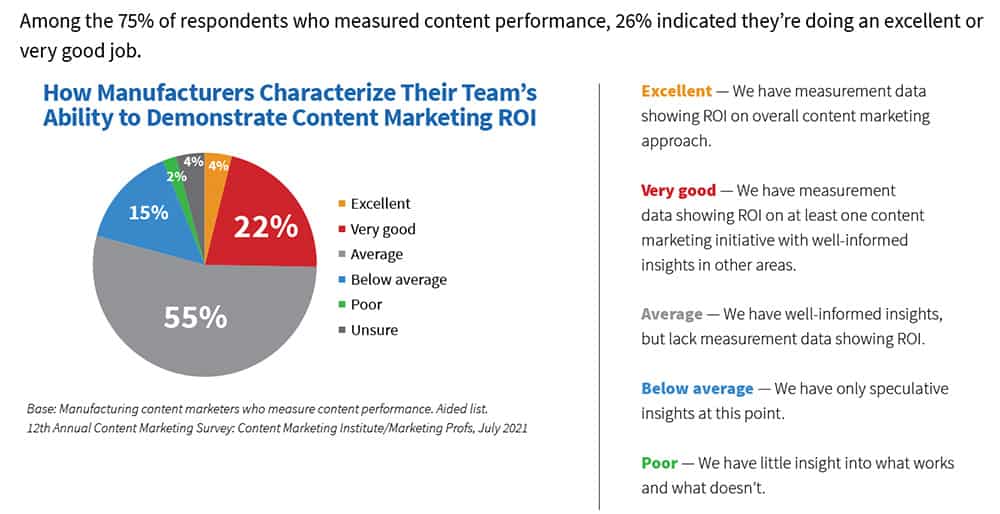
    Measuring the success of your digital marketing efforts is critical to understanding what’s working and what’s not. Unfortunately, it is often ignored other than a cursory look at Google Analytics to measure website traffic, email open and click rates, and other top-of-the-funnel statistics. You won’t know if your marketing strategy and tactics are working or not if you don’t measure. So take the guesswork out of the equation when it comes time to refine your strategy and/or abandon certain tactics that fail to produce results.

    This chart from the CMI report illustrates the problem of lack of measuring for proving marketing’s ROI.

    Benefits of working with a manufacturing marketing company

    Digital marketing is an ever-evolving field, and staying up-to-date on the latest trends and technologies can be challenging. Working with a specialized manufacturing marketing agency can help you stay ahead of the curve and ensure your digital marketing efforts are effective. In addition, an experienced manufacturing marketing expert can provide valuable insights into the latest strategies, tactics, and tools to help you reach your goals.

    You can maximize your digital marketing ROI by leveraging the agency’s specialized expertise, resources, and technology. With the right industrial marketing agency, you can create a robust digital presence that drives results for your business.

    To summarize this long post, digital marketing is a powerful tool for manufacturers to connect with their target audience of engineers and technical professionals and grow their businesses. Following the strategies and tactics I’ve provided in this post, you can develop an effective digital marketing strategy and use proven tactics that drive results for your manufacturing company.

    Let’s talk if you have questions about getting started or need to improve your digital marketing for manufacturers.