Category: Industrial Blogs

  • Overcoming the Challenges of Industrial Marketing for Manufacturers: Strategies for Lead Generation and Growing Sales

    Overcoming the Challenges of Industrial Marketing for Manufacturers: Strategies for Lead Generation and Growing Sales

    Industrial marketing for manufacturers is complicated, with many moving parts that must mesh together to produce measurable and sustainable results, i.e., generate better quality leads that turn into sales opportunities.

    Let’s look at this problem from the perspective of an owner of a small to mid-sized manufacturing company, the Sales Manager, or the VP of Business Development, and finally, from the point of view of the Marketing Manager to understand why s/he needs outsourced help to improve their industrial marketing ROI.

    You may notice some overlap between the challenges for different roles. You may face other challenges but these seem most common in my conversations with manufacturers and industrial companies.

    Industrial Marketing for Manufacturers: Perspective of a Founder/Owner of a Manufacturing Company

    As the owner of a small to mid-sized manufacturing company, I face several significant challenges in growing our business. These challenges are common among companies of our size and often require strategic solutions to overcome. Here are some of the biggest hurdles we encounter and how industrial marketing can assist us in achieving our goals:

    • Limited Resources: One of the most significant challenges for small to mid-sized manufacturing companies is limited resources, including budget, manpower, and time. Industrial marketing for manufacturers offers solutions that allow us to maximize our resources. For example, industrial content marketing can be a cost-efficient way to engage with our target audience and showcase our expertise without requiring a significant financial investment.
    • Competition from Larger Players: Competing with larger manufacturing companies with more extensive resources and brand recognition can be daunting. Industrial marketing for manufacturers helps level the playing field by allowing us to target niche markets and communicate our unique value proposition effectively. By focusing on our strengths and differentiating ourselves from larger competitors, we can carve out a space for our brand in the marketplace.
    • Reaching Target Audience: Identifying and reaching our target audience of engineers, procurement managers, and other technical decision-makers within industries can be challenging. Industrial marketing strategies such as search engine optimization (SEO), targeted advertising, and content marketing enable us to connect with the right audience online. We can increase visibility and attract potential customers by optimizing our digital presence and delivering relevant content to our target audience.
    • Building Brand Awareness: Building brand awareness is crucial for small to mid-sized manufacturing companies looking to expand their customer base. Industrial marketing tactics such as social media, email, and thought leadership content help us increase brand visibility and establish ourselves as industry experts. We can raise brand awareness and attract new customers by consistently engaging with our target audience across various channels.
    • Demonstrating Value Proposition: Effectively communicating our value proposition is essential for persuading potential customers to choose our products or services over competitors. Industrial marketing helps us showcase our unique selling points through targeted messaging, case studies, and customer testimonials. By demonstrating our value to customers and addressing their pain points, we can convince them of the benefits of choosing our offerings. (See How Manufacturers Can Use Content for Differentiation and Create a Competitive Edge).
    • Generating Quality Leads: Generating high-quality leads is critical for driving business growth. Industrial marketing tactics such as content marketing, lead nurturing campaigns and targeted advertising help us attract leads that are more likely to convert into customers. By providing valuable content and solutions to our target audience’s challenges, we can effectively capture their interest and guide them through the sales funnel.
    • Measuring ROI: Like any business investment, we need to measure our marketing efforts’ return on investment (ROI). Industrial marketing provides us with tools and metrics to track the performance of our campaigns, allowing us to measure the impact of our marketing activities on business outcomes such as lead generation, sales, and revenue. By analyzing data and making data-driven decisions, we can optimize our marketing strategies for maximum effectiveness.

    Industrial Marketing for Manufacturers: Point of View of a Sales Manager/Director of Marketing

    As the Sales Manager or VP of Business Development of a small to mid-sized manufacturing company, I encounter several significant challenges in growing our business. These challenges often require strategic solutions to overcome and drive sustainable growth. Here are some of the biggest hurdles we face and how industrial marketing can assist us in achieving our goals:

    • Limited Market Visibility: One of the primary challenges is limited market visibility, especially when competing against larger players in the industry. Industrial marketing plays a crucial role in increasing our brand’s visibility and awareness among our target audience. By leveraging strategies such as content marketing, search engine optimization (SEO), and social media marketing, we can enhance our online presence and reach a broader audience of potential customers.
    • Long Sales Cycles: Sales cycles in the manufacturing industry tend to be longer due to the complexity of products and decision-making processes. Industrial marketing helps facilitate these longer sales cycles by providing valuable educational content that nurtures leads throughout their journey. By delivering informative content such as whitepapers, case studies, and webinars, we can educate potential customers, build trust, and guide them through the sales funnel more effectively.
    • Technical Sales Process: Selling technical products or solutions requires a deep understanding of the customer’s needs and technical specifications. Industrial marketing assists in this process by providing relevant technical content that addresses our target audience’s specific challenges and requirements. By creating detailed product documentation, specification sheets, and technical articles, we can empower our sales team with the resources they need to communicate our value to potential customers effectively.
    • Competitive Landscape: The manufacturing industry is highly competitive, with numerous companies vying for market share. Industrial marketing helps us differentiate ourselves from competitors by highlighting our unique value proposition and strengths. By developing targeted messaging and positioning ourselves as industry experts through thought leadership content, we can stand out in a crowded marketplace and attract customers who value our expertise and offerings.
    • Lead Generation and Qualification: Generating high-quality leads and systematically qualifying them are essential for driving business growth. Industrial marketing tactics such as content marketing, email marketing, and targeted advertising help us attract leads that are more likely to convert into customers. By creating compelling content that addresses the pain points of our target audience and implementing lead scoring and nurturing processes, we can identify and prioritize leads with the highest potential for conversion.

    Why Would a Marketing Manager of a Manufacturing Company Outsource Industrial Marketing Tasks?

    As the Marketing Manager at a small to mid-sized manufacturing company, there are several reasons why seeking outside help can be beneficial in improving our marketing ROI:

    “59% of respondents said their organization outsources at least one content marketing activity. Their top challenge is finding partners with adequate topical expertise (60%).” (Source: The Content Marketing Institute).

    • Expertise and Specialization: Outside agencies or consultants often bring specialized expertise in industrial marketing that may not be available in-house. They have experience working with manufacturing companies and understand the unique challenges and opportunities within the industry. Their specialized knowledge can help identify effective strategies and tactics to improve marketing ROI.
    • Resource Constraints: Small to mid-sized manufacturing companies may have limited resources, including budget, manpower, and time, to dedicate to marketing efforts. Outsourcing certain marketing tasks can help alleviate these resource constraints by leveraging external resources and expertise. This allows the internal marketing team to focus on core strategic initiatives while external partners handle specific tasks.
    • Access to Tools and Technology: Marketing agencies often have access to advanced tools, technology, and analytics platforms that may not be affordable or practical for small to mid-sized companies to invest in independently. These tools can provide valuable insights and data-driven recommendations to optimize marketing strategies and improve ROI.
    • Fresh Perspective: Outside agencies or consultants bring a fresh perspective to marketing initiatives. They can offer new ideas, creative solutions, and innovative approaches that may not have been considered internally. This fresh perspective can help break through existing barriers and drive more effective marketing campaigns.
    • Scalability and Flexibility: Outsourcing marketing tasks provides scalability and flexibility to adapt to changing business needs and market conditions. External partners can quickly scale up or down based on demand, allowing the company to maintain agility and responsiveness in its marketing efforts.

    Specific industrial marketing tasks that could be outsourced to improve marketing ROI include:

    • Content Creation: Outsourcing content creation tasks such as blog writing, whitepapers, case studies, and technical articles can help ensure a consistent flow of high-quality content that resonates with the target audience.
    • Search Engine Optimization (SEO): SEO is crucial for improving online visibility and driving organic traffic to the company’s website. Outsourcing SEO tasks such as keyword research, on-page optimization, and link building can help improve search engine rankings and increase website traffic.
    • Pay-Per-Click (PPC) Advertising: Managing PPC advertising campaigns on platforms like Google Ads or LinkedIn Ads requires specialized knowledge and expertise. Outsourcing PPC advertising tasks to a qualified agency can help optimize campaigns, maximize ad spend, and improve ROI.
    • Social Media Management: Managing social media accounts and creating engaging content requires dedicated time and resources. Outsourcing social media management tasks such as content creation, scheduling, and community engagement can help maintain a consistent presence on social platforms and drive engagement with the target audience.
    • Email Marketing: Email marketing is a powerful tool for nurturing leads and driving conversions. Outsourcing email marketing tasks such as campaign management, list segmentation, and performance tracking can help improve email deliverability, engagement rates, and overall effectiveness.

    By outsourcing these tasks to external partners with expertise in industrial marketing, I can focus on strategic planning, analysis, and optimization to improve overall marketing ROI and drive business growth.

    You may have noticed that increasing brand awareness is a common challenge. Yet, when I talk to manufacturing prospects, our conversations inevitably start with, “We need more leads.”

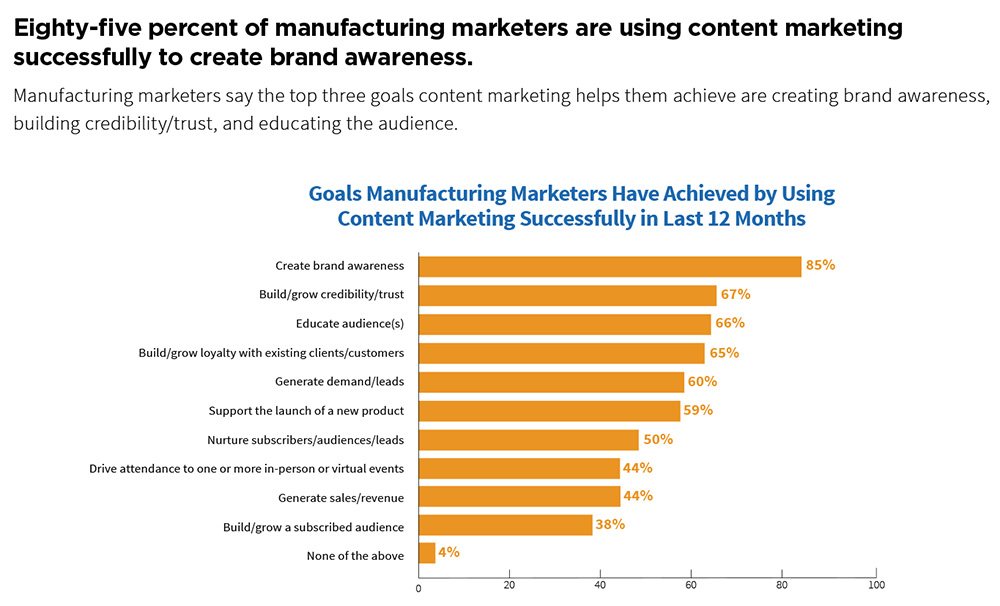
    85% of manufacturing marketers successfully use content marketing to create brand awareness. The fact is that manufacturing branding directly impacts the quality of the leads generated. Look at this chart from the 2023 Insights Manufacturing Content Marketing report published by the Content Marketing Institute.
    Manufacturing content marketing increases brand awareness

    To summarize, industrial marketing offers strategic solutions to help small to mid-sized manufacturing companies overcome challenges and achieve their business goals. By leveraging cost-effective tactics, targeting niche markets, building brand awareness, communicating our value proposition, generating quality leads, and measuring ROI, industrial marketing enables us to compete effectively in the marketplace and drive business growth.

    Tiecas has extensive knowledge and over 35 years of hands-on experience in marketing to engineers and industrial buyers. If you want to improve your industrial marketing ROI, contact us today for strategic help tailored to your manufacturing business. Let’s Talk.

  • A Guide to Writing Industrial Blogs: What Manufacturing Content Marketers Need to Know

    A Guide to Writing Industrial Blogs: What Manufacturing Content Marketers Need to Know

    Industrial blogs are an integral part of manufacturing content marketing. Industrial blogging is an essential digital marketing tool for manufacturers looking to establish themselves as thought leaders and engage with engineers and technical professionals. For manufacturers, creating industrial blogs is a challenge. Why? Because writing effective industrial blogs requires a unique set of skills and strategies.

    Whether new to manufacturing content marketing or looking to improve your efforts, this guide will provide the insights and best practices you need to know when writing industrial blogs.

    Challenges and the Importance of Industrial Blogging

    As a content marketer in a manufacturing company, there are probably a few challenges that you face when creating industrial blogs:

    • Technical complexity: Manufacturing processes and products can be highly technical and complex, making it crucial to translate this information into easily understandable content without oversimplifying it, i.e., not dumbing it down.
    • Industry jargon: Manufacturing industries often use specialized terminology that may be unfamiliar to your in-house writers. Balancing the use of technical terms to maintain credibility while ensuring clarity for an audience that may include less experienced engineers is a challenge.
    • Limited target audience: Industrial blogs generally cater to a small audience of technical professionals and decision-makers within niche industries. Reaching the right audience with relevant content is not easy.
    • Engaging content: Unlike other industries, regularly creating engaging blogs that effectively communicate the value of industrial products or services without sounding “salesy” can be a hurdle.

    Given these challenges, you probably ask yourself, “Is it worth the time and effort?”

    Here are three statistics on B2B blogging that should convince you.

    1. Websites with active blogs have 434% more indexed pages and 97% more inbound links than those without. (BKA Content)
    2. Companies with blogs produce an average of 67% more leads monthly than companies that don’t blog. (DemandMetric)
    3. Companies that blog get 55% more website visitors than businesses that don’t. (HubSpot)

    Industrial blogs are essential in a content marketing strategy for several reasons:

    • Thought leadership: Blogs provide a way to establish the company as a thought leader. By offering valuable insights, expert opinions, and relevant information, the blog can enhance the company’s reputation and position it as an authority within the industry or niche. You create meaningful differentiations by highlighting and showcasing your in-house expertise.
    • Education and awareness: Industrial blogs enable the company to educate potential customers about its products, services, and manufacturing processes. They help build awareness of the company’s capabilities and expertise while offering industry knowledge and informative content. This is an invaluable benefit because younger engineers look to their suppliers to fill their knowledge gap as senior engineers retire and in-house resources become scarce.
    • Lead generation: Blogs can be a powerful tool for lead generation. By following a solutions-oriented format, manufacturing companies can attract potential customers seeking specific solutions or information related to their work-related problems. These engaged readers can then be nurtured and converted into valuable leads that turn into sales opportunities.
    • SEO benefits: Regularly publishing high-quality blog content helps in search engine optimization (SEO). By targeting relevant keywords, expanding the website’s indexed pages, and increasing the overall authority of the industrial company’s website, blogs contribute to higher search engine rankings and improved organic traffic.

    It is not difficult to see how industrial blogs play a vital role in the content marketing strategy for manufacturing companies. Despite the challenges, creating compelling and informative blog content is essential for success with increasing global competition.

    Crafting Engaging and Informative Industrial Blogs for Engineers and Technical Professionals

    Your manufacturing website is probably already full of content about product features, specifications, and other technical information. These are great and necessary to show that your products meet specifications, particularly useful for Design Engineers who “design in” your industrial components.

    However, it is very product-centric content, which doesn’t help in convincing anyone to choose your company over the competition when they have similar, if not the same, product specs. Industrial blogs are the bridge between products and solutions.

    62% of manufacturing content marketers are challenged when it comes to creating content that appeals to different stages of the buyer’s journey. (Source).

    Challenges of creating content for different stages of the buyer's journey

    So, how do you create more content that addresses your audience’s challenges (a.k.a. looking for solutions)?

    Start by choosing the right and relevant topics for your audience. This requires research and talking to your sales team to get a good understanding of the questions they get asked by potential customers. Industrial blogs should be more about your audience’s needs and less about you. This is where a good understanding of search intent comes into play. Your blogs should answer their search queries.

    Here’s the tricky part, you have to strike a balance between helping and selling. Focus on providing insights, sharing best practices, and offering practical solutions to the audience’s challenges. This will elevate your manufacturing company as a knowledgeable and valuable partner instead of just another supplier. In turn, it will help generate better-quality leads and grow sales. This is how you can prove marketing ROI to higher-ups when it comes to budgets.

    Planning and Using an SEO Strategy for Maximum Impact

    Organic SEO for manufacturers and industrial companies is more than stuffing keywords in your blog posts. Planning and implementing a solid SEO (Search Engine Optimization) strategy is essential to maximize the impact of your industrial blogs. By optimizing your blog posts for search engines, you can increase their visibility and reach the right audience of engineers and technical professionals. Don’t go overboard with optimization. Write for your human readers and let the search engines follow.

    While discovery optimization (SEO) is related to conversion optimization (CRO), they are not the same. It is not enough to attract visitors to your blog, your content must persuade them to take some action. Passive reading of blog posts won’t help you move the needle.

    Don’t rely 100% on organic SEO for your audience to discover your industrial blogs. Promote them through various channels to maximize their reach and impact. One of the most effective channels for promotion is social media, such as LinkedIn and YouTube. Also, consider guest posts and publishing articles in well-known industry portals.

    Promoting industrial blogs

    Analyzing and Measuring the Success of Your Industrial Blog

    After sharing and promoting your industrial blogs, assessing their impact is a must. Analyzing key metrics shows what works and what needs tweaking, enabling data-driven adjustments to your industrial blogging strategy.

    It is more complex than gathering data from Google Analytics on Users, Page Views, Avg. Engagement Time, etc. Those are good top-of-the-funnel stats but won’t help you show marketing’s contributions to revenue. The problem becomes even more difficult because of the long sales cycles and the many stakeholders involved in buying decisions.

    The top challenge manufacturing marketers face with measuring content performance is difficulty integrating/correlating data across multiple platforms (48%).

    Measurement challenges in manufacturing content marketing

    Are you tired of investing your valuable time and resources into creating industrial blogs that fail to deliver results? Look no further. At Tiecas, we have the experience and expertise necessary to ensure the success of your industrial blogs. Let’s Talk.

  • How Manufacturers Can Use Content for Differentiation and Create a Competitive Edge

    How Manufacturers Can Use Content for Differentiation and Create a Competitive Edge

    Using content for differentiation of your manufacturing company can be a powerful marketing strategy. Across various industries where global competition is fierce, finding ways to set your company apart from competitors is crucial.

    This goes beyond just marketing tactics and carries real-world significance. When companies have similar value propositions, creating real differentiation that doesn’t come across as a mere imitation or can be easily replicated by the competition allows you to stand out and establish a unique selling proposition. Doing so can attract potential customers, expand your market share, and ultimately drive business growth.

    Those are lofty goals for industrial content marketing. You’ll need strategic planning, diligently executing the strategy, and measuring results regularly to achieve those goals. The more successful manufacturing content marketers almost always focus on quality content over quantity.

    80% of those who always/frequently differentiate their content said they do so by producing better quality content than their competitors. (Source).

    quality content for differentiation

    The Power of Content for Differentiating Your Brand

    To use content for differentiation, you have to take several steps. This post is written for manufacturing content marketers who are not well-versed in marketing to engineers and technical professionals. There is nothing to be ashamed of; marketing to engineers is different and can be challenging.

    Identify Your Target Audience

    Determine who your ideal customers are and what their needs and pain points are. This will help you create content that resonates with them.

    It would help if you went deeper than industry classifications and company size. You want to identify who within those niches you want to target (Job Titles, role in the buying decision – Specifier vs. Functional Buyer).

    Many marketing consultants will advise you to interview your top 10 customers. There is nothing wrong with that per se; however, your favorite customers already like you and do business with you. These are not prospects that you need to win over.

    Talk to your sales team and ask them about the objections they heard from leads that seemed promising but never closed. Combine this information with what you learned about from the loyal customers. This will provide a more complete picture of your target audience.

    Understand Your Unique Value Proposition

    To stand out from the competition, your manufacturing company must identify and emphasize what sets it apart from others in the industry. This could be a variety of factors, ranging from your expertise and experience in the field to the exceptional quality of your products.

    Product features and specifications are essential because they show your products meet the technical requirements, but those alone are not enough.

    Highlighting any innovative approaches or technologies you utilize in your manufacturing processes can showcase your company’s commitment to staying ahead of the curve. You must be careful not to give away proprietary information and/or the company’s IP.

    Another aspect that can separate your business is exceptional customer service, which allows you to build long-lasting relationships with your customers and establish a positive reputation. You can’t just say, “We offer exceptional customer service.” You have to prove it to the skeptical audience.

    For example, you can say:

    • We offer a 24/7 emergency call number where a technically competent person will answer
    • We can deploy a crew to your jobsite or plant within 24 hours
    • We have a searchable knowledge base of common troubleshooting questions
    • Our online video library has many how-to videos for field repairs (Field MRO people may not have a say in the initial purchase but can make or break repeat orders) 

    The key is to identify and effectively communicate the unique aspects of your business to potential customers. This strategic approach is essential for ensuring your company’s continued success and growth.

    Showcase Your In-house Expertise

    Use content to demonstrate your expertise in your industry. Bring your in-house Subject Matter Experts (SMEs) to the forefront. As a content marketer, you are responsible for extracting the key talking points from your SMEs and expanding them into cohesive, customer-centric content that addresses the audience’s challenges. Don’t ask them to write the content for you.

    Have the SME review and vet your draft and publish it under their names. One engineer to another is a powerful strategy and lends credibility to your content. This could involve sharing success stories, highlighting your team’s qualifications, or providing thought leadership content. (See Industrial Blogging Lessons Learned from Working with Technical SMEs).

    Educational Content and Thought Leadership

    This could include blog posts, case studies, whitepapers, videos, infographics, or technical articles published in well-known industry portals and publications. Manufacturing blogging is an excellent channel for this. Focus on creating content that educates and informs your target audience.

    You should share industry insights, best practices, tips, and tutorials about your manufacturing niche.

    Regularly creating and publishing technical blog posts is challenging for many manufacturing content marketers, especially those just starting out. If you are in this situation, consider outsourcing your manufacturing blog creation. Learn from them until you feel confident about writing them yourself.

    59% of manufacturers outsource at least one marketing activity. Last year’s survey found content creation was the most outsourced activity at 80%.

    However, it is not just a matter of finding low-cost freelance copywriters from one of the many services out there. The two biggest challenges were finding partners with adequate technical knowledge and understanding the target audience’s mindset. (Technical Content Writing is Challenging for Manufacturing Marketers).

    Leverage Customer Testimonials and Case Studies

    Incorporate customer testimonials to build trust and credibility. This can help potential customers see the real-world benefits of working with your company. The problem you may face is that many customers tend to shy away from endorsing any vendor. You have to work at it and assure your customers you won’t misuse or abuse their trust when they agree to provide a testimonial. A video testimonial will provide a level of authenticity that is hard to get from written text.

    Case studies are powerful content assets as assurance for your potential customers that your company knows its stuff and has “Been There Done That.”

    Sometimes, NDAs can make it difficult to name names, but there are legal ways to overcome those hurdles.

    Leveraging the persuasive power of customer testimonials and case studies is a highly effective strategy to build trust and credibility, ultimately driving the success and growth of your manufacturing business.

    Don’t Forget About Organic SEO

    With social media garnering all the attention these days, it is easy to think that organic SEO for manufacturers is dead. Nothing could be further from the truth. After all, your audience has to find your content before they can read it.

    Make sure you’ve optimized your content for search engines by using relevant keywords and meta tags. This will help your content rank higher in search engine results and attract organic traffic. Use strategic internal links to drive readers deeper into your site and improve engagement. It also helps with your SEO.

    A word of advice—Don’t rely 100% on organic SEO. Promote your content by sharing your posts and other new content through various channels, such as your social media platforms, email newsletters, and industry forums. Engage with your audience and encourage them to share your content with others.

    Measure, Refine, and Repeat

    Track the performance of your content using analytics tools. Monitor metrics such as website traffic, engagement, conversions, and customer feedback. Use this data to refine your content strategy and make improvements over time.

    Engagement metrics reveal user interaction with your content, such as time on site, pages per visit, and bounce rate, helping you identify engaging content and areas for improvement. Similarly, tracking conversions—like newsletter sign-ups, purchases, or form submissions—is vital to understanding what drives users to act and enhance your site’s conversion process.

    Remember that discovery optimization (SEO) differs from conversion optimization (CRO).

    It is tempting to start with step 1 in this post. Before implementing any content marketing tactics, you should develop a content marketing strategy that aligns with your business goals. It will provide you with a clear roadmap to success.

    Without it, you may get frustrated with the lack of results and find it difficult to prove ROI to upper management.

    We at Tiecas take a strategy-first approach before implementing any hit-or-miss tactics. Take a look at our process to learn from it.

    Developing a content marketing strategy first and following these steps, you can use content to differentiate your manufacturing company and attract customers who value your unique offerings.

  • Industrial Blogging Requires Commitment and Perseverance

    Industrial Blogging Requires Commitment and Perseverance

    Industrial blogging is an important and integral part of manufacturing content marketing. Yet, I’ve found that many manufacturers and engineering companies are not willing to invest the time and resources for industrial blogging. I once had the VP of Business Development at a manufacturing company tell me, “This s**t doesn’t work.”

    The problem is not with industrial blogging, but in my experience, the fault lies with not having a clear understanding of a blog’s purpose and goals. Let me make it crystal clear—blogging is not a quick fix for not enough sales leads.

    Industrial blogging and B2B buyers

    You’ve probably read that blogging doesn’t play an active role in the industrial sales process. I look at it differently; let me share some independent research data on how B2B buyers interact with blogs to make my case.

    My sources are the 2020 Content Preferences Study published by DemandGen and the 12th Annual B2B Content Marketing Report published by the Content Marketing Institute. The findings are relevant to industrial blogging since both surveys included respondents from the manufacturing sector.

    The pandemic forced cancellations of many in-person tradeshows and face-to-face meetings, which meant the use of virtual conferences and Zoom meetings grew exponentially. So it shouldn’t surprise you to read some of the findings from the surveys.

    “B2B buyers increasingly look for credible ‘show-and-tell’ experiences to drive buying decisions.”

    DemandGen

    “The pandemic forced us to start content marketing and add marketing as a focus. We were previously very sales oriented.”

    Content Marketing Institute

    Key findings from both reports:

    • 67% of respondents said they rely even more on content than they did last year to research and make informed purchase decisions (DemandGen)
    • 77% read from 3 to more than 7 pieces of content before engaging with a salesperson (DemandGen)
    • 56% read blogs during their buying process, which puts it in the #3 spot with video at #1 (65%) and white papers at #2 (60%) (DemandGen)
    • 77% reported that their organization has a content marketing strategy. Of those, 58% said their strategy is moderately or slightly different now versus pre-pandemic (CMI)
    • 78% of small companies (1 – 99 employees) and 52% of medium companies (100 – 999 employees) have a small or one-person marketing/content marketing team serving the entire organization (CMI)
    • 61% of large companies (More than 1,0000 employees) indicated last year that they outsourced marketing activities. This year, the figure was up to 75% (CMI)
    • 65% of the respondents who outsourced said their top challenge is finding partners with adequate topical expertise (CMI)

    Role of blogs in content distribution and lead generation

    Past research reports have found the technical audience to be passive participants in social media. However, they do share blog posts with their peers. 36% share blog posts with their peers and colleagues, with LinkedIn being the most popular channel at 81%, followed by Email at 70% (DemandGen).

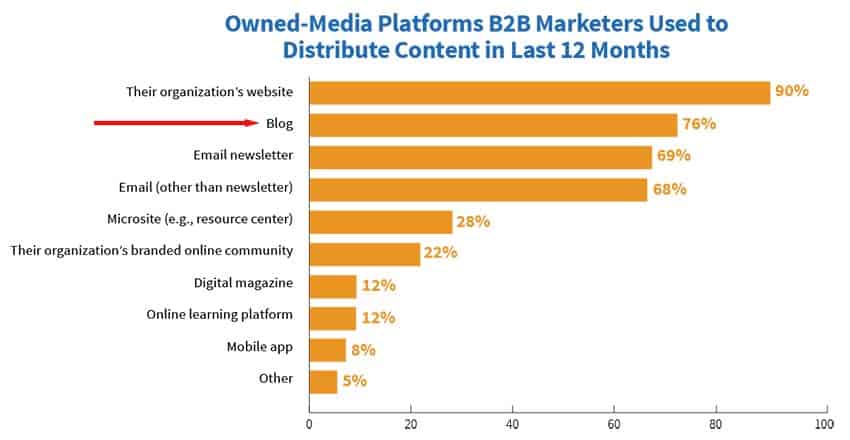
    A company’s website remains the primary channel for content distribution. However, a blog is the second most popular distribution channel, as seen in this chart from CMI.

    A blog is the second most popular channel for content distribution

    While lead generation continues to be the top priority for most industrial companies, manufacturing marketers are using content to achieve various goals. In my opinion, raising brand awareness, earning trust, educating less experienced engineers, winning their mindshare, and increasing subscribers, all play critical roles in generating high-quality leads that need nurturing to turn them into sales opportunities.

    Goals achieved by manufacturing content marketers

    Committed individuals launch manufacturing blogs

    Don’t assume that an industrial or manufacturing blog requires a big staff to launch and maintain. That is not always the case. Let me give you a real-life example of a blog from a manufacturer that two individuals started and have grown their blog into a highly respected source of technical information in their niche.

    Emerson Automation Experts Blog: As the name says, this blog is part of the multi-billion dollar global company, Emerson Electric Co. However, the blog was started by two committed individuals, Jim Cahill and Debra Franke (She has since left the company). The two of them worked tirelessly without any support from the upper management. They had to prove the value of blogging by taking baby steps at first.

    Emerson Automation Experts blog

    I’ve known Jim since 2007 and remember seeing his presentation at an American Marketing Association’s meeting. He shared a story with me, the gist of which went something like this, “…one of my blog posts generated an email about the early stages of a very large greenfield project and gave Emerson an early start in the sales process and an opportunity to help shape the vision for the project.”

    Today, a few other Subject Matter Experts from various fields contribute content. The blog now generates several unsolicited RFQs, which Jim routes to the proper sales organizations.

    Jim is the Chief Blogger, Surface Dweller, and Head of Social Media for Emerson Automation Solutions and has been blogging since 2006. The Emerson blog was named BtoB magazine’s Best Corporate Blog for 2010.

    As you can see, it takes time, dedication, and hard work for an industrial blog to produce results.

    I write about all things industrial marketing here and have been blogging since 2008. I now get 3.5x more traffic from this blog as compared to my company’s website. Blogging has boosted my organic SEO rankings and the bulk of my new leads are inbound leads from either this blog or people who find the blog first and then visit the company website. (I’ll be happy to share my story about why I have two sites. Let’s Talk).

    I help my clients set up their industrial blogs, develop a blogging strategy, and create/edit their blog posts. The research findings cited here and the example I have shared should convince you that industrial blogging does produce results but it requires a serious commitment of time and resources. Don’t blame the strategy if you are not willing to take a long-term approach and persevere.

  • Unique Challenges in Manufacturing Content Marketing

    Unique Challenges in Manufacturing Content Marketing

    Manufacturing content marketing has its own challenges and frustrations as many industrial marketers have experienced. I touched on some of them in my last post about writing technical blog posts.

    While the age-old problem of “What should we write about?” still exists, new research findings show a myriad of other challenges. Some of these may not be unique or specific to manufacturing content marketing, but most do apply in my experience.

    I’ll come back to the problem of finding relevant content topics a little later in this post.

    Long vs short posts in industrial blogging

    Industrial blogging is usually a central part of any manufacturing content marketing strategy. I came across a new research report published by Orbit Media Studios. It is called [New Research] How has Blogging Changed? 5 Years of Blogging Statistics, Data and Trends.

    It is chock-full of data and useful information about the state of blogging today. A few of the findings are contrary to some long-standing beliefs. For example, keep posts easy to read and help with quick scanning by using bullet points.

    The new research found that the average blog post in 2019 was 1,236 words long. That’s 53% longer than six years ago!

    post length in industrial blogging

    It is not surprising then that bloggers are now spending more time writing blog posts than in the past. The average blog post takes 3 hours and 57 minutes to write which is 30 minutes more than 2018 posts and is up 65% since 2014.

    Average time spent writing posts

    It probably doesn’t include the time to do research, interview Subject Matter Experts, find or create appropriate images, editing and distribution—steps that you have to repeat for each new post. Yes, that is a lot of work.

    You may want to seriously consider outsourcing technical blog post writing if you already have a lot on your marketing plate.

    Manufacturing content marketing is too focused on top of the funnel (ToFU)

    Many manufacturing content marketers have learned some hard lessons about the ineffectiveness of the “One-size-fits-all” industrial content marketing strategy. Yet, according to the Manufacturing Content Marketing 2020 report published by the Content Marketing Institute, only 40% of manufacturing marketers always or frequently create content for specific stages of the customer journey.

    Manufacturing content marketing for buyer's journey

    Related to this problem is the fact that 50% of the content created by manufacturing marketers is for the early stages of the buyer’s journey. Most of the effort is for the ToFU results, the low hanging fruit if you will.

    Only 36% of the content created is for mid-funnel (consideration/intent) and late-stage (evaluation/purchase) of the buying decision.

    Manufacturing content marketing for ToFU

    I had written another post that addressed this issue of putting too much focus on ToFU. See Content Marketing for Manufacturers: Are You Using its Full Power?

    The other big challenge is the lack of ROI or proving it. It is complicated to correctly attribute industrial marketing’s contribution to sales and revenues when sales cycles are long and complex with multiple stakeholders involved. Correct attribution is a big problem in manufacturing content marketing. Follow the link in this paragraph to read my post about this issue.

    Content consumption by key decision makers in industrial sales

    Conventional wisdom says key decision makers don’t have time to read content. That simply isn’t true when targeting an engineering audience.

    Here’s a chart from the 2019 study, How Engineers Find Information 2019 published by engineering.com.

    The study found that the more authority a respondent has in the decision-making process, the more total information they consumed.

    Content consuption of decision makers in industrial sales

    While engineers tend to consume more short form articles, long form articles and recorded videos are at #3 and #4 respectively, so they aren’t too far behind.

    Content formats preferred by engineers

    How to find relevant topic ideas for industrial blogging and content creation

    Unlike the world of B2C marketing, there isn’t a lot of data available on industrial customer behavior and their content consumption.

    You do keyword research and build your list of focus keyword phrases, secondary and tertiary keywords, that’s the bare minimum these days. However, I have seen some industrial marketers just skip this step because they are so focused on writing about their latest solution or the greatest product since sliced bread.

    How do you get a pulse of your technical audience? What content are they consuming? Those are important questions when it comes to creating relevant content for engaging with technical professionals.

    I want to give a shoutout to David Fortino, SVP Audience and Product at NetLine Corporation. He and his team have created an incredibly valuable tool, the Audience Explorer. They call it the only real-time interactive buyer engagement tool that helps B2B content marketers outsmart the competition. Best of all, it is FREE.

    You can pick and choose your exact target audience and geographic markets. The results update in real time as you make your selections and returns a wealth of useful information to help you personalize your content and make it engaging for your target audience.

    For example, I started with the broad category of engineering as the type of buyer. Then drilled down and refined my audience with these selections:

    • Job Function > Design Engineering and Mechanical Engineering
    • Industry > Aerospace/Aviation, Automotive, Manufacturing, and Utility/Energy
    • Job Level > C-Level, VP, Director, Manager, and Consultant
    • Region > Canada, Latin America, Mexico, UK, and US
    • Employee Size > 100 – 249, 250 – 499, and 500 – 999

    Results: Total Buyer Content Recommendations (last 180 days): 4,861 (Based on content consumption associated to available NetLine client content.)

    I think this screenshot is self-explanatory for the rest of the results.

    Audience Explorer for technical content marketing

    Give Audience Explorer a try. Note how you can get information on not just high-value content such as white papers and case studies, but it could also spark some ideas about blog post topics in support of those content assets for lead generation.

    My company Tiecas, has partnered with NetLine to offer industrial marketers a service called Content-Centric Lead Gen. See if it might help you.

    Yes, there are some challenges that are unique to manufacturing content marketing and industrial blogging. I hope this post will set you on the right track knowing some of the pitfalls to avoid.

  • Writing Technical Blog Posts for Engineers and Industrial Professionals

    Writing Technical Blog Posts for Engineers and Industrial Professionals

    Writing technical blog posts is not the most popular topic of discussion for many manufacturers and engineering companies. In my experience, industrial blogging is an underused content marketing tactic for many of these companies.

    The two most common objections that I hear are:

    1. Writing fresh and relevant content regularly for industrial blogging is too consuming and we just don’t have the in-house resources
    2. We’ve been blogging for some time now, but haven’t see measurable results (leads, sales opportunities etc.)

    Both are valid complaints, but don’t throw in the towel yet because the benefits of technical blogging far outweigh the effort it takes to keep it stocked with new posts.

    Benefits of industrial blogging

    You are probably already familiar with the benefits of blogging, but let me give you the key points just in case:

    • Search Engine Optimization (SEO)
    • Drive more traffic to website
    • Generate better quality leads
    • Brand awareness
    • Thought leadership
    • Educating your audience
    • Earning trust
    • Creating true competitive differentiation by highlighting your expertise
    • Setting the table for sales

    As you can see, the list is pretty long. Want proof?

    benefits of industrial blogging

    (Source: DemandMetric)

    One more…

    • Marketers who prioritized blogging received 13X more ROI than companies that did not in 2019 (Source: HubSpot).

    I understand if you are a little skeptical about those stats since they are a bit general and not specific to industrial blogging.

    Examples of successful industrial blogs

    As they say, “the proof of the pudding is in the eating” or if you prefer the shortened version, “the proof is in the pudding.”

    Let me give you three cases of very successful industrial blogs. In the first two, I personally know the two men who made blogging a key part of their company’s content marketing strategy and in the third example, the company was a client and I was part of the team that wrote blog posts.

    Indium Corporation Blog

    Writing industrial blog posts - Indium Corporation blog

    Emerson Automation Experts Blog

    Emerson Process Experts

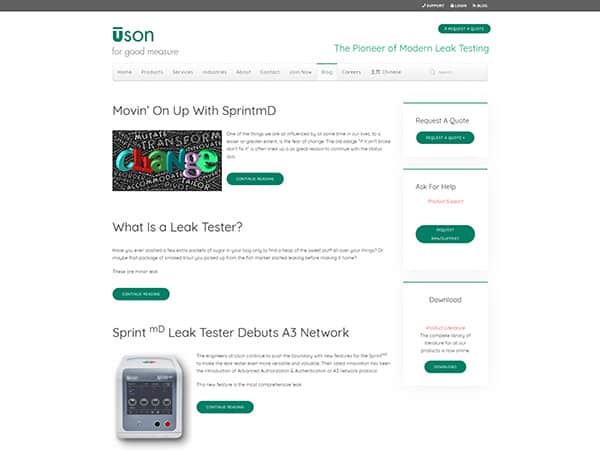
    Uson Leak Testing Blog

    Writing technical blog posts- Uson Leak Testing Blog

    I can tell you it wasn’t easy since I have first-hand knowledge of their journeys before tasting success with industrial blogging. They’ll also readily tell you that the effort was well worth it.

    I have been blogging since 2008 when I launched Industrial Marketing Today for branding and thought leadership of my own company, Tiecas. After publishing over 300 articles, we largely depend on this blog for SEO, high-quality inbound leads and building up reputation as an industrial marketing expert.

    The disconnect between expectations and reality in industrial blogging

    I do see a disconnect between what companies expect from their blogs and the reality of this industrial content marketing strategy.

    It is not a quick fix for slow sales, and neither is it a one-off campaign. Successful industrial blogging takes a team effort, it takes time and yes, it takes money. That is not an easy sell to the upper management.

    You have to take baby steps and show them proof of concept with the site statistics such as traffic, users, average time spent, and the number of pages viewed per session. Start there, and then move on to the number of top of the funnel (ToFU) leads generated (Content downloads, registration for webinars and maybe even contacting your sales team).

    Use the full power of industrial content marketing to nurture ToFU leads and convert them into qualified sales opportunities for your sales team to close and score wins. Implement Marketing Automation and a CRM system so you can track the complete journey of every lead and measure ROI and prove blogging’s impact on sales. This is will also help you better align Sales and Marketing. Now you’ve attained industrial marketing nirvana!

    How often should you publish industrial blog posts?

    This is a common question, unfortunately there is no definitive answer. It really depends on many factors including competition for SEO, your industry and target audience.

    I have read research studies that show that the organic traffic goes up substantially if you publish new posts 2 to 4 times a week. This chart is from HubSpot.

    Frequency of industrial blog posts

    The next chart shows the impact of blog post frequency on site traffic. I saw this chart in a post published by Michael Brenner on his blog.

    Ogranic traffic and the number of posts

    Most industrial companies I have talked to, couldn’t maintain that high a frequency. I have produced good results for my clients with publishing two new posts a month, every month for at least 6 to 9 months.

    What should be the length of blog posts?

    This is another question with no definite answer other than to say, “Depends.” I have seen word count range from 300 to 5,000 words. It used to be you needed a certain length to get the right keyword density for SEO. The general rule of thumb was a keyword density of 0.5 and 3%. While it is still important, it is a somewhat outdated idea, so take that advice with a healthy pinch of salt.

    My advice, write for your human readers in mind first and let the search engines follow. Use the number of words you feel you need to use to convey your complete message without restricting yourself to some imaginary word count. Then ruthlessly edit your draft until you’ve taken out all unnecessary words and sentences.

    Try to keep your posts to at least 600 words long, mix it up with longer posts of 1,000 to 1,500 words occasionally and if you have something longer like 5,000 words, turn it into a pillar post or break it up into smaller parts with a hook at the end for your readers to come back for the next installment.

    Challenges of writing technical blog posts that are engaging

    As I said at the beginning of this post, industrial companies do have legitimate complaints about industrial blogging. Most companies just do not have the in-house resources to write new blogs posts consistently and regularly. Either that or they are not willing to commit to the time and money because they are not yet convinced.

    Keep in mind that writing good posts is much more than just copywriting. You need to do your keyword research, interview in-house Subject Matter Experts (SMEs), draft copy, have your posts reviewed by your SMEs, publish, and promote. You have to repeat that process every time you need to write a new post.

    Before you can create posts, you need to spend time to develop a blogging strategy, identify your audience (personas), understand their challenges, and come up with explicit calls to action. Passive reading of your posts won’t help you.

    If you are facing the same challenges, you are not alone. See this chart from the report Manufacturing Content Marketing 2020 published by the Content Marketing Institute.

    Outsourcing technical content creation

    After listening to the challenges faced by my clients, I recently launched a new service, Technical Blog Post Writing for Industrial Companies. Take a look at it and see if this could be an option for you when it comes to writing technical blog posts that engineers and industrial professionals will find relevant and engaging.

  • Industrial Blogs are Essential in Lead Generation

    Industrial Blogs are Essential in Lead Generation

    Industrial blogs are not often talked about by manufacturers when it comes to lead generation. They tend to brush it off as too time consuming and/or not very effective. They are not completely wrong about their complaints, but don’t be too quick to discard industrial blogging.

    Let’s face it, your audience of engineers and industrial buyers is not actively looking for your products every day, especially if you are a manufacturer of custom-engineered systems. They have very little reason to visit your static website regularly. Whereas industrial blogs can drive a higher volume of traffic and more frequently if you publish relevant content consistently.

    Industrial blogs are integral to content marketing

    You are going to need an industrial blog if you are doing manufacturing content marketing. There is no getting around that. Why do I say that?

    • A WordPress industrial blog is easy to use to publish content
    • Optimized blog posts will improve your SEO rankings
    • 85% of manufacturers use their website/blog to distribute content (See chart below)
    • Content distribution using social media channels depends largely on fresh content published on your industrial blog
    • Blogging tends to be more customer-centric than product-centric product pages
    • Industrial blogs written or published by in-house Subject Matter Experts highlight your company’s expertise and experience (See Lessons Learned from Working with Technical SMEs)
    • Blog posts help to create thought leadership, build awareness and earn trust
    • Marketers who prioritize blogging efforts are 13x more likely to see positive ROI (HubSpot, 2019)

    All the reasons that I have cited here, together play an important role in industrial lead generation.

    Use of industrial blogs for organic content distribution

    Winning the engineer’s mindshare with industrial blogs

    Industrial blogs are invaluable if you target engineers of any kind, especially if your goal is to educate younger and less experienced engineers.

    That’s not just me making that claim. Here are some findings from the study “What’s on the Mind of the Engineer?” – A Global Research Study produced by Beacon Technology Partners, LLC and UBM Tech Electronics Network.

    • Solving problems that haven’t been solved before – this solution orientation pervades everything an engineer thinks or does
    • The #1 concern among all engineers regardless of their experience is keeping their skills current and their technology knowledge up to date
    • Engineers are eager consumers of information regardless of level of experience because of this need to stay current
    • Engineers communicate with and trust other engineers. Marketing must leverage this collaborative ethos without wasting the engineer’s valuable time with content noise

    NOTE: Over the years, I have published a few posts here where I’ve talked about the power of one engineer to another.

    Expectations of industrial blogs and reality don’t align well

    At the very beginning of the post, I acknowledged the fact that complaints about industrial blogs weren’t completely unjustified.

    However, I see the problem a little differently. I say that based on my actual conversations with manufacturers and other industrial companies. There is a definite disconnect between expectations and the reality.

    The reality is that industrial blogs are not specifically designed for direct response. They are more of a “set the table” kind of a strategy. Which means you have to be patient and be consistent with publishing fresh blog posts.

    I have seen too many cases where a website redesign involved setting up a blog with a few posts and is neglected after that. That simply won’t cut it. No wonder I hear many manufacturers complaining about blogging not producing the results.

    That doesn’t mean blogs can’t generate leads. I have seen several instances where a comment left on a blog post, started a meaningful conversation which led to a substantial order or project.

    Creating content for industrial blogs is a challenge

    It is a known fact that creating relevant technical content for industrial blogs is time consuming and most manufacturers and engineering companies do not have the necessary bandwidth and/or the in-house resources.

    That’s why 87% of manufacturing content marketers outsource technical content creation.

    Outsourcing technical content creation

    I’m not suggesting that industrial blogs are a good fit for every industrial company. For example, an industrial distributor of standard products and/or consumables, may find it very difficult to create original content themselves since they depend primarily on their principal manufacturer(s) to provide them product information. For others, industrial blogs are important for their success with content marketing and lead generation.

    Practice social distancing and stay safe.

  • Industrial Blogging – An Underutilized Content Marketing Tactic

    Industrial blogging - IMTIndustrial blogging is usually not a favorite subject of discussion with my manufacturing and engineering clients. Probably the most common complaint I hear is, “We’ve been blogging for a while but haven’t seen any tangible results (leads, sales opportunities etc.).”

    Another major concern is that it is too time consuming to create fresh and relevant content that will engage engineers and industrial professionals.

    These issues with industrial blogging are valid and justifiable, but don’t give up on it just yet. I’ve found industrial blogging to be a strong content marketing strategy for engaging with time-challenged engineers.

    That’s been my own experience working with my clients and in my own industrial marketing consulting business. 100% of new leads are now inbound leads and usually originate from this blog. I admit it has taken me several years to build up to this stage (I’ve been blogging since 2008).

    Using industrial blogging to win the engineer’s mindshare

    Engineers thrive on solving problems and they love a technical challenge. They are keen on gaining knowledge and staying current about their industry. They trust, respect and want to learn from their peers. Those are not just my observations.

    (more…)

  • To Blog, or Not to Blog…That’s the Question Many Industrial Companies are Asking

    Industrial blogging questionsManufacturers, distributors and engineering companies have read or heard about all the benefits of content marketing in general and blogging in particular but many are still sitting on the fence. I’m often asked the question, “Should we start a blog?” It is a simple question but the answer is not a simple yes or a no.

    Yes, you should start an industrial blog if you haven’t already done so. No, you shouldn’t blog if you don’t have a well-thought-out blogging strategy in place already.

    Even though blog strategy comes before content creation, only 19% of manufacturing marketers outsource this function. That was one of the findings from the 2014 B2B Manufacturing Content Marketing Trends—North America: Content Marketing Institute/MarketingProfs.

    (more…)

  • Winning the Engineer’s Mindshare with Industrial Blogging

    Winning engineer's mindshare with industrial bloggingEngineers love a challenge and solving problems. They are always on the lookout for gaining knowledge from their peers. They trust and have more confidence in reading or hearing something from other engineers. One engineer to another is a far more powerful tool than sales messaging when it comes to building trust and establishing thought leadership.

    However, engineers and technical buyers don’t easily change processes that are working well unless you can convince them they may have a problem that they are not aware of and/or you have a better, more efficient way of doing something that they have been doing for many years.

    There is a two-fold challenge here. First, you have to bring attention to real-world technical problems and not something that you’ve cooked up to sell your solution. Second, engineers are trained to be skeptical and demand proof of concept before they’ll buy your solution.

    (more…)