

SEO for manufacturers, or organic SEO for manufacturers, has undergone a seismic shift in the past year. While Google’s AI Overview is still in its experimental phase, early data indicates that it’s already influencing search rankings dramatically—impacting up to 100% of complex queries while prioritizing contextually relevant content. (Source: Search Engine Journal).
This shift isn’t an anomaly. BrightEdge data confirms that Google increasingly relies on AI Overviews (AIOs) for complex searches, particularly those involving multi-step, conversational queries. This suggests that Google’s growing confidence in AI-generated responses reduces visibility for traditionally optimized content. (Source: Brightedge).
Table of Contents
Why Clicks and Traffic from Organic SEO for Manufacturers are Declining in the Age of Zero-Click Searches
The dominance of AI Overviews isn’t just shifting search behavior—it’s drastically reducing organic clicks to manufacturer websites. According to SparkToro’s 2024 Zero-Click Search Study, for every 1,000 Google searches in the U.S., only 360 clicks now go to the open web. (Source: SparkToro).
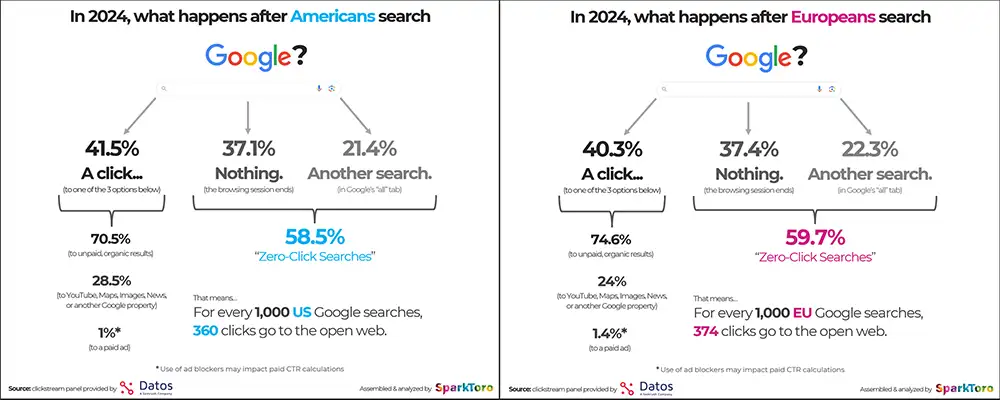
This trend signals a growing challenge for manufacturers relying on traditional SEO strategies. With Google keeping more users within its ecosystem, fewer searches result in actual website visits. Instead, AI-generated answers, featured snippets, knowledge panels, and product carousels provide information directly on Google’s SERP—eliminating the need for users to click through to manufacturer websites.
What Is Search Generative Experience (SGE) and AI Overview? How Do They Differ from SearchGPT?
As organic search traffic declines, manufacturers must understand why Google’s AI-driven features are reshaping search behavior—and what that means in SEO for manufacturers. Search Generative Experience (SGE) and AI Overview are two key technologies driving this shift. While both rely on Google’s AI models, they function differently from SearchGPT, which represents a broader class of AI-powered search tools.
Google’s Search Generative Experience (SGE)
SGE is Google’s AI-powered search experience, designed to provide contextual, AI-generated summaries at the top of search results. Instead of displaying a list of blue links, SGE generates a conversational response based on multiple sources, allowing users to refine their queries interactively.
For manufacturers, this means that traditional ranking factors are evolving, as Google’s AI pulls content from multiple sources rather than directing users to individual web pages.
AI Overview
AI Overview is a subset of SGE that appears for certain queries, offering concise, AI-generated answers at the top of the search results. Unlike SGE, which is more interactive and detailed, AI Overview provides quick, summarized insights—often eliminating the need for users to click on any external links.
Consider this real-world example of my Google search query—“What are the differences between pneumatic and electric actuators in ball valves?”—now triggers an AI Overview that dominates the entire top half of the search results page. As shown in the screenshot, no traditional blog posts or authoritative articles appear above the fold.
AI Overview instantly delivers a structured answer, reducing the likelihood that users will scroll down to traditional organic results.

How SearchGPT Differs—A Niche Keyword Discovery Advantage
SearchGPT represents a new breed of AI-driven search engines that don’t rely on Google’s ecosystem. Unlike SGE and AI Overview, which aim to enhance Google Search, SearchGPT operates as an independent AI chatbot—similar to ChatGPT but optimized for real-time search queries.
One of the biggest advantages of SearchGPT for manufacturers is its ability to uncover niche, long-tail keywords that traditional SEO tools often miss.
Example: Consider a manufacturer of industrial valves for the oil & gas industry. Conventional keyword research tools may suggest broad terms like:
- industrial valves
- high-performance butterfly valves
- ball valves for pipelines
These terms are often highly competitive and generic, making it harder to rank organically. However, SearchGPT can analyze buyer intent and technical specifications to generate hyper-specific long-tail keywords such as:
- corrosion-resistant butterfly valves for offshore drilling
- high-pressure ball valves for LNG applications
- API 6D-certified valves for hydrocarbon processing
While these long-tail keywords have lower search volumes, they attract highly qualified leads searching for specific industrial solutions—making them far more valuable for conversions.
Some industries have seen traffic skyrocket — an increase of ~700% from ChatGPT Search alone. (Source: seoClarity). It’s not just a trend; it’s the new reality.

This ability to discover niche search patterns and generate precise queries is something traditional SEO tools often fail to do, giving manufacturers who leverage AI-powered search engines a competitive edge in their strategy for SEO for manufacturers.
Improving Manufacturing SEO Requires Rethinking and Refining Your SEO Strategy
As Google continues to evolve with AI-driven search experiences, manufacturers can no longer rely on traditional SEO tactics alone. The shift toward Search Generative Experience (SGE) and AI Overview means that simply ranking for broad, high-traffic keywords is no longer enough. Instead, manufacturers must focus on refining their SEO strategy to align with AI-driven search behaviors.
What Needs to Change?
- Prioritizing Context Over Keywords – Manufacturers should optimize for topic clusters, search intent, and AI-friendly structured content instead of targeting high-volume terms. AI-generated results pull contextually relevant information rather than relying solely on keyword density.
- Expanding Beyond Google’s Traditional SERP – With zero-click searches increasing, SEO must integrate with thought leadership, social media visibility, and AI-based discovery platforms to ensure manufacturers remain visible.
- Leveraging AI for SEO Optimization – Generative AI tools can identify gaps in existing SEO strategies, analyze competitive content, and generate insights that traditional analytics tools might overlook.
For a deep dive into how AI is reshaping industrial SEO, check out:
- Could Generative AI Revolutionize Your Industrial SEO Strategy?
- Effective SEO Strategies for Manufacturers and Industrial Companies in 2024
Manufacturers looking for a structured approach to SEO, marketing alignment, and business growth should consider a Strategic Roadmap and/or Fractional CMO.
Writing Industrial Content in a Structured Format That Answers Search Queries
Google’s AI-driven search features, particularly AI Overview and SGE, prioritize well-structured, authoritative content that directly answers search queries. This means manufacturers must shift from traditional promotional content to a more structured, answer-driven approach in their industrial content marketing.
Why Structure Matters for Manufacturing SEO
- AI Overviews favor content with clear headings, bullet points, and concise summaries.
- Complex technical topics must be broken down into digestible, scannable formats that align with AI’s response structure.
- Search queries are becoming more conversational, making FAQ-driven and topic-cluster content more valuable.
Yet, creating high-quality content that ranks and converts remains a major challenge for many manufacturers. According to research from the Content Marketing Institute, one of the top struggles for manufacturing marketers is producing content that is both engaging and leads to measurable business results. (Source).

This is where industrial content strategy must evolve—moving from generic blog posts to highly structured, problem-solving content that aligns with AI-driven search behaviors.
Manufacturers looking to enhance content performance and ensure their insights are shown in AI-generated search results should focus on:
- Industrial Content Creation – Learn More
- Industrial Content Marketing – Learn More
Stay Ahead of AI-driven SEO Changes with Tiecas
Manufacturing SEO is no longer about just ranking on Google—it’s about adapting to AI-driven search experiences that shape buyer decisions. With Google SGE, AI Overview, and evolving search algorithms, manufacturers must rethink their SEO strategy, content structure, and digital presence to remain competitive.
At Tiecas, we specialize in strategic marketing for manufacturers, helping industrial companies navigate AI-driven SEO changes with data-backed strategies, structured content, and expert guidance.
Let’s talk about how we can refine your SEO and content strategy to align with AI-driven search trends.

