Category: manufacturing content marketing

  • How to Craft Compelling Manufacturing Content that Resonates with Engineers and Attracts Industrial Buyers

    How to Craft Compelling Manufacturing Content that Resonates with Engineers and Attracts Industrial Buyers

    When it comes to creating manufacturing content for engineers, it is crucial to understand their unique needs and challenges. Engineers are problem solvers by nature, and they seek content that provides practical solutions to their work-related issues.

    It is important to focus on the value proposition of your product or service when writing compelling content for industrial buyers.

    Know thy audience

    Without understanding their unique needs and challenges, one can’t create compelling manufacturing content for engineers. By identifying their challenges, you can create content that resonates with your target audience and addresses their specific needs.

    I cannot emphasize this point enough. I recently wrote a whole post on this topic. See Industrial Marketing Challenges: Identifying Roadblocks and Developing Effective Solutions.

    Take the time to understand your target audience. What are their job functions, responsibilities, pain points, and their roles in the buying decision? You can then tailor your content to provide the most value by understanding their needs.

    Create manufacturing content that addresses their pain points

    One common pain point in the manufacturing industry is the need for efficient production processes. Engineers are constantly looking for ways to streamline their operations and reduce costs. By addressing this pain point in your content, you can provide valuable insights and solutions that will attract the attention of engineers and industrial buyers.

    Another challenge is staying up to date with the latest technologies and trends. With advancements in automation, artificial intelligence, and data analytics, engineers are constantly seeking information on incorporating these technologies into their operations. By providing content that educates and informs on these topics, you can position yourself as a trusted source of industry knowledge.

    Engineers and industrial buyers also want to work with reliable suppliers and partners they trust. They look for companies that understand their unique needs and can provide high-quality products and services. By showcasing your expertise and highlighting your track record of success, you can build trust and attract industrial buyers to your brand. So earning their trust with content that is more about them and less about you will go a long way towards your success with manufacturing content marketing.

    Crafting compelling and informative manufacturing content

    Once you have identified your target audience’s pain points and challenges, it is time to craft compelling and informative content that addresses these issues. Here are some tips to help you create content that resonates with engineers and industrial buyers:

    • Use storytelling: Engineers and industrial buyers are humans too! They are more likely to engage with content that tells a story. Obviously, I’m not referring to fairytales (😊). Use real-world examples, case studies, and success stories to illustrate how your products or services have helped other companies overcome challenges and achieve success. There are ways to write success stories without violating NDAs.
    • Provide actionable insights: Your content should inform and provide actionable insights that engineers and industrial buyers can implement in their operations. Whether it’s a step-by-step guide, best practices, or tips, make sure your content provides practical value.
    • Communicate clearly: When targeting a technical audience, providing value through informative and educational content is essential. Simplify complex concepts without dumbing down the content. How-to videos are great for this. It’s okay to use industry-standard jargon and acronyms sparingly.
    • Optimize for search engines (SEO): Your content needs to be easily discoverable to attract industrial buyers. Optimize your content for search engines by incorporating relevant keywords, writing informative meta descriptions, and ensuring your content is properly formatted and structured. My take on this is to write for human visitors first and let the search engines follow. Not the other way around. Another thing to remember is that conversion is not automatic; just because someone found your content and visited your site or blog doesn’t mean they’ll become a lead. (See Industrial Marketing is Not Just for ToFU).

    Different strokes for different folks

    So what kinds of content should you create? One thing is for sure, one size fits all won’t cut it. You need to use different formats to target various stakeholders in the buying decision and the stage of the buying journey.

    Instead of writing hundreds of words describing every content format, let me make you a shortlist of commonly used manufacturing content.

    • Product datasheets
    • Blog posts (Published on your own blog, as well as guest posts in industry portals)
    • In-depth technical articles
    • Whitepapers and e-Books
    • Case studies and application notes
    • How-to videos
    • Content for webinars

    What content do engineers prefer in making work-related decisions? This chart from the report Manufacturing Content Marketing – Insights for 2023, published by the Content Marketing Institute, is a good reference.

    manufacturing content used in the past 12 months

    For parts and components manufacturers, I suggest creating content that I refer to as sales enablers. They convert very well. Read my earlier post, Using CAD and BIM Files in Manufacturing Content Marketing.

    There are other types of manufacturing content I have used with good results because they help move the buyer forward in their buying journey. They are:

    • Online product configurators
    • “How to Order” part number builders
    • Parametric part number search applications
    • Valve sizing programs
    • Online maintenance data management, tracking legacy installations, and managing spare parts inventory
    • Online interactive and real-time design tools
    • Cross-reference guides
    • Evaluation and engineering kits

    One final thought, what about using Generative AI for creating manufacturing content? Ah, it’s a hot topic worthy of a few blog posts. Whatever your opinion is about using AI in content marketing, you can’t escape it. Stay tuned. I’ll publish posts soon, where I’ll share my thoughts and personal experiences using AI.

    Okay, now that you’ve reached the end of this post and I thank you for it, it’s time to summarize. Crafting compelling content that resonates with engineers and attracts industrial buyers is essential for successful manufacturing marketing. Get to know your target audience well, especially their pain points, and use different formats for different roles and stages of the buying journey. Earn their trust with relevant educational content that is technically accurate and up-to-date.

    Need help crafting compelling manufacturing content? Let’s talk.

  • Industrial Marketing Challenges: Identifying Roadblocks and Developing Effective Solutions

    Industrial Marketing Challenges: Identifying Roadblocks and Developing Effective Solutions

    As an experienced industrial marketer with 35+ years of hands-on experience, I have witnessed first-hand the unique challenges manufacturing marketers face. In this article, I’ll discuss the most common ones and suggest practical solutions to overcome them. Manufacturers and industrial companies can achieve their marketing objectives by understanding and overcoming these roadblocks.

    Let’s look at some of the unique challenges in manufacturing marketing.

    Lack of industry-specific knowledge

    The manufacturing industry presents a set of distinct challenges that marketers must navigate. First, the target audience in industrial marketing is often niche and specialized. Unlike consumer marketing, where the target audience is broad and diverse, industrial marketers must reach a specific group of professionals with industry-specific knowledge and expertise. This requires a deep understanding of the industry and the ability to communicate effectively with professionals in those fields.

    Without a deep understanding of the industry and the challenges faced by engineers and technical professionals, manufacturing marketers may struggle to effectively communicate the unique value proposition of their offerings and engage with the target audience.

    To overcome this roadblock, marketers need to learn about their target industries and the challenges engineers face in their daily work. I understand that not every marketer is an engineer. So how do you gain this expertise and knowledge?

    One of the best ways is learning from your in-house Subject Matter Experts (SMEs). Do some basic online research and reading before you approach an SME. They are busy doing what they do best, and that is not marketing. You don’t want to waste their time by being unprepared.

    Try attending industry events and meetings and talking to external experts. Attend related webinars to understand what others in your industry are discussing and the challenges they are trying to overcome.

    I’m not saying it will be easy, especially at first. Give yourself time to thoroughly understand the industry so you can effectively tailor marketing messaging to connect with the target audience on a deeper level.

    Read my earlier post, Effective Industrial Content Marketing Requires Working Closely with Subject Matter Experts (SMEs).

    Limited marketing budget and resources

    Another significant roadblock in industrial marketing is the limited budget and resources. With limited funds, executing some of your more ambitious marketing plans can be challenging. However, this challenge can be overcome through strategic planning and prioritization.

    One effective solution is to focus on targeted marketing efforts that reach the niche audience most likely to be interested in your marketing message. Note I did not say “Product Promotions.”

    Of course, your marketing goals should align closely with business goals, meaning you need to help increase sales and revenues at the end of the day. However, making your marketing overly “salesy” is a sure turnoff.

    “51% said they are challenged with creating valuable content instead of sales-oriented content as well as with overcoming the traditional marketing and sales mindset.”

    (Source: Report published by the Content Marketing Insitute).

    Overcoming the challenge of reaching a niche target audience

    Reaching a niche target audience is a common roadblock in industrial marketing. Unlike consumer marketing, where mass media channels can be used to reach a broad audience, industrial marketers need to identify the specific platforms and channels where their target audience is active. This can be challenging, as the industrial sector often has its own unique communication channels and platforms.

    Try leveraging industry-specific publications, attending trade shows and conferences, and utilizing online platforms catering to manufacturing industry professionals.

    Don’t just rely on organic SEO for your audience to find your content. Remember, industrial buyers are not searching every day for engineered systems and components. Use other channels to drive your audience back to your industrial website and blog.

    By understanding the communication habits of the target audience, marketers can develop a targeted approach that ensures their message reaches the right people at the right time.

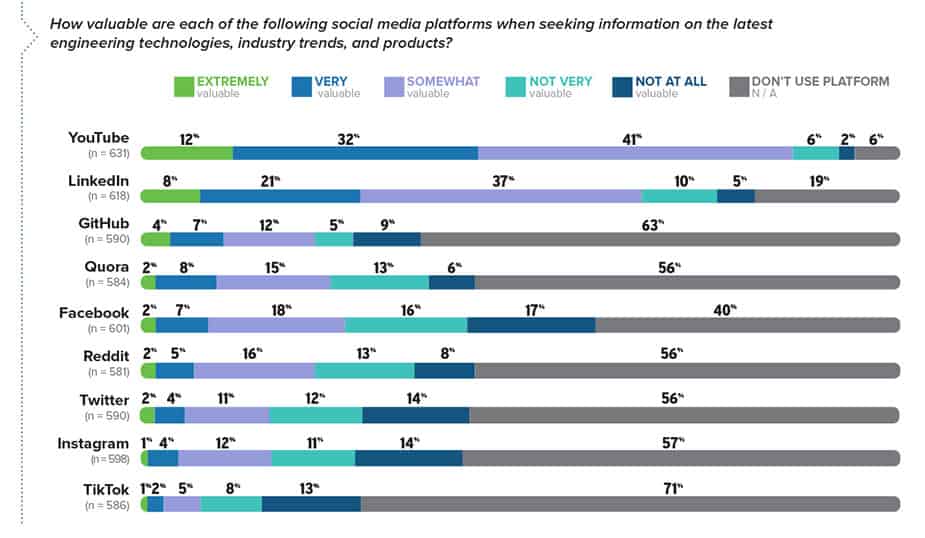
    Here’s a handy chart showing social media channels engineers use for work-related purposes. (Source: 2023 State of Marketing To Engineers, published by TREW Marketing and GlobalSpec)

    social media channels in industrial marketing

    Buyer personas: The specifier vs. the functional buyer

    Here’s something unique and different in industrial or manufacturing marketing. As a manufacturer of industrial components, you have to deal with two different types of buyers—Specifiers and Functional Buyers.

    A specifier is often a staff engineer tasked with gathering all the specs and ensuring they meet the design requirements.

    The Purchasing Department is the functional buyer that issues the RFQ or the PO only to suppliers on the Approved Vendor List (AVL) or whose parts are specified in the bill of materials (BOM).

    Unless the specifier “designs in” your part, you will not likely get that RFQ or a PO. The specifier may not have the final buying authority but ignore him/her at your peril.

    Consider creating an online library of 2D/3D CAD files. This is a proven manufacturing marketing strategy for parts manufacturers. See my earlier post, Using CAD and BIM Files in Manufacturing Content Marketing, for more on this topic.

    Building trust and credibility in the industrial sector

    Building trust and credibility is crucial for success in industrial marketing. Industrial buyers typically make decisions based on a combination of technical specifications, reputation, and trust in the supplier. This presents a unique challenge for marketers, as they must promote the features and benefits of their products or services and, at the same time, establish trust and credibility in the industry.

    This is probably the biggest challenge faced by manufacturing marketers that I’ve seen. You can’t build strong relationships based on earned trust with short-term marketing campaigns.

    A good solution to this challenge is to focus on thought leadership and educational content. Marketers can position themselves as trusted advisors in the industry by providing valuable insights and expertise through blog posts, whitepapers, and webinars. This approach helps build trust with potential buyers and establishes the company as a credible source of information and expertise.

    See How Industrial Marketing for Manufacturers Helps in Building New Relationships.

    Leveraging digital marketing strategies for manufacturing marketing

    Today’s buyers are in self-serve and self-select mode. Leveraging digital marketing strategies is essential for success in this environment.

    Your digital marketing strategy should include search engine optimization (SEO) to improve visibility in search engine results, paid advertising campaigns targeted at industry-specific keywords (I’ve seen my clients have limited success with PPC), advertising on industry portals, and social media marketing to engage with industrial professionals.

    Additionally, email marketing can be a highly effective strategy for nurturing leads and maintaining relationships with existing customers. By providing valuable content and personalized messaging, industrial companies can stay top-of-mind and drive repeat business.

    Utilizing content marketing to overcome industrial marketing challenges

    Industrial content marketing plays a crucial role in overcoming industrial marketers’ challenges. Manufacturers can attract and engage their target audience by creating and distributing relevant and valuable content. This can include blog posts, case studies, industry reports, and educational resources.

    Your content must convey that you understand their challenges and can provide effective solutions. Don’t produce content that is nothing more than thinly disguised product features. It must be more about them and less about you.

    While industrial marketing presents its own set of challenges, you can overcome them with the right strategies and tactics. Manufacturers can drive success and achieve their marketing objectives by understanding the unique characteristics of the manufacturing industry, identifying roadblocks, and implementing effective solutions.

    Let’s talk if you are facing some of these challenges and need help with industrial and manufacturing marketing. I’ll first listen to your concerns and then try to provide tailored marketing solutions to address your specific needs instead of serving up cookie-cutter theories. Together, we can overcome challenges and pave the way for your success in industrial marketing.

  • The Power of Digital Marketing for Manufacturers: Strategies and Tactics

    The Power of Digital Marketing for Manufacturers: Strategies and Tactics

    I am often asked to explain the differences between digital marketing for manufacturers and B2B marketing. I don’t assume anything and start from the basics. You may already know some of this stuff.

    As a manufacturer, you are always looking for ways to grow your business and increase your bottom line. One of the most effective ways to achieve these goals is through digital marketing. In this article, I will share some strategies and tactics that can help you leverage the power of digital marketing for your manufacturing company.

    Differences between digital marketing for manufacturers and B2B marketing

    When it comes to marketing, there are several differences between digital manufacturing marketing and B2B marketing.

    One of the fundamental differences between digital marketing for manufacturers and B2B marketing lies in their target audience. Industrial digital marketing caters to the needs of manufacturers and suppliers of industrial products and services. It involves creating content that speaks to this specific target audience’s unique challenges and needs. In contrast, B2B marketing targets businesses in a wide array of industries, including technology, healthcare, finance, and more.

    While B2B marketing focuses on selling products or services to other businesses, digital marketing for manufacturers is a more specific type of B2B targeting the industrial sector. Industrial digital marketing involves promoting products and services such as machinery, equipment, and materials used in the manufacturing industry.

    Another key difference between the two is the target audience. B2B marketing often targets decision-makers, such as CEOs or managers, while digital marketing for manufacturers targets engineers, procurement personnel, and other technical professionals involved in the buying process. As such, the messaging and content used in each type of marketing may differ to appeal to each specific target audience.

    In short, while digital marketing for manufacturers and B2B marketing share some similarities, they are two distinct concepts with different applications and target audiences. Understanding these differences is essential for businesses to develop effective marketing strategies catering to their needs and goals. Industrial marketing is a subset of the broader B2B marketing, but they are not the same.

    The specifier vs. the functional buyer

    Here’s something unique in industrial or manufacturing marketing. You may be dealing with two different types of buyers—Specifiers and Functional Buyers. Let’s say you are a manufacturer of industrial components or parts. A specifier, often a staff engineer, is tasked with gathering all the specs and making sure they meet the design requirements.

    The Purchasing Department is the functional buyer that issues the RFQ or the PO. They do so only to suppliers on the Approved Vendor List (AVL) or whose parts are specified in the bill of materials (BOM).

    Unless the specifier “designs in” your part, you will not likely get to the RFQ or a PO. The specifier may not have the final buying authority but ignore him/her at your peril.

    Consider creating an online library of 2D/3D CAD files. This is a proven manufacturing marketing strategy for parts manufacturers. See my earlier post, Using CAD and BIM Files in Manufacturing Content Marketing, for more on this topic.

    Why digital marketing is important for manufacturing companies

    In today’s digital age, consumers increasingly turn to the internet to research products and make purchasing decisions. This trend is no different in the manufacturing industry. As a result, manufacturers with a strong digital presence are more likely to be found by potential industrial buyers and generate more leads. Digital marketing for manufacturers is also more cost-effective than traditional marketing methods, such as print ads and trade shows.

    Understanding the manufacturing audience

    Understanding your audience is essential to market your industrial products or engineering services effectively. Your target audience may include engineers, procurement managers, or other decision-makers in the manufacturing industry. Understanding their pain points, needs, and preferences can help you create targeted marketing programs that resonate with them. Each stakeholder will have different content needs as they move forward in their buying journey.

    Developing a marketing strategy for manufacturing companies

    Developing a marketing strategy is important before you start your digital marketing efforts. Your marketing strategy should include your business goals, target audience, marketing channels, and budget. This plan will guide your marketing efforts and help you stay on track.

    Notice that a marketing strategy is not the same as a list of marketing tactics. This is a common mistake or an area of confusion. Since manufacturing content marketing is the most significant component of industrial marketing today, let’s focus on that. 88% of manufacturing marketers said they used content marketing successfully to achieve various goals – Source: 2022 Manufacturing Content Marketing, published by the Content Marketing Insitute (CMI).

    Key tactics for successful manufacturing marketing

    Several strategic tactics can help you succeed with digital marketing for your manufacturing company. These include:

    • Search engine optimization (SEO): Optimizing your website for search engines can help you rank higher in search results and drive more traffic to your site. (Keep in mind, a visit to conversion is not automatic).
    • Industrial content marketing: This is by far the most effective marketing strategy for manufacturers in the current environment where industrial buyers are in self-select and self-serve mode (It is difficult to reach invisible and anonymous buyers with cold calling and email blasts).
    • Email marketing: Email marketing is very much alive despite all the buzz about social media. It continues to be the most effective way to reach engineers and industrial professionals. Targeted email marketing is very different from “batch and blast” emails of the past. (51 percent of engineers prefer their initial salesperson interaction to be by email. Eighty-nine percent of engineers subscribe to at least one newsletter, while 54 percent subscribe to at least three newsletters. Source: 2023 State of Marketing To Engineers).
    • Video marketing: Video marketing is very popular with the industrial audience. Videos were the top content type produced and the top area of content marketing investment in 2022. The top three types of content created in the last 12 months were videos (86%), short articles/posts (83%), and virtual events/webinars/online courses (70%). Videos also were the content type manufacturing marketers said produced the best results. (Source: The CMI report cited earlier).
    • Social media: You must be realistic about social media and manufacturing marketing. Most engineers and technical professionals tend to be passive participants in social media. I’m not suggesting you ignore it, but use it judiciously to promote new content, be it blog posts, how-to videos, events, or announcements. LinkedIn is the organic social media platform that manufacturing content marketers used the most for distributing content (93%), followed by Facebook (86%) and YouTube (80%). (Source: CMI report).
    • Pay-per-click (PPC) advertising: This tactic is contentious. I’ve heard some of my clients complain loudly that it is a “money pit” that produces minimal results. 51 percent of engineers avoid paid search ads at all costs (Source: 2023 State of Marketing To Engineers). In my experience working with industrial companies, PPC can work if you manufacture and sell standard industrial products and consumables. However, if you make custom-engineered systems, PPC is an expensive tactic for driving traffic.

    Measuring the success of your industrial digital marketing efforts

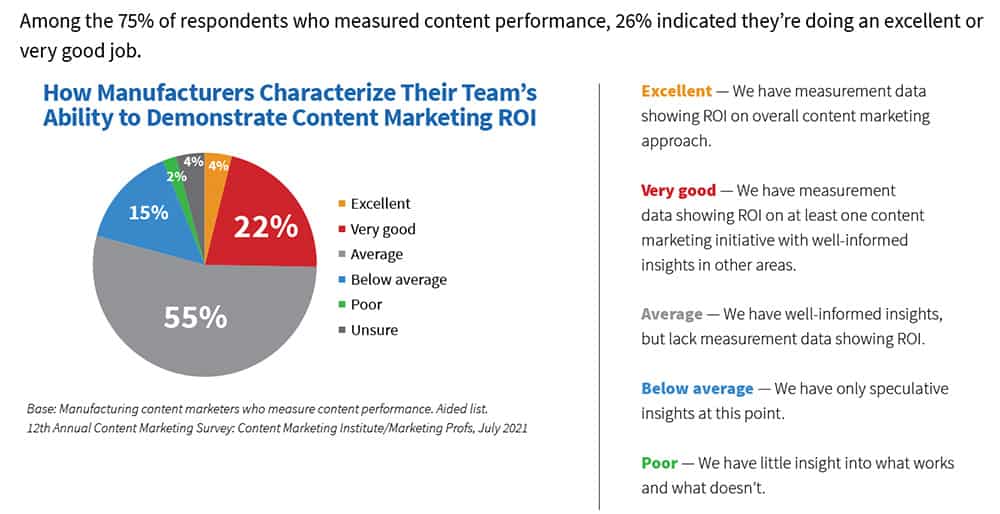
    Measuring the success of your digital marketing efforts is critical to understanding what’s working and what’s not. Unfortunately, it is often ignored other than a cursory look at Google Analytics to measure website traffic, email open and click rates, and other top-of-the-funnel statistics. You won’t know if your marketing strategy and tactics are working or not if you don’t measure. So take the guesswork out of the equation when it comes time to refine your strategy and/or abandon certain tactics that fail to produce results.

    This chart from the CMI report illustrates the problem of lack of measuring for proving marketing’s ROI.

    Benefits of working with a manufacturing marketing company

    Digital marketing is an ever-evolving field, and staying up-to-date on the latest trends and technologies can be challenging. Working with a specialized manufacturing marketing agency can help you stay ahead of the curve and ensure your digital marketing efforts are effective. In addition, an experienced manufacturing marketing expert can provide valuable insights into the latest strategies, tactics, and tools to help you reach your goals.

    You can maximize your digital marketing ROI by leveraging the agency’s specialized expertise, resources, and technology. With the right industrial marketing agency, you can create a robust digital presence that drives results for your business.

    To summarize this long post, digital marketing is a powerful tool for manufacturers to connect with their target audience of engineers and technical professionals and grow their businesses. Following the strategies and tactics I’ve provided in this post, you can develop an effective digital marketing strategy and use proven tactics that drive results for your manufacturing company.

    Let’s talk if you have questions about getting started or need to improve your digital marketing for manufacturers.

  • 6 Innovative Manufacturing Marketing Strategies

    6 Innovative Manufacturing Marketing Strategies

    Manufacturers have unique marketing challenges that other businesses don’t face. As a result, they must develop innovative manufacturing marketing strategies to reach their target audience to succeed. Engineers and technical professionals are two key audiences that manufacturers need to focus on. This blog post will discuss six innovative marketing strategies that manufacturing companies can use in their own marketing efforts.

    Understanding marketing strategies is vital if you’re a manufacturer looking to stay ahead of the competition and grow your sales. As technology advances and your customer base evolves, remaining relevant in today’s competitive global markets requires creative problem-solving and up-to-date marketing approaches.

    “58 percent of engineers said that the competitive landscape is global and competes 24/7.” (Source: 2021 Pulse of Engineering Survey published by GlobalSpec)

    Social media for manufacturing marketing

    That’s why I have gathered six innovative ways manufacturers can beef up their current manufacturing marketing strategy to remain competitive in their rapidly and ever-changing industries. Here’s my recommended list:

    1. Focus on trust-building through educational content
    2. Utilize modern social media channels for outreach
    3. Provide proof of concept to overcome skepticism
    4. Invest in video marketing to explain complex concepts and provide after-sales support
    5. Effective use of online advertising and PPC to reach targeted audiences
    6. Maintain top-of-mind awareness with email marketing and newsletters

    In this post, I will discuss each manufacturing marketing strategy and share my thoughts on implementing them to help you improve your industrial marketing.

    Provide Educational Content

    Create content that educates potential customers about your products, manufacturing processes, and how your products can help them solve their problems. Sometimes raising awareness of the problem is necessary before you can sell your solution. (See Problem-centric Industrial Marketing).

    Providing educational content about your complex engineering solutions is an invaluable step in the marketing process. It creates awareness for potential customers and educates them on the problem they are trying to solve.

    With educational material breaking down the more technical aspects of what you offer, customers can better understand how you may help them, allowing them to make informed buying decisions before investing in your products and services.

    Leverage Social Media

    Use social media platforms to share news and updates about your company and its products and promote new content. Engage with customers and potential customers when and where they hang out.

    Leveraging social media for manufacturing marketing is essential for businesses to reach engineers and industrial professionals. However, engineers tend to be passive participants on social media platforms, resulting in lower engagements from them compared to other industries.

    As such, manufacturers should have realistic expectations regarding engineers’ interactions on their social media channels since this audience likes to read and watch but rarely comment or share. With a well-assembled suite of content and valuable resources, engineers can become long-time brand followers since you allow them to access the helpful information they need and can use it in their daily work.

    Social media for manufacturing marketing

    (Source: 2023 State of Marketing to Engineers published by TREW Marketing & GlobalSpec)

    Utilize Testimonials and Case Studies

    When it comes to emphasizing the value of your product or service, case studies provide engineers with much-needed assurance to get over any skepticism they may have.

    Case studies are real-life stories from actual users and serve as proof of concept. Keep it simple—stick with a proven formula of a problem statement, the solution provided, and the results delivered. Try to be as specific as possible by adding statistics and quantifying results. Case studies are powerful tools that help you build credibility and trust with specifiers and key decision-makers.

    Testimonials have lost some of their value over time because people have lost faith in them since some of them are simply unbelievable. You can make yours more authentic and impactful by using video testimonials.

    Testimonials and case studies are both hard to come by because of restrictions from NDAs and customers unwilling to be seen as endorsing a vendor. However, there are ways to overcome some of the hurdles if you cannot name names.

    Use both judiciously to demonstrate the value of your product or service and show that you can deliver on your promises.

    Invest in Video Marketing

    Investing in video marketing can be highly beneficial for manufacturers. How-to videos are a great way to showcase the unique features of your products or services and how customers can use them.

    Adding how-to videos provide easy-to-follow steps on using your product and help to make complex concepts much easier to understand. As a result, they will increase visitor engagement.

    Additionally, this type of content is particularly effective for MRO professionals and field personnel, who can access these how-to videos anytime and gain the information they need 24/7. It is an easy way to provide after-sales support and increase brand loyalty.

    “Videos were the top content type produced as well as the top predicted area of content marketing investment for 2022. 86% of respondents [manufacturing content marketers] used videos for content marketing purposes in the last 12 months.”

    How-to videos used in manufacturing marketing

    (Source: Manufacturing Content Marketing – Insights for 2022 published by the Content Marketing Institute (CMI)).

    Focus on Targeted Digital Ads

    When advertising online, be sure to target specific audiences interested in what you offer rather than just casting a wide net without considering who will find it most useful/valuable. These advertisements will not only help you reach a more specific and receptive audience that is interested in what you are offering, it will also help to avoid wasting resources on users who are unlikely to convert.

    This is another area where you need to have realistic expectations. Online ads will raise brand awareness and drive traffic to your site from what I refer to as “curious clicks,” but don’t expect a high conversion rate.

    Many of my manufacturing clients complain about PPC ads being a waste of good money. They work well for selling industrial consumables like desiccants and spare parts but are ineffective if you manufacture custom-engineered systems. Therefore, these factors should all be considered when deciding whether paid advertising would benefit your company.

    Email Marketing and Newsletters

    Email marketing and newsletters do work even in this day and age of social media. These two tactics are very effective in maintaining top-of-mind awareness. But, of course, you don’t have to take my word for it. I’ll let the findings from CMI’s survey convince you.

    “The top four owned-media platforms that manufacturing marketers used in the last 12 months were their organization’s website, email newsletters, email, and blogs.”

    The use of newsletters in manufacturing marketing

    Still not convinced? Here’s one more chart. This one is from the 2023 State of Marketing to Engineers study I cited earlier.

    “Eighty-nine percent of engineers subscribe to at least one newsletter, while 54 percent subscribe to at least three newsletters.”

    Newsletter subscriptions by engineers

    Okay, that’s my short list of 6 manufacturing marketing strategies you can deploy. Your industry is constantly evolving, so focusing on putting your company in front of the right audience via digital marketing tools is essential.

    Ultimately, focus on the target audience’s needs when deciding how your message should be conveyed and create a solid and well-rounded online presence. Remember, if potential customers aren’t regularly exposed to what you do, they will forget you even exist.

    If the thought of putting in all this time and effort in strategy and implementation seems overwhelming, or if you need help developing an effective marketing strategy for the manufacturers, don’t hesitate to reach out to industrial marketing professionals who can guide you. Contact me and let me know how I can help.

  • 5 Manufacturing Content Marketing Hurdles and How to Overcome Them

    5 Manufacturing Content Marketing Hurdles and How to Overcome Them

    Are you a manufacturing or technical content marketer struggling to create good content that is seen and used by your target audience (Engineers and industrial buyers)? If so, you’re not alone.

    Many manufacturers face hurdles when it comes to content marketing, from gaps in knowledge and skillset to challenges with budgets and organizational buy-in. However, there are ways to overcome these challenges.

    In this blog post, we’ll explore five common manufacturing content marketing hurdles and suggest solutions for each one. By the end, you’ll have a plan of action for moving forward with your own content marketing efforts. So let’s get started!

    Before diving into the details, let’s examine what independent research shows about where engineers and industrial professionals seek information for work-related purposes.

    “82 percent of engineers go right to the source: supplier/vendor websites.” (Source: 2023 State of Marketing to Engineers)

    sources of information for engineers

    Let’s first talk about the elephant in the room—the lack of resources and/or budget. It is no secret that most manufacturing content marketers are asked to do more with the same resources. However, the good news is that a larger portion of the budget is now going to digital marketing.

    Okay, now that you know you are not alone in facing these challenges, let’s identify the major hurdles and how to overcome them.

    Defining your audience—who are you trying to reach with your content marketing efforts, and what do they want to see from you?

    Understanding your audience and their needs is crucial to manufacturing content marketing success. As manufacturing companies increasingly turn to this industrial marketing strategy to reach potential customers, it is essential to develop a good understanding of the target audience. This requires going beyond the basics—industry, company size, and job function. Digging deeper to get a better understanding of the audience you are trying to engage will give you a clear direction on the type of content you should create and how it should be presented.

    Taking the time to survey current and potential customers can help manufacturers determine the messaging that resonates with their core audience. That will solidify their understanding of who they are trying to reach, craft relevant content to engage them, and motivate them to take action. That’s how manufacturers can achieve their marketing and sales goals with content marketing.

    Developing a manufacturing content marketing strategy—what will be your voice and cadence?

    Developing a content marketing strategy is no easy feat. First, industrial companies must identify topics for the content they wish to create, how often they plan to publish it, and what they expect their readers to do after reading it. This requires careful consideration of the target audience’s preferences and the company’s business goals.

    “66% of manufacturing marketers reported that their organization has a content marketing strategy. Of those, 60% said their strategy is moderately or slightly different now versus pre-pandemic.” (Source: Manufacturing Content Marketing Benchmarks, Budgets, and Trends with Insights for 2022)

    While it might be tempting to anticipate trends to remain relevant, manufacturing brands should ensure that their content aligns with their core values and remains consistent over time. They may run into hurdles when launching their content marketing program, but proper research and understanding of the target audience will help them refine their content marketing strategy and improve their chances of success significantly. It is time well spent and undoubtedly worthwhile.

    Creating quality content—is the content well-researched and accurate?

    Crafting technical content regularly can be challenging. However, quality content is essential for engaging your engineering audience, who likely have expertise in the areas you want to write about. In addition, your audience expects to take away accurate information based on current trends and technologies they can apply in their daily work.

    Manufacturing marketers said their top three content marketing challenges were:

    1. Creating valuable content instead of sales-oriented content (51%),
    2. Overcoming the traditional marketing and sales mindset (51%)
    3. Accessing subject matter experts to create content (50%).

    (Source: The same 2022 Benchmark Report cited earlier).

    To overcome the hurdle of creating quality manufacturing content, it’s essential to spend time researching the technical aspects of the topic, use trusted and reliable sources to cite, create detailed checklists, and establish a review process with in-house Subject Matter Experts (SMEs) who can provide feedback and identify errors before publishing. Just don’t expect your SMEs to write the content for you.

    With the right level of preparation, accuracy, and compelling content, most manufacturers should be able to engage with their target audience effectively.

    Promoting your content—once you’ve created it, how will you get it in front of the people who need to see it?

    Once you’ve created high-quality content, the next step is to put it in front of your intended audience. A successful content promotion campaign should involve social media, industry portals, email campaigns, and more.

    It can be difficult for businesses to manage all these promotion channels on their own–social media alone can take up a lot of time and attention. For example, scheduling posts on social media should generally occur 2–3 times per day for at least a week after publishing new content. This will ensure that your followers in different time zones and in various parts of the world see your message when they are online.

    Despite the challenges posed by content promotion, there are ways to help manage the workload. Automation tools can save time and effort—these free-up resources to focus on the most important aspect: creating highly engaging, relevant content designed with their target audiences in mind.

    “Among the respondents who used paid social media platforms, the majority chose Facebook (76%) and LinkedIn (62%). Respondents said LinkedIn produced the best results.” (Source: The 2022 Benchmark Report).

    social media channels used by manufacturing content marketers

    Measuring success—What metrics to track, and what goals to set?

    When it comes to manufacturing content marketing, one of the essential steps in achieving success is having well-defined KPIs and metrics. It’s critical to take the time to define these clearly to accurately track and measure which elements are contributing to your business goals and identify those that need refining or eliminating.

    Track items such as page views, click-throughs, and conversion rates. While you need a minimum number of leads in the pipeline, the quality of leads is far more important than just quantity.

    Additionally, it helps to have realistic goals when measuring success; otherwise, you may be setting yourself up to fail even before your manufacturing content marketing gets off the ground. Measurable KPIs and realistic goals allow you to track the progress of your content marketing initiatives so you can refine them over time and increase your ROI.

    Regarding lead generation, I’ve seen too many manufacturers focus all their attention and efforts on generating top-of-the-funnel leads (Getting found in major search engines). You won’t use the full power of content marketing if that is only the goal. (See 3 Content Marketing for Manufacturers Myths Busted).

    Overall, manufacturing content marketing is a powerful way to reach potential customers in the manufacturing industry. The key is to create an effective strategy that can help you define your target audience, develop relevant content that meets their needs and interests, promote it effectively, and then measure the success of those efforts. Refine, rinse, and repeat!

    If you’d like to learn more about successful manufacturing content marketing practices and how to create a unique strategy for your business, I encourage you to explore this blog or contact me for a consultation.

  • What You Need to Know About Marketing to Engineers in 2023

    What You Need to Know About Marketing to Engineers in 2023

    Marketing to engineers has always been a challenge. Fine-tune your industrial marketing armed with research findings and knowledge about how engineers and technical professionals make buying decisions. I’ve downloaded the 2023 State of Marketing to Engineers report published by TREW Marketing in partnership with GlobalSpec. It is packed with valuable research data and expert opinions.

    Understanding the survey audience for marketing to engineers

    Before we dive into the data, let’s understand the survey audience. One can find plenty of B2B marketing information online, but it is not easy to find data on engineers and industrial buyers. The survey respondents either make the final buying decision and/or strongly influence it. That’s why I liked the focus of this report instead of relying on answers from marketers.

    I’ve combined two charts from the report to give you a quick summary of the engineering audience.

    Survey demographics of marketing to engineers

    Job Function plays an important role at different stages of the buying journey. The chart below is from an earlier survey report.

    Job function in marketing to engineers

    Read my post, Industrial Content Marketing that Engages Engineers, to learn more.

    What information sources do engineers rely on for work-related decisions?

    It shouldn’t surprise you that most engineers (82%) go straight to vendor/supplier websites. However, that doesn’t mean you can ignore other sources that your technical audience uses. Pay attention to the chart below to understand the different channels where you need to maintain a strong presence.

    Notice how email newsletters are sort of middle of the pack. Nevertheless, don’t discount their effectiveness in 2023. I say this based on my own experience working with manufacturers and engineering companies. The research data also validate my experiences.

    89% of engineers subscribe to at least one newsletter, while 54% subscribe to at least three newsletters.

    89% of engineers subscribe to at least one newsletter

    If you have a small list or need to expand your market reach, it may be more effective to ride the coattails of highly-respected industry publications or portals. They have a captive audience of engineers and technical professionals who have given their permission to receive newsletters and are eager for helpful information from suppliers.

    Content preferences of engineers and industrial buyers

    This audience uses a variety of content in their buying journey. The most helpful content is Datasheets, which have consistently remained the #1 source for several years (See chart).

    Content preferences of engineers

    What was missing earlier were CAD drawings. I refer to this type of content as “sales enablers” because 82% of CAD/BIM downloads turn into actual sales. You can’t argue against those numbers for getting results from industrial content marketing. (Read the post, Using CAD and BIM Files in Manufacturing Content Marketing).

    SEO, search rankings, and paid ads

    Did you know that 43% of engineers will filter through at least five pages of search results to find the information that is relevant to their search? Getting to page 1 in Google search results is great and takes a lot of hard work and knowledge.

    You can see engineers tend to go well beyond the first page of search results to find information that is relevant to them. So don’t obsess over first-page rankings. Instead, focus on creating content that addresses the challenges engineers face in their daily work.

    Engineers go beyond the first page of search results

    I can hear the frustrations in the voices of my manufacturing clients when discussing Pay Per Click ads (PPC). They’ve spent lots of money on PPC but haven’t really seen the results. They ask me if they should continue. Unfortunately, it is not possible to give a quick and pat answer that is right for everyone. The truth is that one needs to do a complete PPC audit to discover the problems before deciding whether it is the right strategy.

    Here’s what the survey found about how engineers use PPC ads.

    51% of engineers avoid paid search ads at all costs. However, if a paid link demonstrates a direct connection to a search inquiry or links to a familiar site, 44 percent will click.

    How engineers interact with PPC

    Getting back to the point about search engine optimization (SEO), I’ve seen too many industrial companies base their entire website redesign and/or content marketing strategy on “being found on page 1 of Google.” You are not using the full power of manufacturing content marketing if SEO is your sole objective. That may sound counterproductive, but it is an area that is often misunderstood.

    If you’ve been a regular reader of this blog, I thank you; you already know SEO is not all there is to it. I’ve written several articles about this problem. Let me point you to two:

    1. Industrial Marketing is Not Just for ToFU
    2. How Industrial Companies are Stuck on SEO for Content Marketing Strategy

    Win the mindshare of engineers with technically accurate content and published under the names of your in-house Subject Matter Experts (SMEs). Don’t expect your SMEs to write the content because they are busy doing what they do best. Read my post, Industrial Blogging Lessons Learned from Working with Technical SMEs, if you need help.

    As a manufacturing content marketer, you must learn to extract the key talking points locked in their heads, Then develop bullet points into cohesive content. Consistently creating such content is not easy. Refer to Technical Content Writing is Challenging for Manufacturing Marketers.

    Armed with the research data and my comments with links to additional articles, you should be better prepared for marketing to engineers in 2023.

  • 3 Content Marketing for Manufacturers Myths Busted

    3 Content Marketing for Manufacturers Myths Busted

    There are a few misconceptions or myths surrounding content marketing for manufacturers. I say this based on my hands-on experience working with manufacturers every day. In this post, I’ll mention the three most misunderstood concepts.

    Myth #1: Content marketing for manufacturers is all about SEO

    Manufacturing content marketing will certainly help in improving your organic SEO results. You may not be using the full power or the potential of content marketing for manufacturers if your entire strategy for content marketing for manufacturers is based on Search Engine Optimization (SEO), as in getting “found in Google.”

    Don’t get me wrong, high visibility in search results is crucial and challenging to achieve. After all, what good is your content if nobody can find it?

    The problem is that not everyone who finds your site in search engines will click and visit, and those who do may not convert into leads. So don’t assume that visitor conversions are automatic just because your site appears in Google.

    Remember, search engines don’t convert into customers, so create content for human visitors first and let the search engines follow. Not the other way around.

    Myth #2: The number of leads is the best KPI for measuring the success of manufacturing content marketing

    Every manufacturer I know wants to generate more leads from content marketing. However, you may be surprised by the goals achieved by manufacturers in the past 12 months. Here are the results from the most recent survey, Manufacturing Content Marketing – Insights for 2022, published by the Content Marketing Institute (CMI).

    Goals achieved by manufacturing content marketers

    Lead generation was middle of the pack at a little over 50% (55%). Brand awareness, building trust, and educating the audience were all above that goal. The top three goals play important roles in creating good leads. They are interrelated. See How Industrial Marketing for Manufacturers Helps in Building New Relationships.

    Converting visitors into leads happens only after engineers and industrial professionals begin to trust your content and find it relevant to their needs. Only then will they subscribe to your list and/or contact your salespeople.

    That’s why your manufacturing content marketing strategy must be based on the entire sales funnel and not just ToFU (Top of Funnel) activities. Traffic by itself means zilch if you can’t convert it into real opportunities. Therefore, understanding the difference between discovery optimization (SEO) and conversion optimization (CRO) is very important.

    Not all leads are the same. This is especially true in industrial sales, where sales cycles are long, and many stakeholders are involved in buying decisions. Turning new leads into sales is not straightforward. Read my earlier post, Industrial Lead Generation for Sales – It’s Complicated!

    Myth #3: Industrial content marketing is just another campaign

    This one is a biggie! The most common question I hear is, “Why does it take so long to produce results?”

    You probably already know the answer, but it is worth repeating, “Industrial content marketing is a process and not a one-off campaign.” Let me expand on that a little bit to provide some clarity. It can take anywhere from 6 to 9 months, depending on the competition and the state of your marketing.

    Unfortunately, that truth doesn’t sit well with executives at manufacturing companies. Their mindset is still very sales-centric. Fair enough, the bottom line does matter in any business.

    Of course, you can improve interim results such as site traffic, new users, average session duration, and reduced bounce rate. Those are all good stats from Google Analytics but mean very little to the higher-ups if you cannot show how they relate to sales.

    It is a constant struggle for Marketing to connect the dots between their efforts and sales. That’s not just my observation.

    The same CMI report found that “Manufacturing marketers continue to face content marketing challenges within their organizations: 51% said they are challenged with creating valuable content instead of sales-oriented content as well as with overcoming the traditional marketing and sales mindset.”

    I’m upfront with my industrial clients by telling them that content marketing for manufacturers is not a quick fix for slow sales. Instead, I recommend they consider other options if they are not prepared to invest the time and money to do content marketing correctly over the long haul.

    As a corollary to myth #3, I’ll add that content creation is not the same as content marketing. It is not just a matter of copywriting and or clever wordsmithing.

    Creating optimized customer-centric content that’s presented logically and validates claims requires additional skills such as:

    • A deep understanding of the buyer’s journey (Engineers and industrial buyers)
    • Skills to prepare for interviewing Subject Matter Experts (SMEs) to extract the key talking points
    • Keyword research and keeping up with ever-changing search engine algorithms
    • Knowledge of white hat SEO and link building
    • Being a ruthless editor to remove unnecessary filler words
    • Taking the time to let SMEs review your content before publishing
    • Content distribution that’s more than just social sharing

    It is not just a matter of outsourcing technical content creation. 60% of manufacturers reported that finding partners with adequate topical expertise is their top challenge.

    Now you know and can separate facts from myths regarding content marketing for manufacturers.

  • To Gate, or Not to Gate, That is the Question in Manufacturing Content Marketing

    To Gate, or Not to Gate, That is the Question in Manufacturing Content Marketing

    Gated content is the most common way for manufacturers to generate leads from industrial websites. If you are not familiar with the term gated content, it refers to content that needs the reader to fill out a form and submit it before either downloading or reading the full version.

    Obviously, you can’t gate all your content without seriously pi***ng off your readers. So, the question is, what content should you gate?

    There isn’t a simple answer because what you may consider valuable, your readers may not perceive it the same way. So, they may not see it as a worthwhile value exchange.

    What gated content do engineers and industrial buyers consider valuable?

    If you use gated content such as white papers, e-books, etc., you know they usually work well at the top of the funnel for Marketing Qualified Leads (MQLs). However, instead of guessing, let’s look at the findings from an independent research study—2022 State of Marketing to Engineers.

    gated content for engineers

    Don’t miss the last item on the chart, some industrial professionals just won’t fill out a form, period.

    Avoid increasing resistance in your sign-up forms

    There is always the temptation to ask for all information you can get from a gated content. Don’t! The more fields you have on your sign-up forms, the greater is the resistance of your readers to complete them. Or they may just fill out garbage information just to gain access to the content. For example, don’t ask for a phone number for someone to download a PDF. Using progressive fields in your forms is a better solution.

    Going back to an older research report from 2020, the increasing resistance of engineers to the number of fields in a sign-up form is very clear. (Source: 2020 Smart Marketing for Engineers).

    “Engineers are most likely to complete the following form fields on a company’s website: work email address (84 percent); first name (82 percent); company name (70 percent); and last name (69 percent). Conversely, engineers are least likely to provide mobile phone number (20 percent) and purchase timeframe (17 percent).”

    fields most likely to be filled by engineers

    Challenges of creating valuable content in manufacturing marketing

    In my previous post, Marketing to Engineers—Why Digital is the Dominant Strategy, I wrote about the value of product datasheets. In fact, engineers consider them the most useful when researching work-related purchases. However, your readers expect these to be freely available and not gated.

    Most manufacturing companies I’ve worked with have a sales-oriented mindset. It is difficult for key decision-makers in these organizations to think about content marketing as setting the table for Sales.

    That’s not just my experience with manufacturing content marketing for industrial lead generation. According to the 2022 Manufacturing Content Report published by the Content Marketing Institute, the top three challenges are:

    1. Creating valuable content instead of sales-oriented content (51%)
    2. Overcoming the traditional marketing and sales mindset (51%)
    3. Accessing subject matter experts to create content (50%)

    Using gated content as sales enablers

    Refer to the first chart in this post—CAD Drawings are the second most valuable gated content for engineers. There are very good reasons for that. These are critically important to manufacturers of industrial components and parts. I’ll cite three of them from the report, 6 Digital Essentials for Selling & Marketing to Engineers & Architects published by CADENAS PARTsolutions.

    1. 65% of engineers & architects see native CAD/BIM models as the #1 criteria for part selection
    2. 80% of designers bounce before contacting a supplier with limited CAD or BIM data
    3. 82% of CAD/BIM downloads convert into physical product sales

    A robust online e-Catalog solution is a huge timesaver for engineers who are already time challenged. For more on this, read my earlier post, Using CAD and BIM Files in Manufacturing Content Marketing.

    I have also seen other content assets that are used effectively as sales enablers. Not all of them are gated either.

    • Online configurators
    • Valve and pump sizing programs
    • Part number guides for cross referencing
    • …and many more

    Another trend that I have seen is for some manufacturers and industrial distributors using e-commerce to sell directly. This works great for standard products. A combination of e-commerce solution with a configurator works well for custom engineered systems where you build a detailed RFQ instead of adding it to a cart and checking out.

    Making sales teams more productive with the right content

    This is more of an internal issue between marketing and sales teams. I’m sure you’ve heard and read a lot about how the two need to play together nicely. The reality is that it takes a lot of hard work and willingness for both parties to make that happen.

    I recently downloaded an excellent guide called, The Complete Guide to Sales Content Management, published by Allego. Here’s a direct quote from their guide: “Your first priority is to deliver the best content that will move deals through the pipeline. But, too often, this content never sees the light of day. Research shows that reps spend 10+ hours a week searching for customer-ready material when content is scattered or lost in silos.”

    The main reasons they provide for this underutilization are:

    • Sellers don’t really like the content and think it’s not relevant, too long, too short, etc.
    • Sellers don’t know there is new content and keep using old, familiar pieces
    • Sellers can’t find new content when they need it
    • Sellers don’t know how to use the content or understand its value in the sales process

    The key takeaway is—Manufacturing marketers can’t focus only on lead generation; they also need to help their sales team use the content they create effectively to become more productive.

    You should have a good overview of gated vs. ungated content in manufacturing marketing now that you have read this post to the end; I thank you for it.  

  • How Manufacturing Content Marketers Can Reduce Stress on Engineers

    How Manufacturing Content Marketers Can Reduce Stress on Engineers

    Manufacturing content marketers can really help reduce the stress on engineers. I’m not being facetious or trying to be clever with my headline. Don’t believe me? Let me explain how.

    First, let me give credit where credit is due. I’ve used three resources for citations in this post. They are:

    1. 6 Digital Essentials for Selling & Marketing to Engineers & Architects, published by CADENAS PARTsolutions
    2. 2021 Pulse of Engineering Research Report published by GlobalSpec
    3. Manufacturing Content Marketing, 2022 Insights published by the Content Marketing Institute (CMI)

    Why are engineers stressed at work?

    The simple fact is that engineers are time-challenged. I’ve written about this issue in my previous posts. Here’s a direct quote from the CADENAS report…

    “Engineers in today’s environment are faced with countless challenges. For example, shorter production times coupled with an increasing in demand for unique solutions multiply the workload for engineers. To exacerbate the situation, engineers are constantly under pressure to cut costs in the design process as well as simplifying the manufacturing of their designs by sourcing off-the-shelf components (COTS).”

    The data from GlobalSpec’s Pulse of Engineering report corroborates the above quote. They reported the following:

    • 58% of engineers surveyed said that the competitive landscape is global and competes 24/7
    • 73% said designs are becoming more complex/sophisticated
    • 64% said time-to-market pressures have increased
    • 58% report that design cycles are shrinking

    The time-crunch problem is not new but has grown over the past few years. In addition, the pandemic has worsened the situation in the last two years.

    How can manufacturing content marketers help alleviate the problem?

    There are several things you can do to help engineers and technical professionals. One of the top items on my list would be offering a robust online library of downloadable CAD and BIM files. This strategy will save them time, improve design accuracy and eliminate some repetitive tasks engineers hate doing anyway.

    Component manufacturers also benefit from offering downloadable CAD/BIM files. Look at this chart to see how they translate directly to sales. Hard to argue against these numbers.

    CAD?BIM files used by manufacturing content marketers

    Manufacturing content for educating less experienced engineers

    Engineers and other industrial professionals regularly search for and want high-quality technical content they can rely on. They consider technical documentation, software and development tools, product specifications, and datasheets necessary in doing their work.

    Younger and less experienced engineers have a strong desire to learn about the latest trends in their field of work and keep their technical knowledge up-to-date. Sometimes they also need mentoring since they lack the hands-on experience of senior engineers. In-house resources have become scarce because of retirements and cutbacks.

    The GlobalSpec survey found that only 39% of manufacturers had formal practices for senior-level and specialized experts to train, transfer, mentor, or pass on their knowledge to younger engineers.

    As a result, these younger engineers look to their suppliers to fill the internal knowledge gap. Manufacturing content marketers can help by creating online training courses, webinars, e-books, guides, and white papers.

    Knowledge gap in industrial and manufacturing companies

    See my post, Marketing to Millennial Engineers, for more on this topic.”

    How can manufacturing content marketers produce results?

    As a manufacturing content marketer, you need to prove ROI to get budget approvals. While reducing stress for engineers is a worthy goal, that alone won’t get you too far with upper management.

    Downloadable CAD/BIM files are strong sales enablers, but what else can you do to generate results? Videos and webinars have proven themselves over the past 12 months. That was one of the key findings from the report published by CMI.

    “Videos and virtual events/webinars were big over the last 12 months with the manufacturing marketers we surveyed. In addition, 85% expect continued investment in video in 2022, making it the top area of predicted investment.”

    Videos and online events are popular for industrial content marketing because they are effective with the technical audience. Results speak for themselves. Look at this chart from the CMI report for proof.

    Use of videos and webinars in manufacturing content marketing

    As you can see from this post, there is a lot manufacturing content marketers can do to reduce stress on engineers while producing tangible and measurable results.

  • Manufacturing Content Marketing—The Year It Was and Looking Forward

    Manufacturing Content Marketing—The Year It Was and Looking Forward

    I just received an advance copy of Manufacturing Content Marketing Benchmark, Budgets, and Trends (Thanks, Amanda!) published by the Content Marketing Institute (CMI). The timing couldn’t be any better, since many of my manufacturing and engineering clients are putting together their industrial marketing plans and budgets for 2022.

    Refer to my post, Industrial Marketing: What Manufacturers Need to Know if you need a quick refresher.

    Let’s first look back at 2021 to see what manufacturing marketers did during the year. As the saying goes, “Those who cannot remember the past are condemned to repeat it.” (George Santayana). Of course, I’m not talking about history repeating itself, but we do gain valuable insights by looking back.

    Post-pandemic manufacturing content marketing

    Let me start with a direct quote from CMI’s report because they’ve summed it up very nicely.

    “This year’s research suggested that the pandemic awoke a sleeping giant – content marketing, that is. Without in-person events and face-to-face selling, many who had previously paid little attention to content marketing suddenly became aware of its power.”

    What kinds of content did manufacturing marketers create in 2021? CMI surveyed manufacturers from a range of industries, functional areas, and company sizes worldwide. They found that 86% of survey respondents used videos for content marketing purposes in the last 12 months.

    Content assets used in manufacturing content marketing

    Using videos as part of manufacturing content marketing aligns very well with the way engineers and technical professionals use content in their daily work. The 2021 State of Marketing to Engineers reported that 96% of engineers watch videos weekly for work. (Work-related videos and not the naughty kind. 😉)

    It is not just that videos are popular with engineers; they produced the best results in 2021 using content marketing, with how-to videos leading the way at 52%.

    Results produced with manufacturing content marketing

    In 2021, manufacturing marketers used content to achieve a variety of goals. Lead generation was not the #1 goal, though I believe everything works together in generating better quality leads.

    Goals achieved by manufacturing content marketers

    Budgeting and planning for 2022

    Let’s look forward to see what manufacturing content marketers are expecting and planning for the next year. Of course, marketing budgets are always at the top of everyone’s mind. There’s some good news here – 64% expect their 2022 content marketing budget to increase over their 2021 budget. That is a significant change from 2021 when only 36% expected their content marketing budget to increase over the previous year.

    Manufacturing content marketing budgets 2021 vs. 2022.

    Where will manufacturing content marketers spend their marketing dollars? Not surprisingly, a whopping 85% of the manufacturers will invest in videos in 2022. Events (digital, in-person, hybrid) is second place at 68%.

    Investments in areas of manufacturing content marketing

    Here’s something you may not have expected, in a post-COVID-vaccine business environment, investment in in-person events is expected to increase by 56%, that’s more than the increases in Digital/virtual events (27%) and Hybrid events (31%). Have we come a full circle?

    Manufacturing content marketers will face challenges in 2022. That has been the case for several years now, but the challenges have changed over the years. In the 2021 survey, manufacturing marketers who outsource at least one content marketing activity (Content creation was the activity outsourced most often at 80%) said their biggest challenge was finding partners with adequate topic expertise (61%).

    That is an important finding because I’ve had conversations with manufacturers frustrated with the quality of technical content they get back when outsourcing to freelance copywriters. Another source of confusion is a lack of understanding between content creation and content marketing. Just publishing content won’t move the needle for industrial companies.

    Challenges manufacturing content marketers will face in 2022

    This is my summary of CMI’s report. Do download it for more statistics. Stay tuned for future posts where I’ll dissect and analyze important sections from the 2022 Manufacturing Content Marketing report.