Category: Website Design & Development

  • Industrial Website Design: Real-World Answers to 9 Common Questions from Manufacturers

    Industrial Website Design: Real-World Answers to 9 Common Questions from Manufacturers

    You can enter any of these questions on industrial website design into Google, and you’ll probably get your answers. Most are summarized versions of online articles written for a general audience. It’s up to you to decide if—and how—those ideas apply to your specific situation.

    What follows are real questions my clients ask me regularly, along with answers drawn from more than three decades of hands-on experience working exclusively with manufacturers, distributors, and engineering companies.

    Straight from the horse’s mouth, so to speak.

    What Makes Industrial Website Design Different from Other B2B Websites?

    Having worked with the industrial sector for over 35 years, I can tell you that an industrial website isn’t just another B2B site dressed up with technical jargon. It serves a far more demanding audience.

    Engineers, plant managers, and technical buyers expect accuracy, speed, and proof—not marketing fluff. The site must:

    • Deliver technical depth. Product data, CAD drawings, performance specs, and compliance documentation must be easy to access.
    • Support complex buying decisions. Industrial purchases often involve multiple stakeholders, long cycles, and detailed comparisons.
    • Educate while qualifying leads. The website has to guide visitors from early research through RFQ without overwhelming them.

    Design aesthetics matter, but usability, navigation logic, and content hierarchy matter more. An effective industrial website is engineered for usability, search visibility, and lead conversion—built to attract skeptical technical audiences and earn their trust.

    Read my blog: Reengineering Your Industrial Website into a Sales-Driven Asset.

    Why Is Strategic Planning Before an Industrial Website Redesign So Important?

    Many manufacturers come to me thinking a website redesign starts with a layout or a theme. In reality, it begins with strategy. Without it, you’re simply putting a fresh coat of paint on an outdated structure.

    An industrial website redesign has too many moving parts to be treated as a cosmetic update. It involves:

    • Complex product categories that require organized taxonomy and data management.
    • Multiple decision-makers—engineers, procurement, and management—each with distinct information needs.
    • A lead generation framework that must integrate with CRM systems, automation tools, and analytics.

    That’s why every successful project I’ve led begins with a strategic discovery phase—a fact-finding process that defines your audiences, messaging, and measurable goals before a single page is designed.

    At Tiecas, we use a Strategic Roadmap to connect your website’s design decisions to your business objectives. This ensures alignment between Marketing and Sales, improves lead quality, and prevents the endless revisions that come from skipping strategy.

    Simply put, strategy drives design, not the other way around.

    What Are the “Must-Have” Features to Reach Engineers and Technical Buyers?

    Engineers and technical professionals don’t respond to hype; they want clarity, credibility, and data. Your website needs to prove you understand their real-world challenges before they’ll consider doing business with you.

    From my experience, these are the essential elements that consistently attract and engage technical audiences:

    • Real-world application examples. Show how your products solve problems, not just what they’re made of.
    • Fast, logical navigation. Organize content the way engineers think—by function, specification, or industry—not by your internal org chart.
    • Optimized performance. Many engineers view websites from the shop floor or field on mobile devices; slow pages cause them to lose interest instantly.
    • Clear conversion paths. Quote request forms, “Ask an Engineer” links, distributor locators, or configurators should be easy to find and quick to use.
    • Add sales enablers (This is a biggie). Earlier, I mentioned CAD drawings. Adding an online library of downloadable CAD files in various formats is a valuable time-saver for engineers and minimizes design errors. More importantly, your industrial component gets “designed in,” moving you one step closer to the RFQ/RFP.

    Here are some third-party data to validate my last statement. My source—The Engineering Survey Report by CADENAS.

    • 66% of engineers consider native CAD/BIM models as the number 1 criterion when selecting components.
    • 79% look for alternatives instead of contacting manufacturers with inadequate CAD / BIM data

    Another very effective strategy I have found is to add an online product configurator. For example, a manufacturer of industrial valves offers an online actuated valve configurator that enables buyers to create an automated valve assembly with just a few clicks. All options, prices and part numbers change in real-time.

    The right design supports your technical credibility while simplifying a complex buying process. In my experience, that combination is what turns anonymous visitors into qualified leads.

    If your industrial website is not producing the results you want, you may want to read What to Do When Your Manufacturing Website Is Underperforming.

    Are the Content and Features the Same as Other Websites?

    Absolutely not. Industrial website content serves a very different purpose from general B2B or corporate marketing copy. It’s not about catchy slogans or emotional storytelling—it’s about credibility, precision, and utility.

    Here’s what I’ve learned:

    • Accuracy comes first. Engineers expect every number, tolerance, and specification to be correct. Even minor errors can undermine trust.
    • Organization is critical. Dense technical data must be structured logically and easy to scan—no one wants to dig through PDFs to find a material grade or flow rate.
    • Educate, don’t oversell. Industrial content should explain how and why your products solve specific problems, not just list features.
    • SEO requires a specialized approach. Instead of chasing high-volume keywords, focus on long-tail search phrases engineers actually use—part numbers, standards, or process-specific terms. This is especially true in this era of AI Overviews and ChatGPT, as well as other AI tools.

    This combination of technical accuracy and buyer-focused communication is what makes industrial content so challenging—and why it’s rarely done well by general B2B agencies.

    The focus should be on content, not just aesthetics. Read “How Technical Content Writing Drives Success in Manufacturing Content Marketing.”

    How Can I Differentiate My Company When We All Sell Similar Products?

    That’s one of the most common—and most difficult—questions I hear from manufacturers. When everyone sells similar products with comparable specs and certifications, differentiation can’t come from the product alone. It must come from how you communicate your technical expertise and build trust with engineers and buyers.

    In my experience, the strategy of “one engineer to another” is incredibly effective. What do I mean by that?

    Bring your in-house Subject Matter Experts (SMEs) to the forefront. Let your marketing team handle the heavy lifting—writing, editing, and optimizing content—but the technical voice should come from your engineers, not from anonymous marketing copy. This approach humanizes your company and instantly establishes technical credibility.

    I’ve seen this firsthand with multiple clients. In fact, I wrote about it back in 2013, and that blog still attracts steady organic traffic today: Industrial Blogging Lessons Learned from Working with Technical SMEs.

    When engineers see content written or endorsed by their peers, they trust it. That trust is the foundation of true differentiation in industrial marketing.

    How Can I Compare Website Design Proposals When Prices Vary So Widely?

    This question always comes up once manufacturers start collecting quotes. It’s not unusual to see proposals that range from a few thousand dollars to several tens of thousands of dollars. The problem is, those numbers often represent completely different deliverables.

    In my experience, a low-cost quote typically means you’re purchasing a template and some page layouts, rather than a strategic sales and marketing tool. A higher-priced proposal, if done right, includes planning, content development, SEO, and integration—all the elements required to make the site perform.

    Here’s what I tell clients to look for when evaluating proposals:

    • Does it include discovery and strategy? Without this, you’re skipping the foundation of your entire project.
    • Who will create and optimize the content? Technical content development is often the most challenging and time-consuming aspect of an industrial website.
    • Will it integrate with your CRM or automation tools? If not, you’re missing the opportunity to measure ROI and track Marketing’s contribution to sales.
    • Does the agency understand your world? Ask for examples of industrial websites they’ve built. Experience in your sector matters more than slick design portfolios.

    At Tiecas, our Industrial Website Design projects always begin with strategy and content before design. That’s why clients get measurable results—not just a new look.

    Read our case study: Developing an Industrial Marketing Strategy for a Manufacturer.

    Why Can’t I Just Buy a Theme and Customize It?

    This one comes up more often than you’d think, especially from smaller manufacturers who’ve been burned by “affordable website packages.” On the surface, buying a theme and customizing it sounds like a smart way to save time and money. In reality, it’s almost always a false economy.

    Most off-the-shelf templates are designed for visual appeal rather than industrial functionality. They’re built for B2C companies, rather than specifically for manufacturers that need to publish complex technical data, multi-layer navigation, or downloadable resources such as CAD drawings and spec sheets.

    Just adding industrial stock images won’t cut it.

    I’ve been brought in to fix many of these situations—and rebuilding always costs more than doing it right from the start.

    Your website isn’t just a marketing tool; it’s a sales enablement platform and often your first point of contact with engineers. It needs to be custom-engineered to reflect your expertise, not assembled from a theme designed by someone else for a different industry.

    Learn more: Industrial Website Design for Manufacturers and Industrial Companies.

    How Long Should an Industrial Website Redesign Take?

    I wish I could give you a simple answer, but the truth is—it depends on how prepared your team is. Most manufacturers underestimate the time required because they assume a website redesign is primarily a design exercise. It’s not.

    A successful industrial website project requires gathering and organizing large volumes of technical content, coordinating with multiple departments, and validating details that engineers and buyers will rely on.

    From my experience, a realistic timeline ranges from three to six months, depending on factors such as:

    • Scope and complexity. The number of product categories, technical resources, and pages to migrate.
    • Availability of content. If product data, drawings, or photos aren’t ready, the schedule will stall quickly.
    • Internal review process. Marketing, Sales, and Engineering each need to sign off on different elements.
    • Integration and testing. Lead forms, CRM connections, automation tools, and, in some cases, back-end integration with ERP systems must all function flawlessly before launch.

    I’ve seen projects finish faster—but only when there’s a clear roadmap, a single point of contact, and everyone understands their role. Skipping these steps just means you’ll spend more time and money later, fixing what was rushed.

    For a detailed discussion of timelines and budgeting, read: How to Plan and Budget for an Industrial Website Redesign—A Guide for Manufacturers and Industrial Companies.

    What Makes an Industrial Website Sales-Driven Instead of Just Attractive?

    Pretty websites don’t sell industrial products—purposeful websites do. The difference lies in how well your site supports the sales process and aligns with how engineers and technical buyers make decisions.

    A sales-driven industrial website is built around function, not flash. The most effective industrial websites function as digital sales assets, empowering your team with qualified leads and actionable insights—not as static brochures that need a “fresh look” every few years.

    Learn more: Industrial Website Design for Manufacturers and Industrial Companies.

    Final Thoughts

    You can find endless online advice about industrial website design—but only experience shows what truly works in the real world. These questions aren’t theoretical; they come directly from manufacturers, distributors, and engineering companies I’ve worked with for years.

    An industrial website redesign isn’t about aesthetics. It’s about creating a sales-ready, technically accurate platform that reflects your expertise and delivers measurable results.

    If you’re planning a redesign, let’s talk. I’ll help you build a website that attracts engineers, converts technical visitors, and strengthens alignment between Marketing and Sales.

  • Your 2026 Industrial Marketing Plan Starts Now—How to Finish 2025 Strong and Set Up for Growth

    Your 2026 Industrial Marketing Plan Starts Now—How to Finish 2025 Strong and Set Up for Growth

    Are you working on your 2026 industrial marketing plan?

    As 2025 winds down, many manufacturers are still focused on closing the year strong—wrapping up campaigns, meeting sales goals, and managing budgets. But this is also the ideal time to shift your attention forward. The most successful industrial companies don’t wait for January to plan; they start in Q4, using lessons from this year to fine-tune their approach for the next.

    A solid industrial marketing plan for 2026 isn’t just a checklist of tactics. It’s a roadmap built on data, aligned with sales, and grounded in what truly drives results—high-quality leads and measurable growth.

    That’s especially critical now, when engineers and technical buyers spend about 60% of the buying process online before ever contacting a vendor, according to the 2025 State of Marketing to Engineers Report by TREW Marketing and GlobalSpec.

    For manufacturers, this means your digital presence—your content, website, and credibility—often speaks long before your sales team does. That’s why now is the time to review your strategy, assess what worked (and what didn’t) in 2025, and lay the foundation for stronger alignment between marketing and sales next year.

    Finalize and Measure Your 2025 Efforts Before Planning Ahead

    Before you start sketching out next year’s goals, take a step back to measure what’s already been done. Many manufacturing marketers skip this critical step, focusing on next year’s tactics without analyzing this year’s data.

    Yet, according to the Content Marketing Institute’s 2025 Manufacturing Marketing Outlook, only 45% of manufacturing marketers say they measure content performance effectively, and 64% struggle to attribute ROI to their efforts.

    That lack of measurement makes it hard to identify which campaigns, platforms, and content types actually deliver results. So, start your 2026 planning with a marketing audit.

    If you find yourself without good data, that’s a signal to improve your tracking and reporting infrastructure in 2026—something our Industrial Marketing Strategy and Fractional CMO services can help with.

    By closing out 2025 with a performance-based mindset, you’re not just wrapping up the year—you’re setting measurable baselines that will make your 2026 industrial marketing plan far more strategic.

    Surface and Solve Last-Minute Marketing Friction

    Even the most experienced manufacturing marketers run into friction points late in the year—things that hold campaigns back or prevent marketing and sales from working in sync. Ignoring them now only carries those problems into 2026. This is your opportunity to diagnose and fix what’s slowing down performance.

    That disconnect between sales and marketing is one of the most significant sources of marketing friction I see when working with manufacturers.

    Engineers don’t want marketing fluff—they want practical, technically relevant information they can trust. When that content isn’t aligned with their buying process, it fails to move leads from awareness to consideration.

    Here’s a short checklist I often use with clients during Q4 to identify and remove friction:

    • Audit content alignment: Map your top-performing content to each stage of the buyer’s journey. Where are the drop-offs?
    • Review handoffs: Look at how Marketing Qualified Leads (MQLs) are passed to Sales. Are definitions consistent? Are leads nurtured properly before being handed off?
    • Check your digital sales assets: Ensure your sales team has updated product sheets, case studies, and application stories to help them close end-of-year deals.
    • Refine your messaging: Eliminate jargon (Don’t dumb it down either) or outdated positioning that no longer resonates with technical audiences.

    Sometimes these fixes are simple process updates. In other cases, you might need structural improvements—like tightening your analytics, automating lead scoring, or overhauling an outdated website.

    That’s where a Fractional CMO engagement or a strategic website redesign can help establish a stronger foundation going into the new year.

    The goal is to clear the roadblocks now so you’re not wasting valuable Q1 momentum solving previous year’s problems.

    Laying the Foundation: Your 2026 Industrial Marketing Strategy

    A successful 2026 industrial marketing strategy begins long before January. The groundwork you lay now determines whether next year’s industrial marketing plan delivers measurable results or just more busy work.

    According to Gartner’s Marketing Predictions 2025, nearly 70% of CMOs say they’re under increasing pressure to demonstrate ROI from marketing investments.

    Yet, fewer than half believe they have the right data to do it. In manufacturing, this challenge is even greater because long sales cycles make it difficult to connect marketing activities directly to revenue.

    That’s why your 2026 strategy should be built on three pillars: clarity, data, and alignment.

    1. Define Clear, Measurable Goals

    Generic goals like “increase website traffic” or “grow leads” won’t cut it anymore. Set specific objectives tied to revenue or pipeline metrics—for example, “increase Marketing Qualified Leads from target accounts by 15%.” Your Industrial Marketing Strategy should define these KPIs upfront, along with how they’ll be tracked and reported throughout the year.

    2. Make Data Your Competitive Advantage

    The latest NetLine 2025 State of B2B Content Report found that 65% of B2B marketers plan to rely more heavily on first-party data for campaign personalization in 2026. Yet many industrial marketers still operate with siloed systems or incomplete analytics. Integrating your CRM, marketing automation, and website analytics will give you the visibility to measure what’s actually working—something that separates strategic marketing from tactical execution.

    3. Align Marketing and Sales Around the Buyer’s Journey

    That means your digital presence must educate, build trust, and position your company as an expert long before a salesperson enters the picture.

    This requires tight collaboration between marketing and sales—ensuring that messaging, lead scoring, and follow-up are seamless. (Refer to Bridging the Gap Between Industrial Marketing and Sales for Better Lead Conversions.)

    When these three elements come together, your industrial marketing plan becomes more than a collection of tactics—it becomes a roadmap for revenue growth.

    If your in-house team needs help building that roadmap, that’s where a structured engagement like our Industrial Marketing Strategy service comes in. It gives you a clear action plan, complete with priorities, timelines, and performance metrics to execute confidently in 2026.

    Fractional CMO: Strategic Oversight Without the Full-Time Cost

    Once your strategy is defined, success in 2026 depends on disciplined execution. That’s where having the right leadership, infrastructure, and systems in place makes the difference between another year of “good intentions” and one that produces measurable growth.

    For many small to mid-sized manufacturers, hiring a full-time CMO isn’t realistic. But without experienced oversight, marketing efforts often drift—projects start strong and fade due to a lack of direction or accountability.

    A Fractional CMO engagement bridges that gap. You gain senior-level strategic guidance, oversight of ongoing campaigns, and the discipline to ensure marketing stays aligned with business goals.

    It also helps maintain momentum between sales, content, and digital initiatives, ensuring everyone is working toward measurable outcomes rather than just activity.

    Think of it as adding executive horsepower without the full-time overhead.

    Industrial Website Design: Your Most Valuable Sales Asset

    Your website is often the first—and most influential—touchpoint in the industrial buying process. Engineers and technical buyers spend about 60% of their research phase online, and 73% rely on vendor websites and technical publications for information. (Source).

    A poorly structured site or outdated design doesn’t just hurt credibility—it slows down sales. A high-performing industrial website does much more than look good.

    If your current site isn’t built with this purpose, 2026 is the year to redesign it around your buyer’s journey. (See: Industrial Website Design).

    Marketing Systems and Data Integration

    Even the best strategy will stall if your tools don’t talk to each other. Yet, as the CMI Manufacturing Marketing Outlook found, 58% of manufacturers lack the ability to automate repetitive workflows or consolidate marketing data.

    By integrating your CRM, marketing automation, and analytics platforms, you can:

    • Improve lead scoring and qualification accuracy.
    • Enable closed-loop reporting between marketing and sales.
    • Identify high-value accounts for ABM-style targeting.
    • Simplify performance dashboards for executive visibility.

    With these systems in place—and guided by a Fractional CMO—you’ll have both the leadership and infrastructure to execute your 2026 industrial marketing plan efficiently and confidently.

    Generative AI in Your 2026 Toolkit (Dose of Realism)

    There’s no denying that generative AI will continue to reshape how we create, distribute, and optimize content in 2026. But as manufacturers rush to integrate AI into their marketing workflows, it’s worth remembering that AI is a tool — not a replacement for expertise or strategy.

    Engineers want to know that the information they read is factually accurate, not machine-generated. They value credibility, transparency, and subject-matter expertise over speed or volume.

    Still, AI has practical uses in your marketing plan — when applied with purpose:

    • Content ideation and optimization: Use AI to generate topic ideas, reformat existing content, or test alternative headlines based on engagement data.
    • Audience insights: Analyze CRM and campaign data to uncover behavioral patterns and inform lead scoring or account segmentation.
    • Efficiency and repurposing: Automate repetitive production tasks, such as converting webinars into blog summaries or creating variations of email copy.

    According to Gartner’s Marketing Predictions 2025, 93% of marketing leaders report positive ROI from responsible AI adoption, particularly in areas like content optimization and personalization. But Gartner also warns that without proper oversight, AI can produce “formulaic” content that undermines credibility and brand voice.

    In other words, generative AI can support your strategy — but it can’t think strategically for you.

    See What Are the New Rules of Manufacturing Marketing in an AI-Driven World? .

    End 2025 Strong — Start 2026 Smarter

    Q4 isn’t just the end of the year; it’s the bridge between lessons learned and opportunities ahead. The manufacturers that outperform their competitors in 2026 will be the ones who use this time to plan intentionally, not reactively.

    A documented, data-driven marketing strategy—supported by the right website infrastructure and guided by expert oversight—can help your company move from tactical execution to measurable growth.

    Whether you need to build a strategic roadmap, strengthen sales and marketing alignment, or modernize your digital presence, this is the moment to prepare—not in January, when the year is already underway.

    Partner with Tiecas for Your 2026 Industrial Marketing Success

    If you’re ready to plan smarter, not just work harder, I can help you develop a customized industrial marketing roadmap that connects strategy, execution, and results.

    At Tiecas, we bring over 35+ years of experience helping manufacturers and industrial companies turn complex technical products into meaningful conversations that drive qualified leads and measurable ROI. Let’s make 2026 your strongest year yet. Start a conversation today.

  • What to Do When Your Manufacturing Website Is Underperforming

    What to Do When Your Manufacturing Website Is Underperforming

    You know your manufacturing website is underperforming. It’s not attracting the right visitors. It’s not producing quality leads. And it’s definitely not helping your sales team start meaningful conversations.

    What should you do?

    It’s tempting to blame the design and rush into a redesign. But that’s not always the right place to start. I’ve worked with manufacturers and industrial companies for over 35 years. In most cases, the real problem lies deeper than the homepage.

    Think about your technical audience. What are they trying to do when they visit your site? What answers are they expecting but not finding? You may be surprised to learn that the issue is often poor positioning or unclear messaging—not the layout or color scheme.

    As Jeffrey Zeldman, a pioneer in web design, said, “Content precedes design. Design in the absence of content is not design, it’s decoration.”

    If your site looks decent but fails to generate leads, jumping straight to a redesign could just mean dressing up the same problem. Start by stepping back. Understand the strategic role your website plays in your larger manufacturing marketing plan.

    For a more in-depth look at how design and strategy must work together, read my blog: Industrial Website Redesign—Reengineering Your Site Into a Sales-Driven Asset.

    Let’s walk through the right steps to take when your manufacturing website isn’t working the way it should.

    Start with a Manufacturing Website Strategy, Not Just Tactics

    When a manufacturing website is underperforming, it’s easy to blame design or SEO. But tactics alone won’t fix the problem.

    Too often, companies try to “fix” their website with isolated digital activities—new pages, plugins, or flashy visuals—without a strategy.

    That’s like repairing machinery without first diagnosing the root cause.

    A strong manufacturing website strategy starts with understanding your buyers. Who are they? What problems are they trying to solve? What information do they expect when they land on your site?

    Without that insight, no design or SEO can deliver consistent results.

    Every website should support your sales process. That includes guiding prospects from first touch to RFQ. Your site must address each stage of the buyer’s journey.

    This is where I often help clients through our Manufacturing Marketing Strategy service. We don’t jump into design. We begin with a plan—based on real customer insights and sales goals.

    Not every situation requires a full marketing strategy. But you need at least a focused roadmap. One that defines who your ideal buyers are, what they care about, and how your site will help them convert.

    Strategy first. Tactics second.

    That’s how you turn an underperforming website into a reliable source of qualified leads.

    Align Website Messaging with Buyer Needs

    Your website isn’t a digital brochure. It’s a conversation starter.

    If your messaging talks only about your company, you’re missing the mark. Industrial buyers don’t care how long you’ve been in business—unless it helps them solve a problem.

    Are you showing how your products or solutions solve specific challenges for engineers, plant managers, or procurement professionals?

    That’s where strong positioning makes a difference.

    Manufacturers we work with often overlook their value proposition and key differentiators. We help them fix that early through discovery calls and rewriting the core messaging and value proposition.

    We go beyond fluff. We get clear about:

    • Why should someone choose your solution
    • How you reduce risk or downtime
    • What technical advantages make you better, not just different (Quantifying them goes a long way)

    And if your current site was built years ago without input from your sales team, it may no longer reflect your real strengths. That disconnect reduces trust, especially with engineers who are wired to spot vague claims.

    Fixing your messaging isn’t just a copy exercise. It’s a strategic move. We build it into every Industrial Website Design project we take on.

    Great content isn’t just written. It’s engineered to connect with real buyers.

    Industrial Website Redesign with Purpose: Your Website Should Be a Sales Asset

    A website redesign might feel like progress. But without purpose, it’s just noise.

    Too many industrial websites get rebuilt with flashy visuals but no real improvement in performance. That’s what happens when design leads the process instead of strategy.

    If your industrial website redesign is based only on aesthetics, you’re likely to repeat the same mistakes.

    Your website should be a sales tool. It should help visitors make informed decisions, support engineers in their research, and lead them toward RFQs or sales conversations.

    That doesn’t happen by chance. It requires deliberate planning—something we build into every Industrial Website Design engagement.

    This is where strategy and execution must work hand in hand. Otherwise, you’ll end up with a prettier site that still underperforms.

    A redesign can help—but only if it’s rooted in messaging, content, and customer expectations.

    That’s how your website becomes a sales asset instead of a sunk cost. If your messaging isn’t aligned with how engineers make decisions, your site will continue to fall short.

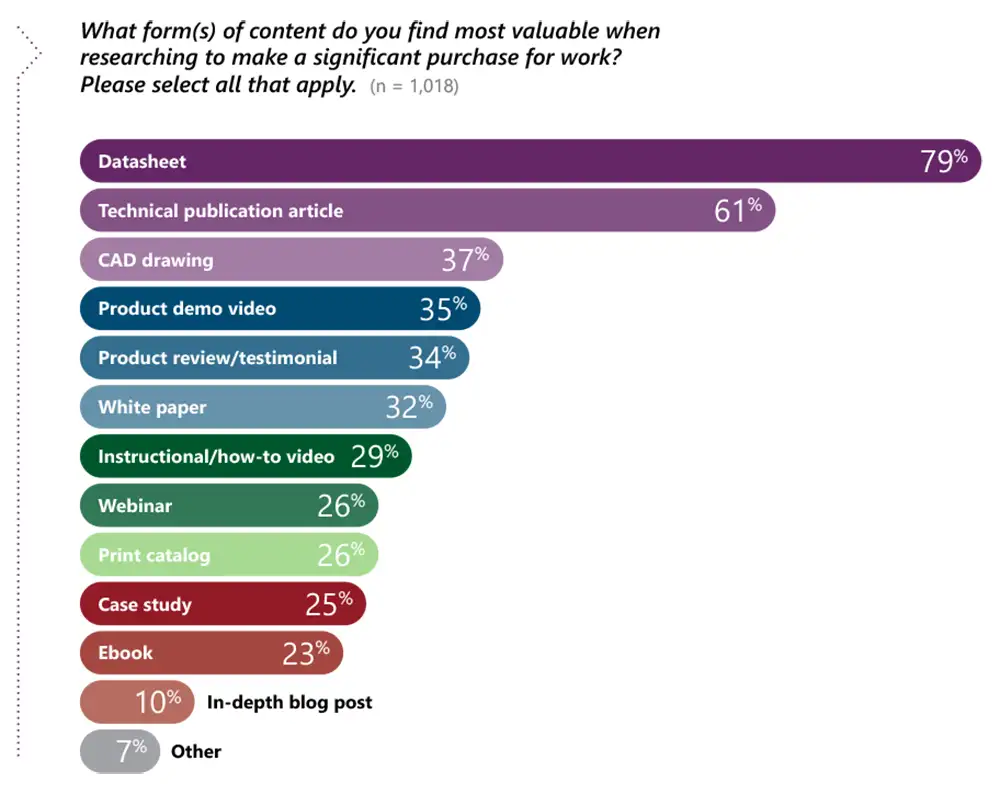
    The data backs this up, as shown in the chart below from the 2025 State of Marketing to Engineers report by TREW Marketing and GlobalSpec.

    Manufacturing website content engineers want

    Marketing Execution Needs Leadership, Not More Tools

    If your manufacturing website is underperforming, adding another platform or tool won’t fix the root problem.

    Most companies already have the tools. What they lack is strategic leadership.

    You may have HubSpot, Google Analytics, or a content management system. But without direction, those tools create activity, not results.

    Manufacturers often rely on internal teams or junior marketers to handle execution. These teams are hardworking but need senior-level guidance. Otherwise, it’s just busywork that doesn’t move the needle.

    That’s why many clients bring me in as a Fractional CMO.

    They don’t need a full-time executive. They need strategic oversight and accountability—20 focused hours a month can make a big difference.

    As a Fractional CMO, I help align marketing with sales, prioritize actions, and ensure your website works as a sales tool—not just a marketing asset.

    We lead with strategy. We fix gaps in messaging, site structure, and lead flow. Then we guide your team—or mine—through execution.

    It’s a practical way to get senior-level marketing without the full-time cost.

    And it works exceptionally well when paired with Manufacturing Marketing Strategy and Industrial Website Design services.

    Tools are helpful. But without leadership, they won’t turn your website into a lead generator.

    Key Questions to Ask Before You Act

    Before investing in a redesign or new tools, ask yourself a few strategic questions.

    These will help you pinpoint why your manufacturing website is underperforming and where to focus first.

    1. Is your site aligned with your sales process?
      Does it help move prospects from awareness to RFQ? Or does it leave them guessing?
    2. Are you speaking your customer’s language?
      Does your content address real-world problems engineers and buyers face? Or is it filled with marketing fluff?
    3. Can a technical buyer find what they need in two clicks or less?
      Engineers are busy. If they can’t find CAD files, specs, or certifications quickly, they’ll bounce.
    4. Is your value proposition clear and easy to find?
      Don’t make visitors work to understand what makes your solution better.
    5. Are you measuring performance beyond page views?
      Metrics like form submissions, time on page, and qualified leads tell the real story.

    You don’t need to answer all of these today. But thinking through them helps you avoid expensive redesign mistakes.

    We use these questions to guide every engagement—whether it’s a Manufacturing Marketing Strategy, Industrial Website Design, or Fractional CMO project.

    A strategic pause now saves a lot of frustration later.

    Start a Conversation with Tiecas

    If your manufacturing website is underperforming, don’t just patch the symptoms—let’s find the root cause.

    Whether you need a focused website strategy, sharper messaging, or ongoing leadership to guide your team, I can help.

    As a Marketing Engineer with decades of experience, I bring clarity, structure, and direction to your digital marketing—without the trial and error. Let’s turn your website into a true sales asset. Start a conversation with Tiecas today.

  • Industrial Website Redesign—Reengineering Your Site Into a Sales-Driven Asset

    Industrial Website Redesign—Reengineering Your Site Into a Sales-Driven Asset

    Are you considering an industrial website redesign? This blog will help you better plan for this challenging undertaking. If your industrial website still looks, feels, or functions like a digital brochure, it’s not just outdated—it’s underperforming.

    As you probably already know, the industrial buying journey has changed over the last few years. Your website needs to do more than display product specs and a contact form. It must engage time-starved technical professionals and move them confidently toward a sales conversation.

    According to the 2025 State of Marketing to Engineers report by TREW Marketing and GlobalSpec, 73% of technical buyers turn to vendor websites for information on a regular basis, making it the #1 source of information during the buying process. That means your website isn’t just a touchpoint—it’s your front-line sales tool.

    This post isn’t a DIY tutorial. It’s a practical guide for understanding the challenges and opportunities behind industrial website redesigns that deliver results. If your goal is to turn your website into a productive sales asset that aligns with how industrial buyers research, evaluate, and select vendors, you’re in the right place.

    Why an Industrial Website Redesign is Different (And Harder Than You Think)

    Redesigning a website for a manufacturing or industrial company isn’t the same as revamping a B2B tech site or a consumer-facing brand. Getting it right is more complex, technical, and frankly, critical.

    Here’s why:

    • Your audience is highly skeptical. Engineers and technical professionals are trained to question vendor claims and demand proof. If your site doesn’t clearly demonstrate expertise and credibility, they’ll move on without a second thought.
    • The buying process is long, non-linear, and involves multiple stakeholders. Unlike impulse-driven purchases, industrial buyers often need to validate product specs, compliance requirements, and long-term reliability before even initiating contact.
    • Legacy websites often have deep structural issues. Years of band-aid fixes, outdated platforms, and disorganized content make it difficult to update or build on top of what’s already there.
    • The product offering is complex. From SKUs and configuration options to application-specific solutions and certifications, industrial websites must present detailed technical information clearly and easily accessible.
    • Your web visitors aren’t “just browsing.” They’re often looking for solutions to their challenges. You’ve lost a sales opportunity if your website doesn’t help them do that quickly and confidently.

    That kind of trust-building and lead enablement doesn’t come from a simple visual refresh—it requires a strategic, deeply considered reengineering of your entire web presence.

    A generic industrial website redesign approach won’t address these challenges. Without a deep understanding of the industrial sales process and the technical mindset of your audience, even a well-designed site can miss the mark.

    From Brochureware to Sales Enablement: What Your Industrial Website Must Do Today

    It’s no longer enough for your website to be a digital brochure listing products, specs, and a phone number. That model assumes visitors already trust you and just need a place to validate what they’ve heard from a salesperson. But in reality, today’s industrial buyers expect your website to guide them through much of their buying journey, on their own terms.

    To become a true sales-enabling tool, your redesigned industrial website must fulfill three strategic roles:

    1. Educate with Authority

    Industrial buyers are problem solvers. They come to your site looking for insights, not fluff. This means offering clear, technically sound answers to real-world questions:

    • Detailed product data sheets, CAD drawings, and BIM files
    • Application notes, how-to guides, and case studies
    • Industry certifications and compliance information

    It’s not about dumping technical data—it’s about organizing it intuitively so that buyers can find what they need without friction.

    2. Engage Specific Personas

    Engineers want technical details. Plant managers need reliability assurances. Procurement wants fast access to warranties, lead times, and pricing. If your website speaks to everyone the same way, you’re talking to no one effectively. A well-reengineered website guides each visitor type through a tailored experience based on their role and objectives.

    You don’t need complex personalization software to get started. What matters more is understanding your different buyer personas and organizing your content so visitors can easily find what’s relevant to their role and stage in the buying process.

    3. Enable Sales Conversations

    Good industrial website design doesn’t just attract attention—it encourages action. That means more than having a “Contact Us” page. Think:

    • Product selectors or configurators
    • Application-based navigation to help visitors self-identify their use case
    • Smart CTAs tied to valuable content offers (e.g., “Download the spec sheet,” “white paper,” or “Talk to an engineer”)
    • Request for quote (RFQ) should be easy to fill out and ask for basic information only to get the ball rolling, not a detailed quote

    The goal isn’t to close the deal on the website—it’s to qualify the lead, start the conversation, and support your sales team with context and insights.

    Trust First, Then Leads: Rebuilding Credibility Online

    If you want engineers and industrial buyers to take action on your website, you need to earn their trust first. That’s not easy; they’re used to filtering out marketing hype and zeroing in on what matters: facts, evidence, and proof of performance.

    Your website’s content, structure, and design must reflect this reality.

    1. Trust Is Built Through Clarity and Competence

    Forget flashy effects or vague benefit statements. Technical professionals are looking for clear, logical navigation, relevant technical content, and signs that you know what you’re talking about. If your website makes them work too hard to find specifications, documentation, or contact information, you’ve lost them.

    2. Visual Design Matters—But for Different Reasons

    Engineers may not care about aesthetics like a consumer might, but that doesn’t mean design doesn’t matter. Clean layouts, well-organized menus, readable fonts, and mobile-friendly functionality all communicate competence and professionalism. Sloppy or dated design can create doubt, even if your products are rock-solid.

    3. Proof Beats Promises

    Trust isn’t just built on what you say—it’s reinforced by validation. Here are a few elements that help:

    • Industry certifications (e.g., ISO, UL, CE)
    • Case studies with real performance data
    • Testimonials from credible customers (when NDAs allow)
    • Project photos, application stories, or installation guides

    These aren’t “nice-to-haves”—they’re trust enablers. Without them, your claims sound like marketing fluff.

    In short, your industrial website must look and feel like the digital equivalent of a trusted sales engineer—helpful, knowledgeable, and quietly persuasive. That’s what builds confidence. That’s what opens the door to leads.

    Strategic Reengineering—Not Just Cosmetic Redesign

    Many industrial website redesign projects fail to deliver ROI because they focus on surface-level improvements—new colors, a modern template, a stock hero image, or two. But that’s not going to cut it with industrial buyers because they care less about design trends. They care about whether your website helps them solve problems, find what they need quickly, and feel confident in choosing you as a supplier or partner.

    That’s why I use the term reengineering instead of redesign. It reflects the depth of thinking and planning required to transform your site into a true sales asset.

    Here’s what that looks like in practice:

    1. Start with a Roadmap

    A successful industrial website redesign starts long before design mockups. It begins with:

    • Stakeholder interviews (Sales, Customer Service, Product Management)
    • Buyer persona development
    • Site audits (SEO, UX, content inventory, analytics review)
    • Competitive and peer site analysis

    This groundwork turns guesswork into a strategic plan tailored to your business.

    2. Map Content to the Industrial Buying Journey

    Engineers and technical buyers don’t make quick decisions. Your site must support every stage of their buying journey—from early research to evaluation to vendor selection. That means content shouldn’t just promote your company—it should guide, inform, and help them make an informed decision.

    Read my post, “Mapping Your Manufacturing Marketing Strategy to the Industrial Buyer’s Journey.”

    3. Align With the Sales Process

    Your website shouldn’t operate in a vacuum. It must support how your team sells, whether through reps, distributors, integrators, or direct channels. Key alignment points include:

    • Clear paths to request a quote, sample, or demo
    • Smart lead routing to the right person or team
    • CRM integration for seamless follow-up and attribution

    4. Choose the Right Platform—Not Just the Popular One

    Not every CMS is ideal for industrial websites. Your platform must handle large product catalogs, secure file downloads, multilingual support (if applicable), and integrations with tools like ERP, CRM, and marketing automation. WordPress can do all that—with the right development partner—but so can other platforms if chosen strategically.

    The takeaway? You’re not just building a prettier manufacturing website—you’re building a scalable, purpose-built tool for digital lead generation and sales enablement.

    Why You Shouldn’t Go It Alone

    Most industrial companies wouldn’t hesitate to call in an outside expert to optimize a complex production line or troubleshoot a controls issue. Yet when it comes to a website redesign—a project that directly impacts lead generation and sales—many try to handle it internally or hand it off to a generalist agency.

    That almost always leads to one of two outcomes:

    1. A visually updated site that fails to meet the needs of technical buyers, or
    2. A lengthy, frustrating process with missed deadlines and misaligned expectations.

    Here’s the reality: industrial website redesigns are too important, too complex, and too strategic to be left to trial and error.

    This isn’t about learning as you go. It’s about working with someone who understands your industry, sales cycle, and customers’ mindset from day one.

    You need a partner who:

    • Understands how engineers and technical buyers think and search
    • Knows how to translate complex product information into effective digital content
    • Builds websites that align with your sales process, not just your brand colors
    • Can streamline collaboration across your internal teams—sales, marketing, product, and leadership

    That’s precisely what we do at Tiecas. With more than 35 years of experience in industrial marketing and a deep understanding of how technical buyers engage online, we bring strategic clarity and execution to your website project.

    Your redesigned site should be a revenue-generating tool—not just a digital placeholder. Let’s make sure it’s built to perform.

    Ready to Reengineer Your Website Into a Sales Asset? Let’s Talk.

    Your industrial website redesign shouldn’t be an afterthought or another glorified online brochure. It should be engineered with purpose, built to win trust, and designed to support your sales team from the first click to the qualified lead.

    If your current site isn’t pulling its weight, let’s change that.

    At Tiecas, we specialize in industrial website redesigns that align with how engineers and technical professionals research and buy. We don’t just make websites look better—we make them work better for your business.

    Schedule a discovery call, and let’s talk about how we can reengineer your website into the high-performing sales tool it’s meant to be. Contact us today to get started.

  • How to Plan and Budget for an Industrial Website Redesign—A Practical Guide for Manufacturers and Industrial Companies

    How to Plan and Budget for an Industrial Website Redesign—A Practical Guide for Manufacturers and Industrial Companies

    Planning for an industrial website redesign is highly relevant at this time of year since many manufacturers are actively budgeting for 2025. Some of these industrial companies realize the importance of a customer-centric digital presence.

    In this blog, I’ll share my thoughts and recommendations based on hands-on experience of working on many website design projects over the years.

    Some of the key problems I have noticed are:

    • Many companies think of a website redesign as a quick, aesthetic update
    • Manufacturing websites, in general, remain product-focused rather than customer-centric; a redesign should enhance the user experience—while aligning closely with the sales process
    • Not incorporating an ROI perspective by using a data-driven approach that helps to quantify the impact

    Ready to dive in?

    Establishing Goals and Objectives for an Industrial Website Redesign

    Why do so many redesigns fail? Many industrial website redesigns fall short because they’re driven by a desire for a visual refresh rather than a strategic vision. In reality, a successful redesign goes beyond aesthetics. It must become a functional and productive online asset for your business—aligning with your overarching marketing and sales objectives.

    Start with User Needs and Sales Alignment

    Before diving into design concepts, it’s crucial to ask: “What do we want our website to accomplish?” For industrial companies, this could mean increasing lead generation, improving user engagement, or offering a seamless experience for existing clients seeking technical information. Additionally, alignment with your sales funnel is essential. Every page and feature should guide visitors through a journey that addresses their needs while supporting your sales team.

    How a Clear Strategy Saves Time and Budget

    With clearly defined goals, you avoid costly revisions, scope creep, and ineffective features that don’t move the needle. The redesign also sets a solid foundation for metrics, making it easier to measure ROI once it’s complete.

    Tip: Start with a strategic meeting to outline specific goals with stakeholders from both sales and marketing.

    Building a Realistic Budget for an Industrial Website Redesign

    Is it worth the time and expense of an industrial website redesign? The short answer—YES!

    And that’s not just my opinion. According to the 2024 State of Marketing to Engineers report, most technical buyers still rely on supplier/vendor websites as their primary source of information when researching products and services.

    The data shows that 41% of technical professionals routinely turn to supplier websites, surpassing all other sources of information (see chart below).

    Industrial website is the number 1 source of information

    Breaking Down the Key Cost Components

    Understanding the full scope of costs involved in a website redesign is critical, especially for industrial companies where technical complexity and specialized requirements are the norm. A budget that accounts for every aspect—from design and development to SEO and content—helps avoid unexpected expenses and ensures the final product meets both marketing and sales objectives. Here’s a breakdown of the primary cost components:

    • Design and Development: Custom design tailored to your brand, combined with a robust development process, forms the core of a high-quality industrial website. Budgeting for both visual appeal and functionality is essential, as they work together to engage users and guide them through the customer journey.
    • Content Creation: Industrial websites often need content that goes beyond basic descriptions to technical information, spec sheets, and application details that matter to your buyers. Content may need rewriting or repurposing to become more user-centric, requiring a substantial investment in both time and expertise.
    • Search Engine Optimization (SEO): SEO is crucial to ensure that potential customers can find your website. It includes keyword research, on-page optimization, and technical elements that make your site easier to discover and rank for relevant searches. SEO for industrial sites can be complex, given the niche keywords and specialized audience.

    Average Cost of an Industrial Website Redesign

    On average, a complete website redesign can cost between $15,000 and $80,000 or more, depending on size, functionality, and the level of customization. Manufacturing companies with custom needs should expect to budget higher to accommodate specialized content, design, and functionality.

    Why Working with an Industrial Website Design Company Pays Off

    By partnering with a specialized industrial website design agency, you can avoid the pitfalls of unexpected expenses and ensure efficient budget use. Agencies experienced in industrial marketing understand how to prioritize critical features without inflating costs, giving you a website that performs and scales with your business needs.

    Tip: Map out all essential features upfront with your agency partner to prevent scope creep and maximize the value of every dollar spent.

    Defining the Scope: A Customer-Centric Approach

    Traditionally, industrial websites have been product-focused, designed more as digital catalogs than as user-centered platforms. However, today’s buyers expect more—they want to feel understood, supported and guided through a website that speaks directly to their needs. Shifting to a customer-centric design means rethinking your website’s purpose: it’s not just about listing products; it’s about offering value through a user-friendly experience that supports your buyer’s journey.

    Understanding the Buyer’s Journey

    Creating a customer-centric website begins with a deep understanding of your target audience and their typical buying journey. Most manufacturing marketers find it challenging to understand and create content to fit the needs of different stakeholders at different stages of their buying journey because of the long and complex sales cycles.

    Different stakeholders—such as engineers, procurement managers, and decision-makers—each have unique informational needs depending on their role and stage in the process. For a closer look at addressing these needs, read my blog How Technical Content Writing Drives Success in Manufacturing Content Marketing.

    Content Strategy: Beyond Product Descriptions

    A customer-centric website requires a content strategy that goes beyond standard product descriptions. This means including resources like whitepapers, case studies, application notes, FAQs, online resource libraries, how-to videos and blog posts addressing your buyers’ questions and challenges.

    Retrofitting content to a website redesign usually fails, often resulting in a disjointed experience that doesn’t fully support the buyer’s journey. For a deeper dive into this issue, check out my blog, Why Retrofitting Industrial Website Redesigns Usually Don’t Work. Website content can’t be an afterthought; it needs to be strategically developed to enhance the site’s structure, guide users intuitively, and reinforce your company’s credibility at every step.

    Tip: Collaborate with an experienced industrial marketing agency to ensure your content strategy aligns with your customer’s needs and your sales objectives.

    Deciding on the Right Platform and Technology

    In many industrial companies, website redesigns are handed off to internal IT teams. While IT professionals bring a wealth of technical knowledge, they often prioritize the backend development and technical specifications over the essential marketing aspects of a website.

    Coding is not marketing, and this difference in focus can lead to missed opportunities in user engagement, SEO, and content strategy. A successful industrial website isn’t just a functional asset—it’s a powerful marketing tool designed to attract, inform, and convert prospects.

    The Pitfalls of Custom Development

    From my own experience, I’ve seen several instances where IT teams opted for custom development instead of using established content management systems (CMS) like WordPress.

    In two particular cases, IT teams developed custom platforms, thinking it would offer more control. However, when the original developers left, the clients found themselves “stuck” with a system they couldn’t easily update or edit.

    Unlike widely used WordPress, supported by a large community and accessible to non-developers, custom-built sites can be challenging—and costly—to manage in the long term. Finding a custom developer familiar with the system became an ongoing struggle, impacting the client’s ability to update content and adapt to evolving market needs.

    Why Choosing the Right CMS Matters

    Using a platform like WordPress for your industrial website offers flexibility, ease of use, and a wealth of plugins tailored to industrial B2B marketing needs. WordPress, for instance, enables your marketing team to make updates independently, without relying on developers, so your website remains agile and responsive to business goals.

    Plus, the vast ecosystem of developers and support resources ensures you’re never left without options if changes are needed.

    Tip: At Tiecas, we use WordPress to develop front-end industrial websites and integrate them with Marketing Automation (MA) platforms and CRMs on the back end for seamless lead nurturing and tracking. We’ve also handled complex ERP integrations, ensuring a smooth connection between your website and essential backend systems.

    Preparing a Timeline for Development and Launch

    An industrial website redesign is a complex project with many moving parts, from strategy and design to content creation and testing. Setting a realistic timeline ensures that each phase is completed thoroughly without rushing through critical details. A rushed redesign often leads to errors, missed opportunities, and setbacks that proper planning could have avoided.

    Key Phases to Include in Your Timeline

    • Discovery and Planning: Start with a discovery phase to align your website goals with your business objectives. This phase involves gathering insights from sales and marketing, understanding the buyer’s journey, and setting measurable goals for the redesign.
    • It cannot be condensed into a single call; at Tiecas, we conduct at least three discovery calls—sometimes more, depending on the project’s scope and complexity. This thorough approach allows us to capture the nuances of your goals and ensure we’re building a site that supports your sales and marketing strategies.
    • Design and Development: Designing and developing the new website involves creating wireframes, building prototypes, and implementing custom features. In industrial B2B, this often includes specific functionalities, such as spec sheet downloads, application resources, product configurators, and sometimes even custom search applications. For example, a custom search application can enable visitors to mix and match various product options to achieve the exact specifications they need. Allocate sufficient time for both initial design, feedback rounds, and development work.
    • Content Creation and SEO: Content is one of the most critical elements in a successful redesign, yet it’s often underestimated in terms of time and effort. Each page should be optimized for SEO and designed to meet the informational needs of your audience. Allow ample time to create, review, and refine content to ensure it supports your sales and marketing goals.
    • Testing and Quality Assurance (QA): A thorough testing phase is essential to identify and resolve any issues before launch. This includes testing for usability, mobile responsiveness, loading speed, and SEO readiness. Ensuring that all integrations—such as CRM and MA platforms—function smoothly is also crucial.
    • Launch and Post-Launch Optimization: Even after the launch, your website will benefit from monitoring and fine-tuning. Set aside time in your timeline for tracking metrics, gathering feedback, and making adjustments based on user data to improve performance. Additionally, investing in an ongoing site care package is essential to keep your website updated, secure, and functioning smoothly, ensuring it remains a reliable online asset for your business.

    Avoiding Common Delays

    Common delays often stem from insufficient planning, underestimated content needs, or prolonged feedback cycles. Working with an experienced industrial website design agency can help keep your project on track by providing structured project management and ensuring that all critical milestones are met.

    Tip: Build buffer time into each phase to account for any unforeseen issues so your launch date stays realistic and achievable.

    Measuring Success Post-Launch: Tracking Key Performance Indicators (KPIs)

    Launching your industrial website is a significant milestone, but the work doesn’t end there. It’s essential to track key performance indicators (KPIs) that reflect both user engagement and business outcomes. This step is a data-driven approach to proving your redesign delivers real value.

    Metrics such as conversion rates, bounce rates, average time on page, and lead generation activity clearly show how effectively your website is meeting your marketing and sales goals.

    Conversion Rates and Lead Quality

    One of the most critical KPIs to track is the conversion rate—whether that’s form submissions, contact requests, downloads of gated resources or a mix of all. Tracking conversion rates allows you to see how well your website engages visitors and moves them through the sales funnel.

    Additionally, focusing on lead quality (not just quantity) is essential for industrial companies with complex sales cycles. High-quality leads are more likely to convert into sales, making this an essential measure of your website’s effectiveness.

    Continuous Improvement Through Data

    Post-launch, it’s vital to use data to make continuous improvements. Analyze user behavior patterns to identify potential pain points or areas where users drop off.

    For example, a product page with high traffic but a low conversion rate might signal that the content or call-to-action needs refinement. This iterative optimization approach ensures your website evolves based on real user insights, keeping it aligned with business goals.

    Setting Up Analytics and Integrations

    Properly configuring analytics tools—such as Google Analytics, heatmaps, and your Marketing Automation (MA) platform—is essential to capture meaningful data. Integrating your website with a CRM or MA platform enables more accurate lead tracking and provides valuable insights into lead behavior, helping you nurture them through targeted follow-up actions.

    Tip: Regularly review and adjust KPIs to reflect changing business objectives and market conditions. A well-performing industrial website should evolve with your business needs.

    Selecting the Right Agency Partner

    Choosing the right agency partner for your industrial website redesign is crucial. An experienced partner understands the unique demands of the industrial sector and can design a site that aligns with the technical needs of your audience and supports your business goals.

    Generalist web design agencies may overlook key B2B industrial requirements, such as complex product specifications, content hierarchies, and lead capture mechanisms that cater specifically to engineers, procurement managers, and other stakeholders in your sales cycle.

    What to Look for in an Agency Partner

    When evaluating potential agency partners, consider these factors:

    • Industry Expertise: Look for a proven track record in industrial and manufacturing website design. Agencies familiar with B2B buying behaviors understand the nuances of creating industrial content and features that resonate with technical buyers and decision-makers.
    • Technical and Marketing Knowledge: The right agency should offer a balanced approach, combining strong technical capabilities with in-depth marketing expertise. This balance ensures that your website will function smoothly and serve as a robust lead-generation and customer-engagement tool.
    • Case Studies and Testimonials: Ask for case studies and testimonials that demonstrate the agency’s success in delivering results for other industrial clients. A strong portfolio with measurable outcomes can provide reassurance that the agency is equipped to handle your project.
    • Long-Term Support: Website redesigns are only the beginning. Partnering with an agency that offers long-term marketing support packages—covering everything from technical maintenance to ongoing content updates—ensures your site remains optimized and aligned with evolving business goals.

    The Tiecas Difference

    At Tiecas, we specialize in industrial marketing and website design. Drawing from decades of experience, we create highly functional sites strategically aligned with the needs of B2B industrial buyers. Our approach combines marketing and technical expertise, from SEO-driven content to seamless integrations with CRM and Marketing Automation platforms, delivering a solution that not only looks professional but drives measurable results.

    Ready to schedule a discovery call? Let’s talk to assess if this is a good fit for a long-term partnership.

  • Successful Industrial Website Redesigns: The Essential Elements and the Benefits of Regular Updates

    Successful Industrial Website Redesigns: The Essential Elements and the Benefits of Regular Updates

    Industrial website redesigns require careful planning and attention to many details. You are likely to be disappointed with the results if you or your developer don’t put in the time upfront before doing any designing and developing.

    See Why do so Many Industrial Website Redesigns Fail?

    An up-to-date and user-friendly industrial website is essential for success in today’s business world with global competition. That is not a hyperbole; see the direct quote from “2021 Pulse Of Engineering Survey” published by GlobalSpec.

    An up-to-date and user-friendly industrial website is essential for success in today’s business world with global competition. That is not a hyperbole; see the direct quote from “2021 Pulse Of Engineering Survey” published by GlobalSpec.

    “In terms of competition, 58 percent said that the competitive landscape is global and competes 24/7, while 47 percent said the number of competitors is growing.”

    While Industrial websites must be designed for aesthetics and functionality, I firmly believe in “form follows function.” That’s good to know, but how do you put it into practice? This post is all about that, so let’s get started!

    Planning the User Experience (UX) for industrial website redesigns

    One of the essential elements of industrial website redesigns is the user experience (UX). Thinking like visitors and anticipating their needs is crucial when designing a website. An intuitive navigation system is vital in creating an excellent user experience. Visitors to your site should quickly find what they are looking for without spending a lot of time searching around or being overwhelmed by the sheer volume of information.

    An intuitive navigation should minimize clicks and streamline the browsing experience. Plan the flow of information from the Home page to internal pages to help your site visitors find the information that is relevant to them with a minimal number of clicks. Then, guide them to specific internal pages where you provide additional content to help them make an informed decision.

    Intuitive navigation can make or break your UX. You have to think from your visitor’s perspective and not what you think is obvious.

    Unique Selling Proposition (USP)

    Your unique selling proposition (USP) and value proposition should be clear and concise

    That is not just marketing speak. A USP is where you tell your visitors why they should do business with you, not the competition. There can be some overlap between USP and your Value Proposition.

    Here’s a good way to understand the differences I found on Zoho Academy’s website.

    “While the USP situates a business in relation to its competitors, the value proposition focuses more on how customers’ lives will be improved by working with the business. In other words, while a USP describes for your target market how you’re different, a value proposition answers the question: Why should they care about that difference?”

    Your industrial website must quickly answer the who, what, and why questions using short, direct statements. It shouldn’t be a blatant sales pitch. Instead, it should motivate visitors to have meaningful conversations with your sales team because they see you as a good fit for their needs.

    Use webpage content to create true differentiation

    Many manufacturers struggle to create true differentiation when there’s parity in value propositions. They continue to use generic statements like “exceptional customer service” or “highest quality.” The competition can just as easily make the same statements. Validate your claims and provide proof of concept if you want serious consideration from site visitors.

    Content creation for website redevelopment is probably the biggest bottleneck. However, it cannot be an afterthought or retrofitted after completing the redesign. See Why Retrofitting Industrial Website Redesigns Usually Don’t Work.

    Jeffrey Zweldman on content and web design

    Your expertise should be front and center

    Bring your in-house Subject Matter Experts (SMEs) to the forefront to highlight your expertise. This is not something your competition can easily copy. Marketing can do the heavy lifting of content creation but must remain in the background. One engineer to another is a powerful concept that simply works!

    I speak from 35+ years of hands-on experience working with industrial clients but don’t just take my word for it. (Source: 2023 State of Marketing to Engineers published by TREW Marketing and GlobalSpec).

    one engineer to another

    Planning for search engine optimization (SEO) and conversions

    Search Engine Optimization (SE)

    A well-thought-out search engine optimization plan is a necessity. There are no tricks or magical formulas (Formulae if you want to be technically correct) to gain first-page rankings. It takes knowledge of white hat techniques, keeping up with Google’s algorithm updates, and the experience to do SEO right. Above all, it takes time to produce results, so don’t expect immediate results from organic SEO.

    Responsive web design is another important consideration. Google’s “mobile-first indexing” is an important signal for ranking. It is not enough to have a mobile-friendly site. It needs to be mobile-optimized.

    Another common problem is the lack of understanding between SEO and conversions. Just because someone found your site in search engines and visited your website doesn’t mean they are ready to talk to your sales team. There is a difference between discovery optimization (SEO) and conversion optimization (CRO). They are related but not the same.

    Webpage content must address visitors’ concerns and logically move them forward in their buying journey. That’s when the conversion happens.

    See SEO Must Complement Conversion Optimization for an Effective Industrial Marketing Strategy.

    Regularly updating and keeping the website secured

    Website updates and maintenance

    This step happens after the redesigned site has launched. Neglect it at your own peril. If your industrial website is/was built using WordPress, plugins must be regularly updated, or they may fail. That’s just a fact of life with WordPress. Don’t take the lazy way out by using automatic updates. Incompatibilities between new versions and bugs are pretty common. Do read up on the plugins used on your site, and it is sometimes safer to wait a week or two for the dust to settle whenever a major update is released.

    Securing your website against hacks is another issue you must be aware of, especially if you have an online store. Cleaning up after a hack is a long-drawn process that can be expensive. Another thing to check is your backend integrations with CRM and ERP systems. I’ve seen API connections fail from time to time. Check them regularly to make sure nothing is broken.

    An industrial website redesign can be complex, but it is well worth the effort. You can create an effective website that drives conversions and achieves business goals by leveraging user experience (UX), navigation, segmentation, search engine optimization, and content tailored to your target audience’s needs.

    Additionally, regular updates and putting security measures in place will keep your site functioning without glitches and lower the risk of hacks.

    Industrial website redesigns will help increase brand awareness and customer engagement if done correctly. With this in mind, it is clear why investing time into creating a successful website redesign strategy should be at the top of every manufacturer’s list when looking to expand their online presence.

  • Why Retrofitting Industrial Website Redesigns Usually Don’t Work

    Why Retrofitting Industrial Website Redesigns Usually Don’t Work

    Industrial website redesigns are major undertakings, not something you want to decide or do in a hurry. They require careful planning and input from many stakeholders for them to succeed. I’m talking about redesigns that turn industrial websites into productive and effective sales tools.

    Many industrial website redesigns fail, not because of a lack of effort but also for many other reasons. The sad truth is that most of the pitfalls can be avoided by the website redesign team. I’ve seen some of these cases firsthand, and I’ll share them with you in this post.

    Industrial website redesigns are not just marketing projects

    I’ve had manufacturers and engineering companies approach me because their last redesign was handled by their in-house Marketing department or outsourced to an outside web developer.

    These people have the necessary skill set to create a good-looking website, but the classic mistake they make is to think it is their sole responsibility. They don’t take the time to get feedback from Sales, Management, and other stakeholders during the planning stage. They work in isolation and show a draft to these stakeholders, asking for their feedback.

    It is human nature for people to come up with their own suggestions for improvements lest you think they haven’t taken the time to do their job of reviewing. Suddenly, everyone is an expert at website redesign and development. As a result, the website project comes to a screeching halt because it may mean going back to the drawing board and starting from scratch.

    Content for websites can’t be an afterthought

    Jeffrey Zweldman on content and web designContent development for websites must go hand in hand with the redesign; retrofitting can be a disaster. I’m not suggesting that the same people must do both, but the developer and the content creator must work as a team and constantly communicate.

    The messaging must be on target for the new site to attract the right audience and convert those visitors into qualified leads. You are not going to persuade engineers and technical professionals to act with more meaningless marketing fluff.

    It is not that owners and decision-makers at industrial companies don’t care about their website content. I’ve heard many reasons for holding off on website content until after the redesign is almost done. Here are the ones I’ve heard most often:

    • We don’t have any money to hire an expert industrial content marketer (Budgets are always tight)
    • We know our business better than any outsider ever will (True but are you an expert at marketing?)
    • Writing copy can’t be that hard; we’ll do it ourselves (No one steps up to produce copy)
    • Nobody reads anymore, and we just want industrial buyers to find us in Google and call our salespeople who will tell them everything they need to know (The phone hardly ever rings)
    • Most outside copywriters don’t understand our technical business (Our in-house Subject Matter Experts (SMEs) are too busy for copywriting)
    • Engineers don’t like marketing; they just want the facts. We have plenty of product datasheets and catalogs to provide them the right information (Those can’t highlight your expertise)

    Product specifications, features, and benefits are important at the top of the funnel. Still, those alone can’t create true differentiation for an industrial company when there is parity in value propositions. Bring your technical expertise, knowledge, and experience to the forefront.

    The pandemic has resulted in many trade shows being canceled; engineers are turning to supplier/vendor websites for information they feel is technically accurate, current, valuable, and relevant to their work-related challenges. (Source: 2021 State of Marketing to Engineers, TREW Marketing and GlobalSpec).

    industrial website redesign: supplier websites are valuable to engineers

    Is the industrial website redesign built around your content marketing strategy?

    That may sound like a rhetorical question; unfortunately, it is very real. Sometimes there is a disconnect between upper management and the team tasked with the site redesign. Let’s take the example of a manufacturer that has decided to go all-in with e-commerce for selling directly. That’s a strategic business decision made by the executives. However, the Marketing department is tasked with generating qualified leads using industrial content marketing.

    The new e-commerce site was tightly integrated with their ERP system and took over a year to develop. However, the outside development team failed to talk to the Marketing department. As a result, there was only one page on the new site that was dedicated to engineering services and solutions. Marketing people had to go back to the developers if they wanted to add pages and/or a blog. This made it virtually impossible to do content marketing and produce results. There was enough frustration to go around in this situation.

    The moral of the story, industrial content marketing strategy, and industrial website redesigns are connected. Neither can be effective if they work independently of each other.

    Also, refer to my previous post, Using CAD and BIM Files in Manufacturing Content Marketing for a content marketing strategy that produces results if you target engineers and architects.

    Spend the time to plan before you start redesigning

    Again, this may sound obvious without stating it. However, I’ve seen too many web developers dive right into wireframing and coding without taking the time to really understand the sales process and how the new site fits into that workflow.

    Compounding the problem is the fact that not too many of them have hands-on experience or the understanding of long and complex industrial sales cycles involving many stakeholders. They try to force-fit their general knowledge of B2B websites.

    It is crucial to first develop an effective website redesign strategy that is closely aligned with your content marketing strategy and your sales process with all that is at stake.

  • Is Your Industrial Website Ready for Business After the Coronavirus Pandemic?

    Is Your Industrial Website Ready for Business After the Coronavirus Pandemic?

    Will your industrial website still meet the needs of engineers and industrial buyers when the coronavirus pandemic is over, whenever that is? In my last post, I talked about adapting your industrial content marketing strategy for COVID-19. In this post, I want to focus on the changes that you may need to make to your industrial website for post-pandemic business.

    A site audit will help you determine if you need a complete industrial website redesign or just edit and/or create new content. The first step must be an in-depth review of the current site by a team that includes Marketing, Sales, and Executives. This is important because management may have made certain strategic business decisions which need to be reflected accurately in your website content. How your company approaches business during and after the pandemic will have an impact on your sales processes too. In short, this can’t be just a marketing initiative.

    Let me give you a few real-world examples to illustrate what I’m talking about.

    Industrial website changes for the upstream Oil & Gas industry

    Rig layups and preservation services are part of the regular offerings by some service companies in the Oil & Gas industry. However, the current economic conditions have increased the number of offshore rigs being stacked and/or mothballed. Look at your current content, can it be better optimized to address this need during the pandemic?

    These companies could also highlight their expertise by publishing new blog posts about re-commissioning and reactivation after the pandemic. Creating a short white paper explaining the differences between warm and cold stacking would be a good lead generator because of its educational value.

    I understand it takes times and the right skills to come up with new content at short notice. Consider outsourcing technical content creation if you don’t have the in-house resources or are shorthanded right now.

    Website content to match repurposed manufacturing

    You’ll find a ton of online articles if you Googled the words repurposing manufacturing. Many manufacturers across a variety of industries have repurposed their manufacturing to meet the pressing needs during the crisis.

    Some have increased their sourcing and production capabilities to meet the increased demand for safety equipment for healthcare workers. Others have completely changed their manufacturing focus even if it is only temporarily.

    Make sure the Home page of your industrial website highlights these changes. For example, a Houston based and locally operated MedTech company, successfully created a line of cleaning products including surface disinfectant and hand sanitizer to meet market demands during the current COVID-19 pandemic.

    Website updates for medical device manufacturers

    Here are some search statistics from IEEE GlobalSpec over the past few months that are all related to COVID-19.

    • Searches for face shields are up 125% year over year and 338% from last month
    • Resuscitator searches are up 32% year over year, and 182% in the last month
    • Searches for HEPA filters, while steady year over year, have seen a recent spike of 120% from last month
    • Searches for autoclaves and sterilizers are up 302% in the last year, and 42% in the last month

    For manufacturers and suppliers in the Medical Device industry, the above stats should help them think about their own SEO strategy and how they can fine-tune it for their company’s industrial website.

    ThomasNet has created a dedicated online resource called the COVID-19 Response Suppliers. You can sign up for free and be found by over 1.5 million industrial buyers. Use their free matchmaking tool to look for COVID-19 related manufacturing partnerships.

    I don’t have to tell you that SEO for industrial websites is not a quick and easy task. It takes SEO knowledge, research, planning and consistent publishing of fresh content that is relevant to your audience to achieve results.

    Why not partner with one of these well-known industrial search engines and ride their SEO coattails? Sure, there is an associated cost for some of the paid options, but the ROI may be worth it.

    NOTE: I’m not affiliated with any these companies.

    COVID-19’s impact on industrial e-commerce websites

    Many industrial distributors already have robust e-commerce websites. However, COVID-19 has had a major impact on supply chains, production, and labor. On top of that, buyer preferences have changed during this time. More companies are putting their dollars into “essential supplies” and putting off upgrades and expansions for the foreseeable future.

    Your online store needs to adjust to these changes for both, disruptions to your own supply chains and customer demands. Your individual business situation will vary, but I have seen many industrial e-commerce websites with some common changes.

    • Online inventory is updated real time (This may require back-end integration with your ERP system)
    • “Out of Stock” items are clearly marked. Some have taken the extra step to indicate anticipated date of new incoming stock
    • Changes to normal delivery and shipping schedules are shown prominently
    • Measures taken to ensure safety of customers and employees for “will call” orders
    • Expanded or curtailed hours of operation to sync with customers’ operations
    • New or specific items made available in online stores during the pandemic
    • A customer resource center devoted to answering FAQs related to COVID-19 and regulatory compliance

    I have already mentioned using webinars and virtual meetings as part of your COVID-19 content strategy in my last post.

    Some of these changes to industrial websites may be permanent to match business conditions after the pandemic. As I have mentioned at the beginning of this post, making these changes to your industrial website will require active participation of all stakeholders and Marketing cannot and shouldn’t try to do them on their own.

  • Industrial Website Redesign and Content Marketing Strategy are Connected

    Industrial Website Redesign and Content Marketing Strategy are Connected

    An industrial website redesign is a major undertaking. It is not something that you should do on a whim or expect to launch a new site in a few weeks. According to a survey done by IEEE GlobalSpec, 60% of industrial companies will increase spending on their company website and 52% on content creation and distribution.

    There are pitfalls of diving straight into the design phase before creating a documented content marketing strategy. It must be fully vetted by all stakeholders and the document reviewed regularly.

    Industrial website redesign follows content marketing strategy

    You probably already know about the importance of having a documented strategy. Let me share two key findings from the research study published by the Content Marketing Institute if you are still not convinced.

    1. A documented content marketing strategy is often a key indicator of content marketing success
    2. Less than 1 in 4 (21%) of manufacturing content marketers have a documented strategy

    The above two points should remove any doubts about the importance of having a fully vetted documented content marketing strategy that aligns well with your goals and sales process. Like the majority of industrial companies, if your number one goal is to generate more of better-quality leads with content marketing, then let your strategy dictate how the website should be redesigned. Not the other way around.

    Business goals don’t align with the website redesign

    I have seen many website redesigns fail; it is not because they are aesthetically bad, but because they fail to meet the planned objectives. In essence, they end up being nothing more than a cosmetic facelift for the website. It doesn’t matter how much or how little money you spent on the redesign; it is still wasted.

    I don’t know how many times I’ve heard clients tell me, “We send people to our website after we’ve talked to someone (sales call) for them to get more information.” In the same breath, they’ll also tell me that they wanted their redesigned site to generate more high-quality leads by engaging with engineers and industrial buyers. Do you see the disconnect?

    There are many causes for redesign failures. Based on my experience, I can make suggestions to avoid a complete disaster.

    • Involve your sales team in strategy planning and goal setting. Don’t wait to ask for their opinion just before going live.
    • Get everyone on the review committee to participate in whatever capacity possible during content creation and reviewing drafts.
    • Ask for help from your in-house Subject Matter Experts (SMEs) to ensure that the content is technically accurate, presented in a logical manner and talks about solutions to real-world challenges faced by your audience.
    • Do your due diligence for SEO. It needs to be part of your content marketing strategy and not an afterthought

    For more on this topic, let me direct you to two of my earlier articles.

    Invest the time in a content marketing strategy

    It is going to be difficult for any web designer or an outsourced web development company to design an industrial website that will be an efficient lead delivery system unless s/he has the necessary experience and the expertise in industrial marketing. By that I mean, a good understanding of complex industrial sales with long sales cycles involving many stakeholders.

    An industrial website redesign for lead generation requires careful planning, paying attention to many details and first-hand knowledge of what engineers and technical buyers want to see on a supplier’s site. That kind of experience and expertise isn’t cheap. That’s why you’ll see a wide range in prices for a site redesign.

    There is a lot at stake here, so it is critical that you spend the time in developing a documented content marketing strategy that aligns well with your sales process before diving into an industrial website redesign.

  • Content Marketing Strategy Must Drive Your Industrial Website Redesign

    Jeffrey Zweldman on content and web designAn industrial website redesign shouldn’t be a quick decision because your site is the very foundation of your online presence. Why is it such an important decision?

    According to the Industrial Buy Cycle survey of engineers and technical professionals conducted by IHS Engineering 360 (formally GlobalSpec), “The top three most frequently used sources for searching for products and services to purchase are search engines, supplier websites, and online catalogs.

    The survey also found that in the early stages of the Buy Cycle, Needs Awareness and Research phases, industrial professionals use a variety of online sources of information.

    By the time buyers reach the final Procurement stage, supplier websites and online catalogs become the most important sources of information. Take a look at this chart from IHS Engineering 360’s Buy Cycle survey.

    (more…)