Category: manufacturing content marketing

  • Industrial Content Marketing for Manufacturers: Adapting to AI Overviews and Zero-Click Search

    Industrial Content Marketing for Manufacturers: Adapting to AI Overviews and Zero-Click Search

    Industrial content marketing for manufacturers is not dead—but it has changed significantly over the past two years.

    If you’re a manufacturing marketer, a business owner, or a VP of Sales & Marketing in a manufacturing or industrial company, you know how vital organic search traffic has been for generating qualified leads.

    For decades, well-crafted technical content has driven buyers to your site and helped you compete with bigger players, without Fortune 500 marketing dollars.

    But that landscape has shifted fast.

    According to SparkToro’s 2023 Zero-Click Search Study, more than 65% of Google searches now end without a click—a sharp reminder that traditional content strategies must adapt or risk becoming invisible (SparkToro, 2023).

    For more on this problem, read How AI Overview Is Changing Manufacturing Content Marketing and SEO—And What You Can Do About It.

    Yet here’s the good news: the fundamentals of industrial content marketing for manufacturers haven’t disappeared. Engineers, technical professionals, and industrial buyers continue to require trustworthy, detailed, and relevant information, particularly in niche B2B markets. But how you create, package, and optimize that content must change to break through AI overviews and zero-click barriers.

    And that’s where a strategic approach to Industrial Content Marketing becomes more important than ever.

    Why Industrial Content Marketing for Manufacturers Isn’t Dead—But Different

    Despite the AI buzz, industrial buyers still do deep research online before ever talking to your sales team.

    According to the 2024 B2B Manufacturing Content Marketing Benchmarks, Budgets, and Trends report from the Content Marketing Institute, 71% of manufacturing marketers say content marketing is more important to their organization than it was a year ago.

    That’s no surprise — engineers want to solve problems, compare options, and check specs long before requesting a quote.

    What has changed is how easily your content reaches them, and whether your hard-earned organic traffic converts into qualified leads.

    Google’s AI Overview and generative search have added a new layer between your expertise and your potential buyers. The same blog post that ranked on page one two years ago might now sit far below AI summaries that scrape bits and pieces of your insights.

    That doesn’t mean your investment in content is wasted. It means your strategy needs to evolve. To break through today’s AI filters and zero-click searches, your industrial content must be more technical, more useful, and more credible than ever—the kind of in-depth material AI can’t easily summarize in a few sentences.

    For small to mid-sized manufacturers, that’s a tall order, especially for lean marketing teams that juggle multiple priorities with limited bandwidth. But with a clear roadmap, it is possible to adapt and keep your content working as a lead-generation engine.

    How Google AI Overview and ChatGPT Search Are Disrupting Manufacturing SEO

    For years, manufacturing SEO was straightforward: create technical content that answers buyers’ questions, optimize it for relevant keywords, earn a spot near the top of Google’s organic results, and capture clicks. But with the rapid rollout of Google’s AI Overview and tools like ChatGPT Search, that familiar playbook is no longer enough.

    Today, a growing share of B2B buyers are getting instant answers to complex questions directly on the search results page. Google’s AI Overview summarizes information from multiple sources and displays it prominently at the top, pushing traditional organic listings further down. In many technical searches, the first organic link can appear halfway down the page, or lower.

    A Search Engine Journal study found that AI Overview results can occupy 30% or more of the screen on both desktop and mobile, dramatically shrinking the real estate available for traditional organic links (Search Engine Journal, 2024).

    Add ChatGPT Search and other AI tools that give direct answers — and it’s clear why click-through rates are dropping.

    For manufacturers, the impact is clear. You’ve invested time and money into detailed technical content—application notes, product selection guides, how-to articles—but if your prospects never click through to read them, your pipeline dries up.

    This is why so many manufacturing marketers are seeing a disconnect between their content output and actual lead generation. If you’re depending on SEO alone to deliver traffic, these new AI-driven filters can quietly siphon off your audience without warning.

    In short, the days of publish and pray are over. Manufacturers must adjust their SEO and content strategy to stay visible.

    See What Are the New Rules of Manufacturing Marketing in an AI-Driven World?

    Zero-Click Searches: The New Challenge for Manufacturers

    So what does this mean? More of your audience gets the answers they need without ever visiting your site.

    When buyers see a summarized answer in Google’s AI Overview—or get a direct response from ChatGPT Search—there’s no need to click through for more. For small to mid-sized manufacturers, this is a real threat.

    Every zero-click search represents a potential missed opportunity to showcase your expertise, build trust, and start a conversation with a qualified prospect. The more technical your solutions, the bigger the loss, because AI can’t replace the depth engineers need to make complex decisions.

    Here’s where the challenge gets tougher: your competition for organic clicks is no longer just other manufacturers—it’s the AI summary boxes themselves. If your content isn’t distinctive or valuable enough to break through, it risks being reduced to a snippet—with no credit, no click, and no lead for your sales team.

    The takeaway? Zero-click searches aren’t going away—but smart industrial content marketers can find ways to adapt, not just accept the loss.

    Why Small and Mid-Sized Manufacturers Struggle with Technical Content Creation

    Adapting your industrial content marketing strategy for AI-driven search is easier said than done, especially if you’re a small or mid-sized manufacturer with a small marketing team.

    Here’s the truth: creating technical content that resonates with engineers isn’t something you can delegate to just any freelancer or general agency. It takes time, deep knowledge of the technical audience, and the ability to translate complex engineering details into content that’s both accurate and easy to understand.

    Yet, in most small manufacturing firms, marketing teams are stretched thin. Often, it’s just one person juggling trade shows, website updates, email campaigns, and sales support, with content squeezed in where possible. The result? Inconsistent publishing, generic posts that don’t stand out, or technical inaccuracies that undermine credibility with your audience.

    According to the Manufacturing Content Marketing Benchmarks, Budgets, and Trends: Outlook for 2025 report, “Sixty-six percent of manufacturing marketers say creating content that prompts a desired action is challenging. Fifty-four percent say creating content consistently is a challenge, and half say creating enough content is.”

    These challenges feed the zero-click problem. If your content doesn’t add depth beyond what AI can scrape, you’ll struggle to win the click.

    Here’s another eye-opener from the same report: Only 22% of the survey respondents considered AI-generated content as excellent to good.

    That’s why partnering with an experienced industrial content specialist makes a real difference — delivering credible technical content that stands out from AI summaries.

    That’s exactly why I offer dedicated Industrial Content Creation services—to help manufacturers consistently produce the kind of deep, technical content AI can’t easily replicate or replace.

    So, how can manufacturers adapt their content marketing strategy in a world of zero-click searches and AI overviews? The answer isn’t to publish more content — it’s to publish better, deeper, and more differentiated content that adds value AI can’t easily replicate.

    Start a Conversation — Stay Ahead of the Shift

    Industrial content marketing for manufacturers isn’t going away — it’s evolving. Manufacturers who adapt now will keep driving qualified leads, even as AI and zero-click searches change the game.

    You don’t need to figure this out alone. With over three decades of experience marketing to engineers, technical buyers, and industrial decision-makers, I understand the complexities that come with creating technical content that works.

    If you’re ready to rethink how your industrial content marketing can perform in this new era of AI-driven search, let’s start a conversation. Together, we can develop a strategy that keeps you visible where it matters most — in front of your ideal buyers.

  • Building a Data-Driven Marketing Culture in Manufacturing

    Building a Data-Driven Marketing Culture in Manufacturing

    Gone are the days when leaders relied solely on business intuition to drive their organizations forward. Today, high-stakes decisions are guided by accurate figures, and companies increasingly leverage data analytics to optimize operations. Building and maintaining a data-driven culture is essential for creating a competitive advantage.

    The Importance of Data-Driven Marketing in Manufacturing

    Manufacturing has traditionally focused on making production more efficient and meeting stringent quality standards. Nowadays, integrating data analytics into marketing strategies has introduced a new element. Manufacturers now better understand other factors that are more influential in improving business outcomes outside production and quality control.

    Precision Marketing

    Instead of a generalized approach, data analytics helps segment customers into behavior, preferences and purchasing pattern groups. This allows companies to develop informed strategies about when and where to engage with customers. When the right message is delivered at the right time, the relevance helps get better results with less waste of resources.

    Personalized Customer Experience

    Personalization for each customer is a significant factor since 71% already expect customized experiences from businesses. Data in personalized marketing adjusts what every individual sees or gets, like showing the most relevant products on a website or offering the support people need. When done right, these personalized campaigns can raise engagement rates and improve customer loyalty since the audience feels genuinely valued.

    Improved Budget Allocation 

    Every dollar counts, especially for budget-conscious companies. A data-driven marketing culture saves resources by providing specific details where ROI is best maximized. Once the marketing strategies that work are highlighted, resources can be rerouted to high-performing channels. This also helps identify which underperforming campaigns can be cut and which areas to shift the budget. 

    Forecasted Market Demands

    Previous sales information, customer behavior and seasonal cycles can help predict future demand more accurately. Take these details and tailor upcoming product campaigns to promote solutions to the right audience at the right time. For example, if data shows consistently rising demand every third quarter, this information can be used by the sales team to prepare to close more deals.

    How to Implement a Data-Driven Culture

    As with any major change, adopting a new culture requires broad support across departments. A shift in behavior and mindset can only be considered successful when individuals at all levels of the organization are open to and engaged with the transition.

    1. Gain Executive Buy-In

    Every forward step begins with pioneering leaders who drive change. Senior executives must champion the shift to data-driven decision-making, providing the vision, funding and organizational alignment required for long-term success. A strong top-down leadership commitment sets the tone for companywide adoption. 

    2. Audit Current Data Capabilities

    Since information is the backbone of a data-driven marketing culture, it’s best to create a system that makes it more accessible across the organization. Departments might suffer from siloed materials kept compartmentalized from one division to another. 

    Evaluate the current data infrastructure, marketing platforms and analytic tools. Identify what type of customer, sales and production information are already being collected, how accessible and organized it is and where gaps exist. This step helps prioritize technology upgrades or integrations, such as customer relationship management (CRM) or marketing automation. 

    3. Provide Employee Training and Data Literacy

    Employees must possess the necessary skills so they can interpret and utilize the data at their disposal effectively. Extracting meaningful insights from raw numbers takes an analytic mind and a keen eye for trends and patterns before competitors can act on them. Training workers to make faster, evidence-based decisions and to communicate insights across teams, such as marketing, production and sales, helps inform future actions. Without basic data literacy, valuable insights can go unused or misinterpreted, leading to mistakes that drain resources. 

    4. Define Clear Marketing Objectives and KPIs

    Numerical data provides evidence of whether or not goals are being met. Before that, clear metrics and key performance indicators (KPIs) should also be defined in measurable terms to ensure the success of data-driven marketing initiatives can be accurately evaluated.

    Aligning marketing with business objectives ensures that the proposed strategies support broader organizational goals, such as sales growth, lead generation or market expansion. Regularly tracking KPIs also helps identify changes in customer acquisition cost, conversion rates or campaign ROI, providing a clear picture of what’s working and what isn’t. This prevents further resource waste.

    Clear metrics also drive accountability across teams by holding marketing departments responsible for results. Establishing standardized KPIs enables the team to effectively communicate its impact on how it influences sales, finance and production functions.

    5. Encourage Cross-Department Collaboration

    A data-driven marketing culture requires insights from across departments — engineering, production, finance and sales. Collaboration allows marketing to access real-time demand forecasts, inventory levels and product life cycle information to tailor campaigns accurately.

    The goal is for data from various sources to be integrated into one unified system that lets marketing teams access it more easily. Ensure that the information stored is automatically updated so only accurate data drives product campaigns.

    6. Invest in the Right Tools and Technology

    When choosing tools and technology, organizations shouldn’t limit themselves to current capabilities. Instead, they should prioritize scalability — selecting platforms that can grow alongside the company’s expansion.

    Tools that enable real-time data collection and analysis offer immediate insights, supporting faster decision-making. Many manufacturing marketers benefit from using CRM systems that are integrated with enterprise resource planning (ERP) platforms and predictive analytics software rather than relying on separate tools for individual tasks. A unified system with a broad range of features improves performance tracking while reducing the need to train staff on multiple tools with different functions.

    7. Run Small-Scale Data-Driven Campaigns 

    Before launching a full-blown data-driven campaign, start by running smaller, low-risk pilot marketing initiatives like targeting a specific customer segment based on past purchase behavior. For example, companies can entice previous buyers of their product with a discount or promotion on compatible replacement parts or supplies related to the product. Track the results closely. These early, information-backed successes can help win support from other departments and show the value of using data before scaling up.

    8. Create a Feedback Loop

    Set up a system to review what worked and what didn’t after every campaign. Collect insights from customer responses, sales figures and web traffic. A manufacturer might notice a spike in quote requests after an ad launches on a specific website compared to others. That feedback can guide future messaging or ad placement. 

    Sharing this data builds trust and transparency across the whole team. A high-trust environment generates 76% more team engagement and leads to smarter marketing decisions going forward. 

    9. Scale and Standardize Best Practices

    When a campaign proves successful, turn it into a repeatable model. Create templates, guides or checklists so other teams can use the same methods. For example, if an email campaign yields strong leads, document the strategy so sales or regional teams can reuse it. Standardization avoids reinventing the wheel and keeps messaging consistent across the company.

    Once successful patterns emerge, formalize the processes into playbooks, templates and standard operating procedures. Standardization helps scale efforts and reduce inefficiencies in marketing execution across teams or regions.

    10. Foster a Culture of Curiosity and Accountability

    About 52% of managers note that curiosity is especially valuable when analyzing information critical in seeking patterns, trends and solutions. Encourage employees to dig into particulars and ask why something worked or didn’t. Review progress regularly and highlight wins — like when data leads to a big sale or faster turnaround. 

    This could mean recognizing a marketer who used analytics to cut customer acquisition costs or a coordinator who discovered which days of the week perform better than others when sending emails. Celebrating outcomes motivates teams and makes statistics and figures part of the company’s everyday thinking.

    Turn Insights Into Industry Advantage

    Major changes can feel overwhelming, but very few initiatives offer more strategic value than building a culture rooted in data-driven decision-making. Unlike guesswork or one-off strategies, using data to expand marketing reach and increase revenue relies on existing information that often reveals repeatable patterns. A top-down acceptance from head executives to departments and cultivating a work environment that encourages and rewards these initiatives lets manufacturers strengthen their marketing efforts and lay the foundation for sustainable growth.

  • What Manufacturing Marketing Strategies Are Most Effective for Technical Audiences?

    What Manufacturing Marketing Strategies Are Most Effective for Technical Audiences?

    While writing this blog, I Googled my title—What Manufacturing Marketing Strategies Are Most Effective for Technical Audiences?—and saw an AI Overview as part of Google’s Search Generative Experience (SGE).

    Google AI Overview (SGE)

    This is a prime example of how AI-driven overviews are reshaping the way your technical audience searches for answers. Instead of sifting through multiple search results, they get a summarized answer instantly—reducing the likelihood of clicking through to your website.

    If your content doesn’t provide more value than the AI-generated response, you may never get a visitor, even if your page ranks. And that’s assuming it even appears in Google’s search results at all—a growing challenge as AI-generated answers push organic rankings further down the page.

    Even though SGE is still evolving, it is having an impact on manufacturing content marketing. I have written two blogs on this topic that may interest you.

    1. SEO for Manufacturers in the Age of AI: How Google’s Search Generative Experience is Reshaping Search Results
    2. Could Generative AI Revolutionize Your Industrial SEO Strategy?

    So, how can manufacturers ensure their marketing efforts cut through this noise and reach the right audience? The key lies in industry-specific, data-driven marketing strategies that engage technical buyers at every stage of their complex buying journey.

    Let’s explore the most effective manufacturing marketing strategies that deliver results where AI-generated overviews fall short.

    Why Manufacturing Marketing Strategies Must Be Industry-Specific

    The manufacturing sector is not like other B2B markets. Industrial buyers, engineers, plant managers, MRO and procurement professionals, and executives do not make impulse purchases. Instead, they rely on in-depth research, peer recommendations, and data-driven decision-making before selecting a supplier or product.

    The Problem with Generic B2B Marketing Approaches

    Many generalist marketing agencies assume that what works in other B2B industries will work for manufacturers. That’s rarely the case. Engineers and technical professionals expect detailed specifications, performance data, and real-world applications, not just marketing fluff.

    A 2023 GlobalSpec survey found that 87% of engineers prefer content that includes detailed technical data and specifications before making a purchasing decision (GlobalSpec). Yet, most manufacturing websites and marketing materials fail to provide the depth of information technical buyers need.

    Manufacturing websites are chock full of spec sheets, case studies, customer testimonials, and online resource libraries. However, they often lack a clearly articulated value proposition, which differentiates them from the competition. Without this, their audience may have little reason to start a conversation with the sales team. (Read my blog, Content Can Differentiate Industrial Companies When There’s Parity in Value Propositions).

    What an Industry-Specific Approach Looks Like

    Effective manufacturing marketing strategies prioritize:

    • Technical content that educates buyers rather than just promoting products
    • SEO optimized for niche, long-tail technical keywords that AI-generated results often overlook
    • Omnichannel engagement, combining content, trade shows, and direct sales efforts

    Instead of taking a one-size-fits-all B2B approach, manufacturers need a strategic roadmap that aligns marketing efforts with the realities of technical sales cycles.

    The Role of Manufacturing Content Marketing in Educating and Engaging Engineers

    Content marketing is a pivotal tool for educating and engaging technical audiences in the manufacturing sector. Manufacturers must develop a well-crafted content marketing strategy to engage with engineers and other technical professionals.

    Current Landscape of Manufacturing Content Marketing

    I will cite several key findings from the Manufacturing Content Marketing Benchmarks, Budgets, and Trends: Outlook for 2025, published by the Content Marketing Institute (CMI).

    Recent research indicates that while content marketing is widely adopted in the manufacturing industry, there’s room for improvement in effectiveness. Specifically:

    • 67% of manufacturing marketers rate their content strategy as only moderately effective.
    • A mere 20% consider their strategies to be very effective.

    These findings suggest a need for more targeted and impactful content marketing approaches.

    Manufacturing marketing strategies effectiveness

    Key Strategies for Effective Manufacturing Content Marketing

    To overcome these hurdles and better engage technical audiences, manufacturers should consider the following strategies:

    1. Developing a Documented Content Strategy: With only 37% of manufacturing marketers having a documented content marketing strategy, formalizing this process can provide clarity and direction.
    2. Creating High-Quality, Relevant Content: Given that 66% of marketers struggle with producing content that prompts the desired actions, focusing on quality and relevance is essential. This includes:
      • Technical Articles and White Papers: Providing detailed insights into products and technologies.
      • Case Studies: Showcasing real-world applications and success stories.
      • Video Content: Utilizing demonstrations and tutorials to convey complex information visually.
    3. Leveraging Data and Analytics: Incorporating data-driven insights can refine content strategies. This involves:
      • Audience Analysis: Understanding the target audience’s specific needs and pain points.
      • Performance Metrics: Regularly measuring content effectiveness to refine future efforts.
    4. Enhancing Distribution Channels: Expanding beyond traditional platforms can increase content reach. While 85% of manufacturing marketers find value in LinkedIn, exploring other channels like YouTube (40%) and Facebook (31%) can diversify audience engagement.
    5. Integrating AI Tools: With 76% of manufacturing marketers already utilizing generative AI tools, these technologies can aid in content creation and optimization, leading to more personalized and efficient marketing efforts. No AI can’t replace human expertise (at least not yet); it can be a time-saver.

    The Power of Account-Based Marketing (ABM) for Manufacturing Lead Generation

    Account-Based Marketing (ABM) is a powerful strategy that helps manufacturers target and engage high-value accounts rather than casting a wide net with generic lead-generation tactics.

    The 2024 Global Account-Based Marketing Benchmark Report by Momentum ITSMA and Demandbase indicates that 81% of organizations report higher ROI with ABM compared to other marketing activities.

    ABM is most effective for manufacturers when integrated with a broader, strategic marketing approach. This is where the expertise of a Fractional CMO for manufacturers can make a difference—helping manufacturers structure and execute an ABM strategy that delivers real results.

    Manufacturing Marketing Strategies for Driving Long-Term Success

    Short-term marketing wins are helpful, but sustained success with manufacturing marketing requires a long-term strategy.

    Manufacturing sales don’t happen overnight because of the long and complex sales cycles. Hoping for better results while continuing the old ways of prospecting and generating leads just won’t cut it anymore.

    Gartner’s B2B Buying: How Top CSOs and CMOs Optimize the Journey report indicates that 75% of B2B buyers now prefer a rep-free sales experience, highlighting an increasing inclination towards self-service in the purchasing process.

    Given these developments, it’s crucial for manufacturing marketing strategies to adapt accordingly, ensuring they provide comprehensive, easily accessible information that empowers buyers to make informed decisions independently.

    Key Pillars of Long-Term Manufacturing Marketing Success

    1. Thought Leadership and Industry Authority

    • Engineers and industrial buyers trust brands that demonstrate expertise in their field.
    • The 2025 Manufacturing Marketing report from CMI that I cited earlier also found at least half of manufacturing marketers predict increased investment in thought leadership content (50%) in 2025.

    2. SEO and Digital Visibility

    • A strong SEO strategy that considers SGE ensures manufacturers are discovered organically.
    • High-authority content marketing improves search rankings and builds credibility.

    3. Trade Shows and In-Person Events

    While digital marketing is critical, trade shows and in-person events remain key to industrial marketing strategies.

    • The 2023 Manufacturing Marketing Insights said, “Sixty percent reported using in-person events.”
    • A mix of digital engagement before and after events enhances ROI from trade show participation.

    4. Digital and Traditional Media Integration

    Manufacturers often underestimate the power of blending traditional and digital marketing efforts.

    • Print media, when combined with digital campaigns, can increase brand recall.
    • A mix of email campaigns, retargeting ads, banner ads, and industry publication placements keeps manufacturers visible across multiple touchpoints.

    Reaching technical buyers requires more than content—it demands a strategic, data-driven approach tailored to manufacturing sales cycles.

    Whether you’re looking to refine your manufacturing content marketing, create more targeted technical content, or build a long-term marketing roadmap, we can help. Schedule an exploratory call today.

  • Content Marketing for Manufacturers: What Makes It Different and Why It’s Challenging

    Content Marketing for Manufacturers: What Makes It Different and Why It’s Challenging

    Content marketing for manufacturers is very different from regular B2B or B2C marketing. Manufacturing companies face unique challenges—long sales cycles, highly technical products, and multiple decision-makers—making traditional marketing tactics less effective.

    Unlike industries with shorter sales cycles, manufacturers must build trust over time through educational and technical content that speaks directly to engineers, procurement teams, and executives.

    Yet, many manufacturers struggle with implementing a strategic content marketing approach. Without a clear understanding of what works in the industrial space, efforts can lead to low engagement and poor-quality leads.

    In this blog, I’ll share insights from my 35+ years of working with manufacturers and industrial companies to highlight why content marketing for manufacturers is different and the challenges that come with it.

    Why Content Marketing for Manufacturers is Important

    Manufacturing content marketing has become a pivotal strategy for raising brand awareness, generating leads, and driving sales. The proof of its effectiveness is clear, with 74% of companies reporting an increase in lead generation due to their content marketing efforts. (Source: Forbes).

    For B2B brands, the top marketing channels resulting in ROI in 2024 were:

    1. Website, blog, and SEO
    2. Paid social media content
    3. Social media shopping tools.

    (Source: HubSpot).

    Approximately one in four manufacturing marketers reported that their organization spends 25% to 49% of their total marketing budget on content marketing. (Source: The Content Marketing Institute).

    These findings should convince you that a well-executed content strategy attracts potential customers and nurtures them through the sales funnel, ultimately leading to increased sales.

    How Content Marketing for Manufacturers Differs from General B2B

    Content marketing for manufacturers works at a different level of complexity than general B2B marketing because manufacturers often sell custom-engineered and highly technical products with multiple configurations, materials, and specifications.

    While product datasheets and technical specifications are essential—especially for design engineers—successful manufacturing content must go beyond that, providing real-world applications, problem-solving insights, and industry expertise.

    Unlike many B2B industries with relatively short sales cycles, manufacturing sales take longer and involve multiple decision-makers, from engineers and procurement teams to C-suite executives. Each of these audiences has unique concerns, requiring targeted content that moves beyond marketing fluff to deliver credible, data-backed insights that influence purchasing decisions.

    Translating technical expertise into engaging and customer-centric content is another major challenge. Many generalist marketers struggle with this, which is why a deep understanding of the engineering and manufacturing buying journey is critical.

    My experience as a Marketing Engineer—bridging technical knowledge with strategic marketing—has shown me that industrial content must speak the language of engineers while still being engaging for decision-makers who need non-technical content. It doesn’t mean you should pack your content with technical jargon, nor should you dumb it down.

    While thought leadership plays a role in all B2B marketing, in manufacturing, it’s a key differentiator when companies offer similar products or solutions. When there’s parity in value propositions, positioning a brand as an industry authority through expert content—such as whitepapers, application notes, and case studies—can create a competitive edge and establish trust with skeptical buyers.

    Manufacturers must also rethink traditional SEO strategies. Standard keyword research tools often fail to capture niche, long-tail search queries used by engineers and procurement teams when searching for solutions.

    This is where intent-driven SEO combined with Generative AI can help uncover these specialized keywords. Read my blog, Could Generative AI Revolutionize Your Industrial SEO Strategy? to explore how AI can refine industrial keyword research.

    Challenges in Industrial and Manufacturing Content Marketing

    Many manufacturers struggle with content marketing, not because they aren’t creating enough content, but because they face unique hurdles that general B2B marketers don’t encounter.

    Here’s a unique challenge—your content must address the different needs of two types of buyers. On the one hand, you have the specifiers, usually design engineers. They need product specs, performance characteristics, configurators, CAD drawings, etc. On the other hand, you have functional buyers—the purchasing department. They need content about delivery time, logistics, warranties, vendor background and credibility, after-sales service, etc. One-size-fits-all content is not going to cut it.

    According to the Manufacturing Content Marketing Benchmarks, Budgets, and Trends: Outlook for 2025 report from the Content Marketing Institute, only 20% of manufacturing content marketers say their strategy is very effective, while 67% rate it as only moderately effective. Only 13% admit their content marketing strategy is ineffective.

    The challenges don’t stop at strategy. The report highlights the top obstacles manufacturing content marketers face:

    • Creating the right content for our audience (45%)
    • Differentiating our content (44%)
    • Repurposing content effectively (42%)
    • Optimizing for SEO (34%)
    • Creating high-quality content (32%)
    challenges in content marketing for manufacturers

    Another major hurdle is measuring content marketing ROI; without clear attribution models, it’s difficult to tie content marketing efforts to revenue growth, making it harder to justify budgets and prove effectiveness.

    Measurement challenges in content marketing for manufacturers

    These challenges underscore the importance of having a well-defined content strategy that aligns with the industrial buyer’s journey, incorporates SEO best practices, and ensures content is engaging and technically accurate.

    I’ll cover these topics in more depth in a future blog post, but for now, the key takeaway is clear: manufacturing content marketing isn’t just about producing more content—it’s about creating the right content that speaks to the right audience.

    Building an Effective Content Marketing Strategy for Manufacturers

    For manufacturers, content marketing isn’t just about getting found online, which is challenging enough—it’s more about converting traffic into real opportunities and guiding technical buyers through complex purchasing decisions. Engineers and procurement teams rely on informative, problem-solving content rather than promotional messaging.

    That’s why a structured, strategic approach is essential to ensure content delivers real value at every stage of the buying process.

    The key takeaways are:

    1. Align Content with the Buyer’s Journey
    Manufacturing buyers go through multiple research phases before making a decision. Content must address each stage—from educational blogs for awareness to technical whitepapers and case studies that support evaluation and purchase decisions. Mapping content to the buyer’s journey ensures it remains relevant and impactful.

    2. Leverage Thought Leadership for Competitive Differentiation
    In an industry where products often have parity in value propositions, thought leadership content can be a key differentiator. Blogs written by Subject Matter Experts (SMEs), industry trend reports, and application-based insights help manufacturers establish authority and build trust with engineers and decision-makers.

    3. Make SEO More Intent-Driven
    Traditional keyword research tools often fail to uncover niche, long-tail search queries used by engineers and procurement teams. A more intent-driven SEO approach and Generative AI can help manufacturers identify and optimize for specialized search terms.

    4. Track Performance and Prove ROI
    Manufacturing sales cycles are long, making measuring content marketing ROI a challenge. Manufacturers can track lead nurturing, engagement metrics, and conversion rates using marketing automation and CRM integration to tie content efforts directly to outcomes.

    A successful industrial content marketing strategy requires a well-planned roadmap that aligns content with business objectives, sales processes, and customer needs. If you need a structured, data-driven approach, explore our Strategic Roadmaps & Fractional CMO service to build a content strategy that drives measurable results.

    Partner with an Industrial Marketing Agency that Understands Manufacturing

    A well-executed content marketing strategy for manufacturers is essential for building trust, authority, and long-term customer relationships.

    At Tiecas, we don’t take a one-size-fits-all approach to industrial marketing. With 35+ years of experience working exclusively with manufacturers, distributors and engineering companies, we know what it takes to create content that resonates with engineers and technical buyers.

    Let’s build a content strategy that turns technical expertise into a competitive advantage that attracts, nurtures, and converts high-value industrial leads.

    Contact us today to discuss how we can strengthen your manufacturing content marketing efforts.

  • Manufacturing Content Marketing: 5 Key Considerations for Creating More Customer-centric Industrial Content

    Manufacturing Content Marketing: 5 Key Considerations for Creating More Customer-centric Industrial Content

    Creating customer-centric content for manufacturing marketing is no small feat. Unlike other industries, manufacturers face long and complex sales cycles, often involving multiple stakeholders—from engineers to procurement teams to C-suite executives—each with unique priorities. The challenge doesn’t end there. Manufacturing marketers must also produce content that resonates across every stage of the buyer’s journey, from initial awareness to the final purchase decision.

    According to the 2023 Manufacturing Content Marketing Report by the Content Marketing Institute (CMI), 62% of manufacturers identify creating content for different stages of the buyer’s journey as a top challenge. This statistic underscores the struggle many businesses face in aligning their marketing efforts with the nuanced needs of industrial buyers.

    I’ll explore five key considerations for creating customer-centric industrial content in this blog. From aligning content with buyer personas to leveraging the power of Generative AI, this guide will help you navigate the unique challenges of manufacturing content marketing.

    While these insights are designed to get you started, achieving success often requires a deeper, strategic approach. That’s where my industrial marketing agency, Tiecas, and I can help. With decades of experience crafting effective manufacturing marketing strategies, we understand what it takes to deliver measurable results.

    Aligning Manufacturing Content Marketing with Buyer Personas and Journey Stages

    Today’s informed manufacturing buyers expect more than generic marketing messages. They seek solutions tailored to their unique challenges, and this is where customer-centric content becomes a game-changer.

    Consider this: 60% of B2B buyers can and may finalize purchase decisions based solely on digital content (SellersCommerce). Moreover, 55% of buyers rely more on content to make decisions now than in previous years (ExpertMarket).

    These statistics highlight a clear trend: buyers prioritize content that addresses their specific needs, making customer-focused content a must-have for manufacturing marketers.

    The success of your manufacturing content marketing strategy hinges on how well you understand your audience. This isn’t just about knowing their job titles; it’s about diving deeper into their unique roles, responsibilities, and pain points. For example, engineers typically look beyond product specifications. They need proof of concept—evidence that your solutions work under real-world operating conditions. This could include:

    • Case studies demonstrating how your product solved a specific problem.
    • Results from field tests conducted in demanding environments.
    • White papers that explore applications relevant to their challenges.

    According to the 2024 Content Trends & Planning Guide by NetLine, engineering and manufacturing professionals consume content in diverse formats, including white papers, eBooks, and infographics. The same report highlights that 12% of content consumers in manufacturing and production represent engineering, while 14% work in manufacturing operations. These insights reinforce the need for targeted, format-specific content that resonates with your audience’s preferences.

    Content consupmtion trends in manufacturing content marketing

    But engineers aren’t the only audience. Procurement teams often prioritize cost-effectiveness and supply chain efficiency, while decision-makers at the executive level focus on ROI and long-term value. To effectively reach all these personas, you must map your content to the buyer’s journey stages:

    1. Awareness Stage: Content like blog posts, educational videos, and industry reports can help introduce your expertise and solutions.
    2. Consideration Stage: White papers, webinars, and product comparison guides offer buyers deeper insights to evaluate their options.
    3. Decision Stage: Case studies, product demos, and ROI calculators can provide the final push toward a purchase decision.

    Manufacturing marketers often struggle to achieve this level of alignment due to the complexity of their audience. That’s why a strategic approach is critical. By mapping content to personas and journey stages, you ensure that every touchpoint addresses a specific need or challenge, driving engagement and trust.

    For a tailored roadmap that aligns your manufacturing marketing strategy with these critical buyer personas and stages, explore our Manufacturing Marketing Strategy service.

    Developing a Manufacturing Content Marketing Strategy for Long and Complex Sales Cycles

    In manufacturing, the sales cycle is rarely linear. It often involves multiple stakeholders, each with their own priorities and decision-making criteria and evolving buyer needs over time. Add to that the complexity of extended timelines, and it’s easy to see why a one-size-fits-all content approach fails. Without a strategic framework, even well-crafted content can miss the mark.

    Components of a Strategic Roadmap:

    1. Audience Segmentation
    2. Journey Mapping
    3. Content Prioritization
    4. Measurement and Feedback Loops
    5. Data-driven Strategy Refinement

    A robust content marketing strategy aligns your marketing efforts with the complexities of your buyer’s journey, ensuring your messaging remains consistent, relevant, and effective.

    If you’re struggling to create a roadmap tailored to your unique challenges, explore our Manufacturing Marketing Strategy service. With decades of experience in industrial marketing, Tiecas can help you build a strategy that delivers measurable results.

    Creating Industrial Content That Is Technically Accurate and Relevant to Customers’ Challenges

    For industrial buyers, trust is built on a foundation of technical accuracy and a deep understanding of their challenges. Engineers, for instance, expect content that goes beyond surface-level marketing fluff—they need detailed insights that address their specific pain points while demonstrating your expertise. The same holds true for other stakeholders, such as procurement teams and executives, who require tailored messaging that aligns with their priorities.

    The Challenge: Producing content that bridges the gap between technical complexity and customer relevance. This means:

    • Engineers: Demand technical specs, performance characteristics, application examples, and real-world use cases.
    • Procurement Teams: Look for cost-effectiveness and supply chain reliability.
    • Executives: Want concise, business-oriented content that highlights ROI and strategic benefits.

    Why Relevance Matters: Irrelevant or overly generic content fails to resonate and can damage credibility, industrial buyers are quick to dismiss materials that don’t demonstrate a clear understanding of their unique requirements and challenges.

    This is where the expertise of technical writers who understand manufacturing comes into play. Unlike generalist writers, they can create content that:

    • Strikes the right balance between technical jargon and clarity, ensuring engineers feel respected rather than talked down to.
    • Demonstrates a firm grasp of industry-specific terminology and standards.
    • Builds trust by showcasing solutions that solve real-world challenges.

    At Tiecas, we specialize in Industrial Content Creation that balances technical accuracy with customer relevance. Whether it’s technical articles, white papers, or case studies, we help you deliver content that engages your audience and builds confidence in your brand.

    Leveraging Generative AI for Industrial Content Creation

    Generative AI has transformed how marketers approach content creation, offering speed and efficiency that were once unimaginable. For manufacturing marketing, AI tools can assist with:

    • Brainstorming ideas for new content topics and specialized keyword research.
    • Generating first drafts of blog posts and case studies or writing better product descriptions.
    • Summarizing technical documents into more digestible formats.

    However, while AI excels in efficiency, it has clear limitations when it comes to creating industrial content that resonates with your industrial and technical audience.

    Limitations of Generative AI for Manufacturing Content:

    1. Contextual Nuance: AI struggles to interpret the nuances of buyer intent and cannot fully understand the priorities of engineers, procurement teams, or executives.
    2. Technical Accuracy: While AI can mimic technical jargon, it often falls short in providing accurate, reliable content that meets the standards of industrial buyers.
    3. Original Insights: Industrial buyers value expertise and thought leadership. AI lacks the ability to provide original insights or address real-world challenges based on practical experience.
    4. Trust and Credibility: Over-reliance on AI can lead to content that feels generic or impersonal, potentially damaging trust with your audience.

    To make the most of Generative AI, you need human expertise to refine its outputs. This involves fact-checking, adding industry-specific insights, and ensuring the final content is both technically accurate and aligned with buyer needs. As I’ve written in my earlier blogs on Generative AI for Industrial SEO Strategy and Industrial Content Creation and Content Marketing, AI is a powerful tool—but it’s not a substitute for human expertise.

    Here’s a telling statistic from Gartner Marketing Predictions: AI will reduce brand visibility in search engine results pages (SERPs). By 2028, brands’  organic search traffic will decrease by 50% or more as people embrace GenAI-powered search.

    The evidence: Search Generative Experience (SGE), a GenAI Q&A form, takes the top organic position in over 90% of popular search queries, and almost half of consumers prefer SGE over traditional search results. The Gartner Digital IQ Index also identified that brands experienced a 9.5% decline in organic site traffic this year.

    At Tiecas, we combine the efficiency of AI with decades of industrial marketing experience to deliver high-quality, customer-centric content.

    Measuring and Refining Content Performance

    Creating industrial content is only part of the equation. You need to track its performance and refine your approach based on data to ensure it drives measurable results. Industrial buyers expect relevant and timely content at each stage of their journey, making performance measurement a critical part of your manufacturing content marketing strategy.

    The Importance of Lead Nurturing:

    Content plays a crucial role in engaging top-of-the-funnel Marketing Qualified Leads (MQLs) and guiding them toward becoming Sales Qualified Leads (SQLs). By nurturing leads with personalized and relevant content, you enable your sales team to have more productive conversations with better-informed prospects and more likely to convert. This approach can significantly improve win rates while aligning marketing and sales efforts.

    Key Metrics to Track:

    1. Engagement: Metrics like time spent on page, bounce rates, and click-through rates indicate how well your content captures and holds attention.
    2. Lead Generation: Evaluate downloads of gated content like white papers or eBooks to assess how effectively your content attracts high-quality leads.
    3. Lead Nurturing Success: Track the progress of MQLs through the funnel to ensure they are engaging with your nurturing efforts and converting into SQLs.
    4. Conversion Rates: Measure how often your content drives desired actions, such as scheduling a demo, requesting a quote, or completing a purchase.

    The Role of Marketing Automation:

    While tools like Google Analytics provide valuable insights, they may not be sufficient for tracking the full buyer’s journey. A Marketing Automation (MA) platform enables you to:

    • Track interactions from the first point of contact to the hand-off of leads to Sales.
    • Implement lead scoring to prioritize the most engaged prospects.
    • Personalize content delivery based on a lead’s behavior and interests.
    • Measure the impact of your nurturing campaigns on overall conversions.

    Refining content performance isn’t just about fixing underperforming pieces but also optimizing what works.

    At Tiecas, we help manufacturers refine their content marketing strategies by using data to drive decisions and marketing automation to enhance lead tracking and nurturing. Our Industrial Content Marketing service ensures your content consistently delivers results across the buyer’s journey.

    Creating customer-centric content for manufacturing marketing is a challenge, but you don’t have to face it alone. At Tiecas, we bring decades of experience in industrial marketing to help manufacturers like you overcome these hurdles and achieve measurable results.

    Whether you need a comprehensive content marketing strategy, technical content creation, or a lead nurturing program to drive conversions, we’re here to help.

    Explore our core services:

    Let’s start a conversation if you’re ready to elevate your content marketing with data-driven insights and lead nurturing strategies.

  • How Technical Content Writing Drives Success in Manufacturing Content Marketing

    How Technical Content Writing Drives Success in Manufacturing Content Marketing

    Effective technical content writing is crucial for manufacturers to stand out and rise above the noise. It is not about stringing together words and sentences stuffed with technical jargon.

    Technical content writing helps translate complex concepts into clear, valuable information that resonates with technical audiences and buyers of industrial products.

    In this blog, I’ll explore how technical content writing differs from traditional technical writing and why it’s critical for success in manufacturing content marketing.

    Defining Technical Content Writing for Manufacturers

    Technical writing, traditionally used for creating user manuals, product datasheets, and instructional guides, serves a specific purpose: conveying complex information clearly and precisely. This kind of writing focuses on detailed accuracy to ensure the end user understands how to use a product.

    Technical content writing for manufacturing content marketing, however, goes beyond this. It’s about creating customer-centric content that not only explains how something works but demonstrates how it solves real-world problems.

    This type of writing engages potential buyers by addressing their needs, challenges, and goals. For manufacturers, this approach is vital for communicating product value in a way that resonates with both technical experts and decision-makers who may not have a technical background but strongly influence the buying decision.

    Key Characteristics of Effective Technical Content for Manufacturing Marketing

    Creating high-quality technical and industrial content for manufacturing marketing requires a balance of technical depth and customer relevance. Here are four essential characteristics to consider:

    1. Accuracy and Clarity
      Manufacturing audiences rely on detailed, precise information. Your content must be factually accurate while remaining clear and understandable to a broader audience, including those without technical expertise.
    2. Customer-Centric Focus
      Effective content addresses customer pain points instead of just describing technical features and shows how your product provides solutions. This focus helps potential buyers see the value in your offering.
    3. Engaging and Practical
      Use real-world examples, case studies, and practical applications to bring your technical content to life, helping readers connect your product’s benefits to their specific needs.
    4. SEO Optimized for Niche Terms
      While technical terms are critical, effective technical content should also be optimized for niche, industry-specific keywords. This helps ensure your content reaches the right audience online, supporting your overall marketing strategy.

    For more on striking a balance between human expertise and the efficiency of generative AI, read my blog, Industrial Content Creation for Scalable Manufacturing Content Marketing Needs GenAI + Human Expertise.

    By focusing on these key characteristics, you can develop technical content that builds trust, educates your audience, and ultimately drives results.

    How Technical Content Drives Tangible Results in Manufacturing Content Marketing

    Good technical content writing can deliver measurable and tangible results that align with your business objectives in manufacturing content marketing. It’s about creating strategic assets that strengthen your digital presence, attract the right audience, and help prospects make informed purchasing decisions.

    Improved SEO Performance
    When your content addresses specific technical queries—like “best practices for CNC machine maintenance” or “how to reduce energy consumption in industrial pumps”—it matches the search intent of your target audience. This helps your content rank higher in search results, bringing in qualified leads actively seeking solutions.

    Attracting the Right Audience
    Unlike broad, generic content, well-crafted technical content speaks directly to your niche audience—engineers, procurement teams, and decision-makers. By providing them with in-depth knowledge and actionable insights, you capture their attention and build credibility. This content positions your brand as a trusted expert in solving industry-specific challenges that attract higher-quality leads.

    Guiding Buyers Through Complex Decisions
    Manufacturing purchases often involve multiple stakeholders and long decision cycles. Technical content can be valuable throughout this process, helping buyers evaluate their options by addressing their challenges and providing proof of concept with real-world case studies. This level of detail allows prospects to make informed decisions that meet their needs, speeding up the purchasing process while minimizing uncertainty.

    By focusing on these tangible results, technical content becomes a powerful tool that goes beyond marketing. It drives business growth by supporting every stage of the buyer’s journey.

    The end of the paragraph is important because it is a challenge for most manufacturing content marketers. I don’t want to repeat myself. Instead, let me direct you to my post, Writing Technical Content for the Industrial Buyer’s Journey: Mapping Your Content to Each Decision Stage.

    The chart below, from the 2023 Manufacturing Content Marketing Insights published by the Content Marketing Institute, shows these challenges.

    Challenges in creating industrial content

    The Unique Challenges of Manufacturing Content Marketing

    Manufacturing content marketing comes with its own set of challenges. Long sales cycles, multiple decision-makers, and the products’ complexity contribute to a more intricate marketing process than other industries.

    One of the biggest challenges manufacturers face is bridging the gap between technical information and business outcomes. Engineers may be interested in the detailed specifications, but procurement teams and executives are focused on how those specifications translate into operational efficiency, cost savings, or compliance.

    This is where professional technical content writing becomes essential. It positions the technical details in a way that appeals to both technical and non-technical decision-makers, helping streamline the sales process and facilitating smoother discussions between departments.

    However, you cannot go light on technical specifications because Design Engineers want the tech specs to ensure your component meets their design requirements. They are the ones who ‘spec’ your products. Without that, you may never get to the RFQ if you are a components manufacturer.

    Another challenge is the sheer volume of content needed to maintain a strong online presence. With the growing demand for content marketing in manufacturing, companies must continuously produce relevant, high-quality content to stay competitive. However, producing so much content in-house can be overwhelming. Many manufacturers lack the internal resources to keep up with the demand for regular blog updates, case studies, product documentation, and more.

    By trusting a professional partner with your technical content needs, you ensure high-quality, accurate content and free up your internal teams to focus on innovation and production.

    That’s why partnering with experts like Tiecas can make all the difference. With our extensive experience in industrial content creation, we understand how to craft content that speaks directly to your target audience—whether they’re engineers looking for detailed specifications or executives seeking business outcomes.

    Ready to start a conversation? Let’s talk.

  • Effective SEO Strategies for Manufacturers and Industrial Companies in 2024

    Effective SEO Strategies for Manufacturers and Industrial Companies in 2024

    As we approach 2024, I cannot overstate the importance of Search Engine Optimization (SEO) strategies for manufacturers and industrial companies.

    In this blog post, I will discuss the most effective SEO strategies for manufacturers and industrial companies for the next year and beyond. I will provide actionable insights to help you elevate your online presence and beat the competition by using proven SEO strategies based on my experience and industrial marketing expertise.

    Focus on user experience (UX)

    In 2024, the success of SEO efforts will hinge on optimizing websites for user experience. Google’s algorithm prioritizes seamless browsing, so manufacturers and industrial companies should focus on easy navigation, fast-loading, and valuable content. Continuous UX optimization involves addressing user pain points in real time, tailoring messaging and design to engage the target audience, and reducing bounce rates.

    Google confirmed the role of UX in SEO by incorporating Core Web Vitals into their ranking criteria — an initiative that measures elements of web usability such as loading time, interactivity, and the stability of content when loading. (Google, 2020)

    A study by Forbes reported that for every dollar invested in improving UX, the return on investment could be as high as 9,900% – a powerful testament to the impact of effective UX design on your bottom line.

    Prioritizing UX should be a part of effective SEO strategies for manufacturers. This will improve search engine rankings, increase site traffic, and ultimately drive business growth.

    My take on UX and industrial website designForm Follows Function.

    You may want to read my post, Successful Industrial Website Redesigns: The Essential Elements and the Benefits of Regular Updates.

    Use topic clusters and pillar pages to boost SEO

    Topic clusters and pillar pages are a powerful SEO strategy for manufacturers. By creating a central pillar page that covers an overarching topic and related subtopics, search engines can better understand the semantic relationships within your website’s content. This “hub and spoke” model has gained popularity in manufacturing content marketing for its effectiveness in organizing and optimizing information.

    For example, you create a “Pillar Page (Hub)” on a central topic, for example, ANSI Centrifugal Pumps. Then, create and publish articles related to that central topic that address subtopics of interest to your audience. These are your “Spokes.” For example, Industry Applications of ANSI Centrifugal Pumps, ANSI vs API Pumps, How to Spec and Select the Right ANSI Pump, ASME B73.1 standard and ANSI Pumps, etc. The list of subtopics can be as long as you want it to be.

    Topic Clusters, an import part of SEO strategies for manufacturers

    By interlinking these pages, you enhance the user experience and navigation and signal to search engines that you are a subject matter expert. This powerful SEO strategy can significantly enhance manufacturers’ digital footprint, improve search engine rankings, and ensure competitiveness.

    Be careful; overusing the same keywords across multiple pages can dilute your SEO efforts, impact your site’s authority, and ultimately weaken your overall visibility in search engine results. This is known as keyword cannibalization, which poses a significant risk to your SEO strategy, confusing search engines about which content to prioritize and rank.

    Leverage the power of Generative AI to improve SEO strategies for manufacturers

    Generative AI is gaining widespread adoption in marketing and is expected to see accelerated growth in 2024. Its impact on SEO for manufacturers is significant as it enables the creation of highly targeted and personalized content. This advanced technology generates human-like text based on input, allowing manufacturers to engage engineers and technical professionals effectively.

    The key takeaway is that AI bots could generate human-like text based only on the information they are given. The better the prompts you provide, the better the output. Some refer to this as prompt engineering. I like it!

    The GIGO principle definitely applies here. The human touch is still missing from current AI tools but is getting better.

    AI provides powerful benefits in data processing and pattern recognition. Using AI can enhance content relevance, improve search rankings, streamline keyword research, and forecast SEO trends. Stay ahead of the competition and deliver valuable content that resonates with your target audience.

    Don’t just copy and paste the output from AI. A skilled manufacturing content marketer with editing expertise should carefully review and enhance the content to ensure a human touch. Also, having in-house Subject Matter Experts (SMEs) review the content for accuracy is crucial before publishing.

    Using 100% AI-generated content may also have legal ramifications (Copyrights and IP).

    Embrace video marketing for better SEO

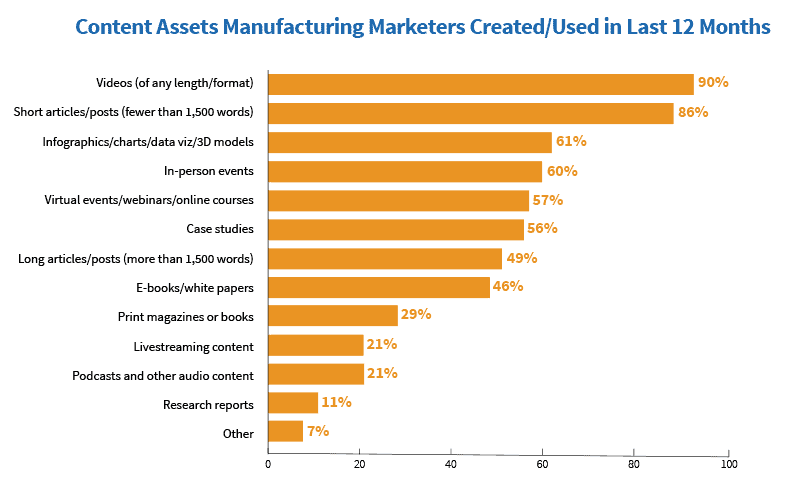
    Video marketing is becoming increasingly important in the industrial sector. According to the 2023 Manufacturing Content Marketing Report by the Content Marketing Institute, video content is quickly gaining traction. The report highlights that 90% of manufacturing marketers have used video content in the last 12 months.

    Videos is an important part of SEO strategies for manufacturers

    Moreover, 57% of manufacturing content marketers who use video content find it effective in their marketing strategy.

    Videos produced the best results for manufacturing content marketers

    To optimize videos for SEO in 2024, prioritize high-quality, relevant content that addresses your audience’s work challenges. How-to videos are effective for technical and MRO professionals. Optimize video descriptions and titles with researched keywords and create a video sitemap for easy indexing and ranking on Google.

    Optimize for mobile—A crucial part of SEO strategies for manufacturers

    Mobile optimization has been crucial for SEO and will continue in 2024. As more people use phones to access the internet, industrial companies must ensure mobile-friendly websites.

    Google prioritizes mobile optimization as part of its mobile-first indexing policy. Mobile responsive websites gain an advantage in Google’s SERPs, highlighting the importance of optimizing your website for mobile devices. This optimization can significantly impact your online visibility and overall success.

    To optimize for mobile, manufacturers and industrial companies should focus on creating responsive websites that adjust to different screen sizes and optimize loading speed. Content readability and mobile navigation are also crucial considerations.

    My experience with manufacturing clients is slightly different. The bulk of their site traffic still comes from desktops. Your mileage may vary. You still have to please the “Google Gods!”

    SEO strategies for manufacturers are vital for online success in 2024 and beyond. By prioritizing user experience, harnessing the power of Generative AI, embracing video marketing, and optimizing for mobile, manufacturers and industrial companies can strengthen their online presence and surpass their competitors.

    Tap into my extensive knowledge gained over three decades of hands-on experience working with manufacturers and industrial companies, from understanding the buying journey of engineers and industrial buyers to implementing highly effective SEO strategies customized for your business.

    Contact me today, and together, we can unlock the full potential of your online presence and set you on a path to sustained success. Don’t let your competition outperform you in search rankings.

  • Leveraging Industrial Content Marketing for Manufacturers—a Key Strategy for Lead Generation

    Leveraging Industrial Content Marketing for Manufacturers—a Key Strategy for Lead Generation

    Industrial content marketing for manufacturers is a powerful tool to help your business achieve its lead generation and sales goals. It’s a strategic marketing approach focused on creating, distributing, and promoting valuable, relevant, and consistent content to attract and engage a clearly defined audience. Ultimately, it aims to drive visitor action leading to conversions.

    Some refer to it as inbound marketing, which is a business methodology that attracts customers by creating valuable content and experiences tailored to them. That term was first coined in 2005 by HubSpot’s co-founder and CEO, Brian Halligan, and became popular around 2012.

    Understanding the role of industrial content marketing in manufacturing

    The importance of content marketing for manufacturers cannot be overstated. With the advent of digital transformation and the changing landscape of the manufacturing sector, traditional marketing methods are no longer sufficient. It’s no wonder why more and more manufacturers are turning to content marketing to reach their target audience, build trust, and generate leads.

    Moreover, content marketing is not just about selling products or services, but it’s about providing useful information that helps your audience understand your products and solutions better. It’s about telling your company’s story, showcasing your in-house expertise, and positioning your company as a thought leader within your industry or niche. This, in turn, can strengthen your brand’s credibility, boost customer loyalty, and drive business growth.

    This strategic shift in manufacturing marketing aligns very well with today’s industrial buyers who are in self-select and self-serve mode. They don’t need to speak with your salespeople to get product information.

    Developing an effective manufacturing content marketing strategy

    Creating a successful manufacturing content marketing strategy requires careful planning and execution. It’s not just about writing blog posts or creating videos but about delivering the right content at the right time to the right audience. I have often said, “Content creation is not content marketing.”

    First, it’s essential to understand your audience. Know their needs, challenges, and pain points so you can create content that resonates with them. This involves conducting market research and creating buyer personas. This step is critical as it forms the basis of your content marketing strategy.

    Next, set clear goals for your content marketing efforts. This might include boosting brand awareness, generating leads, increasing website traffic, or improving customer engagement. Having well-defined goals will help guide your content creation and distribution efforts, ensuring that every piece of content serves a specific purpose.

    Goals achieved using industrial marketing for manufacturers

    (Source: Manufacturing Content Marketing Insights for 2023, CMI).

    Last but not least, it’s crucial to measure the effectiveness of your content marketing strategy. This involves tracking key performance indicators (KPIs) like website traffic, lead generation, social media engagement, and conversion rates. By monitoring these metrics, you can determine what’s working and what’s not, allowing you to tweak your strategy as needed.

    How to leverage industrial content marketing for lead generation and conversions

    Leveraging industrial content marketing for manufacturers for lead generation and conversions is about using content to attract, engage, and convert visitors into potential leads. It’s about providing valuable content that answers your audience’s questions, solves their problems, and guides them through the buying journey in a logical manner to make a more informed buying decision.

    One effective way to generate leads is by offering gated content. This is content that requires visitors to provide their contact information to access. Examples of gated content include eBooks, whitepapers, and case studies. Gated content offers valuable information in exchange for the reader’s email—this is where you capture top-of-the-funnel leads (MQLs) that you can nurture into qualified leads.

    Gated content can be a pitfall if you are not careful. Content not perceived as valuable by your audience but gated for the sake of capturing contact information can hurt credibility and damage your brand.

    A recent survey of B2B technology buying decision makers done by Informa Tech showed that 71% of respondents were sometimes or often disappointed by the quality of the gated content.

    Gated content in industrial content marketing for manufacturers

    Optimizing your content for search engines is another crucial aspect of leveraging industrial content marketing for manufacturers for lead generation. This involves using SEO best practices like keyword optimization, creating high-quality backlinks, and ensuring your website is mobile-friendly. By improving your search engine rankings, you can drive more organic traffic to your site and increase the chances of converting visitors into leads.

    How to Measure the Success of Your Manufacturing Content Marketing

    Measuring the success of your manufacturing content marketing involves tracking key performance indicators (KPIs). These might include website traffic, number of leads, social media engagement, and conversion rates.

    Website traffic is a crucial metric, it is the lifeblood of online marketing. This can help you gauge the effectiveness of your content marketing efforts and identify areas for improvement.

    Lead generation is another critical KPI. You can determine how effectively your content attracts and converts visitors by tracking the number of leads generated through your content marketing efforts. However, quality trumps quantity when it comes to leads.

    Social media engagement is also an essential metric. It measures how people are interacting with your content on social media. This can provide insights into how your audience perceives your content and how effectively it’s engaging them. Temper your expectations from social media because engineers and industrial professionals tend to be passive participants. They like to read or view videos but don’t leave comments or share often.

    Finally, conversion rates indicate the percentage of visitors who take a desired action, such as filling out a form or making a purchase if you have an online store. You can assess how effectively your content drives profitable customer action by tracking your conversion rates.

    Connecting the dots between publishing content and lead generation is often difficult, and many manufacturing content marketers struggle with it. However, you can’t escape or ignore this part because the C-suite execs want to know what they are getting for the money invested in industrial content marketing. They are not impressed by top-of-funnel stats from Google Analytics.

    Measuring performance of industrial content marketing for manufacturers is difdficult

    Putting it all together—A real-world case study

    Manufacturing Content Marketing Helps Improve Industrial Digital Marketing KPIs and Achieve Goals

    Outsourcing vs in-house: choosing the right approach for your manufacturing content marketing

    When it comes to executing your manufacturing content marketing strategy, you have two options: outsourcing or in-house. Each has pros and cons, and the right choice depends on your needs, goals, and resources.

    Outsourcing your content marketing can be a great option if you lack the time, expertise, or resources to do it in-house. It can also give you access to a team of experts with the skills and experience to deliver high-quality content that resonates with your audience.

    On the other hand, keeping your content marketing in-house gives you more control over your strategy and execution. It also allows you to closely align your content marketing efforts with your overall business goals and strategies.

    Ultimately, choosing between outsourcing and in-house depends on your specific needs and resources.

    “59% of respondents said their organization outsources at least one content marketing activity. Their top challenge is finding partners with adequate topical expertise (60%)”

    Source: The Content Marketing Institute

    Industrial content marketing for manufacturers is a powerful tool that can help you attract, engage, and convert visitors into potential leads. By understanding your audience, setting clear goals, creating high-quality, relevant content, promoting your content, and measuring your success, you can leverage content marketing to boost your lead generation and conversions.

    Whether you choose to outsource or keep your content marketing in-house, the key is to ensure that your content marketing efforts are strategic, targeted, and effective.

    Remember, content marketing is not just about selling products or services but about providing valuable information that helps your audience make a more informed buying decision and elevates you to a valued partner, not just a supplier.

    Need help improving your industrial marketing for manufacturers? Let’s talk.

  • Creating Industrial Content that Resonates with Engineers and Industrial Professionals

    Creating Industrial Content that Resonates with Engineers and Industrial Professionals

    As someone who has been creating industrial content and blog posts for engineers and industrial professionals for many years, I understand the difficulties and the importance of creating high-quality content that is informative, engaging, and easy to understand.

    In this article, I will share my thoughts and insights on creating industrial content to help you connect with your audience and establish yourself as an authority in your target industry.

    Industrial content creation: what sets it apart?

    Creating industrial content is different from other types of content creation in a few key ways. First, industrial content is typically more technical and specialized than other types of content, requiring a deep understanding of the subject matter and the industry in question.

    Second, industrial content is often targeted at a specific audience of engineers, industrial professionals, or other technical experts. This requires a nuanced approach to writing, using industry-specific language and terminology to communicate your message effectively.

    Finally, industrial content often provides practical insights and solutions that can be applied directly to a specific industry or technical challenge. This requires a deep understanding of your audience’s needs and pain points and a commitment to providing valuable, actionable information.

    The problem with creating industrial content

    Here’s a direct quote from the Manufacturing Content Marketing – Insights for 2023, published by the Content Marketing Insititute.

    “Manufacturing marketers struggle with creating content for the buyer’s journey, aligning content efforts across sales and marketing, and communicating internally among teams/silos.”

    Challenges in creating industrial content

    If it is any consolation, as you can see, you are not alone in your struggles in creating industrial content.

    Whether you are writing for engineers, industrial professionals, or other technical experts, your goal should be to provide them with valuable insights and information that they can use to improve their work and stay up-to-date with the latest trends and technologies.

    The last sentence is the key—your content must be relevant to their work-related challenges and fill their knowledge gaps. In short, don’t write about your perceived solutions in search of real-world problems.

    Why understanding your audience for industrial content is so important

    I’m sure you are already familiar with the advice, “Get to know your readers.” It becomes even more important in creating industrial content because of the audience you are dealing with—they already have some knowledge of the subject matter, sometimes more than you do.

    Therein lies the challenge. Someone can be good at marketing but weak in understanding technical concepts. It is hard to find both in one person or a marketing agency unless you are like me, a Marketing Engineer. 😊

    How do you discover challenges faced by engineers?

    Unless you have experience in the field, you’ll need to do your homework before creating industrial content. You’ll only understand your readers’ challenges by talking to your in-house Subject matter Experts (SMEs) and customer-facing people within your company. Ask them about the kinds of questions prospects and customers ask in their conversations.

    To conduct in-depth research for your industrial content, you should start by identifying credible sources of information. This might include academic journals, industry publications, and reports from reputable organizations and associations. It would help to consider interviewing industry experts and thought leaders to gain insights and perspectives you might not find elsewhere.

    Get your draft reviewed by your SMEs before you publish anything. A word of caution here: SMEs are busy people doing what they do best. Don’t expect them to drop everything to help you. Refer to the chart above, 41% of manufacturing content marketers said they had trouble with “Accessing subject matter experts to create content.”

    You may want to read my earlier post, Industrial Blogging Lessons Learned from Working with Technical SMEs.

    Clarity without dumbing down the content

    Writing good and effective technical content is about communicating complex information clearly so that your target audience comes away with a good understanding and gains insights that s/he did not have before. You’ll have a sure winner if you create an “Ah-ha moment” for your readers.

    You often hear advice such as “Use simple and concise language: Avoid jargon and technical terms your readers might not understand.” I don’t wholly agree with that.

    At the heart of creating industrial content is the ability to break down complex concepts into simple, easy-to-understand terms. However, that doesn’t mean you need to dumb down your copy. After all, your readers are engineers and technical professionals, not 5th graders. Using standard industry acronyms, such as ASME, ANSI, DSP, etc., is okay. You may spell it for the first use for clarity, but there is no need to avoid them altogether.

    Consider using short how-to videos to explain the complex workings of a manufactured product instead of writing thousands of words.

    According to the 2023 Manufacturing Content Marketing report I cited earlier, “Ninety percent of manufacturing marketers reported that they used videos in the last 12 months. They also said video produced the best results for their content marketing. In addition, 80% said their organization will invest/continue to invest in video in 2023, making it the top area of content marketing investment.”

    Creating industrial content relevant to your audience is a critical and valued skill for manufacturing and industrial marketers. By creating high-quality, engaging, and informative content, you can establish your industrial company as an authority in your industry and become a trusted source of information that your readers are searching for and want.

    If you need help creating industrial content, please reach out. Let’s talk about how I can help you create engaging and informative content that will help you connect with your target audience and achieve your business goals.

  • Manufacturing Content Marketing Survey Results [2023]

    Manufacturing Content Marketing Survey Results [2023]

    I recently downloaded the report Manufacturing Content Marketing – Insights for 2023. The results are from the survey done and published by the Content Marketing Insititute. They do this survey every year.

    I’m not going to rehash the entire report in this post. Instead, I’ll highlight some of the important findings and share my thoughts based on working with manufacturers every day. I encourage you to download the full report from the link above.

    Understanding the audience for the manufacturing content marketing survey

    Let me first talk about the respondents for this survey. It will help to understand some of the findings in the proper context.

    1,104 people responded to the survey. They were from around the world, from different industries in varying job functions, and working within companies ranging in size from Micro (1 – 9 employees) to Large (1,000+ employees). So it was a reasonably large sample and representative.

    Manufacturing content marketing is still a one-person show

    Manufacturing content marketers wear many hats

    Even though 78% of the manufacturers in the surveys were from Medium to Large sized companies, 61% said one group (or person) is responsible for handling all types of content in their organization (including advertising, thought leadership, brochures, SEO content, etc.). Yes, the percentage was lower at 47% for large-size companies.

    These findings match what I see on the ground. Many industrial companies I talk to don’t even have one person dedicated to manufacturing content marketing. It’s all done ad hoc by whoever has some time. That’s why they contact me for help in the first place. 😊

    Help is on the way for manufacturing marketers

    Don’t panic, at least not yet. Decision-makers in many manufacturing companies have realized that their marketing departments are severely understaffed, and those few are wearing too many hats.

    Manufacturers plan to hire or contract out more in 2023, and 42% of respondents think their content marketing budget will increase in 2023. Unfortunately, that’s down from 2021, when 64% expected their marketing budget to increase the following year.

    Manufacturing content marketing budgets

    Content creation is not the same as content marketing

    That is my mantra, and I repeat it often to whoever will listen. Let’s be serious for a minute, I’ve had too many conversations where stakeholders in industrial companies have unrealistic expectations about manufacturing content marketing.

    What do I mean by that? Here’s a typical example, “We want you to write blog posts for us that will show up on the first page of Google, so our target audience (engineers and industrial buyers) will find us easily, visit our blog and contact our salespeople.”

    If it were that simple, everyone would be doing it.

    Only 32% of manufacturing content marketers have a documented content marketing strategy in place. This lack of strategy often leads to content creation without clear objectives or alignment with business goals.

    Little to no thought is given to developing a content marketing strategy, clearly defining the audience, and writing about their pain points. Just creating content for the sake of content marketing will not move the needle. Your content needs to be more about them and less about you.

    “Manufacturing marketers who want to differentiate their content should focus on quality and unique stories.”

    Manufacturing Content Marketing Survey – 2023

    Eighty percent of those who always/frequently differentiate their content said they do so by producing better quality content than their competitors.

    Manufacturing content marketing can create true differentiation

    Goals achieved by manufacturing content marketers in the last 12 months

    You’d think this would be a no-brainer. Of course, lead generation is the number #1 goal, right? Well, take a look at this chart.

    Goals achieved in the past 12 months using manufacturing content marketing

    Surprised by the findings? You shouldn’t be. Let me explain based on my hands-on experience working with manufacturers.

    Raising brand awareness, earning the audience’s trust (engineers are naturally skeptical), and educating them with content relevant to their work-related challenges, all play a critical role in generating better quality leads that have a good chance of converting into sales opportunities.

    Refer to my earlier post, Industrial Lead Generation for Sales – It’s Complicated!

    What is working and what is not

    The report has a whole section dedicated to discussing the various channels. I don’t want to repeat them here. Let me highlight a few of them.

    • Sixty percent reported using in-person events, compared with only 28% the previous year (The pandemic had a big impact on this)
    • The use of videos increased to 90% from 86% the previous year
    • Manufacturing marketers said videos produced the best results for their content marketing in the last 12 months (57%)
    • The use of guest posts increased to 47% from 26% the previous year
    • The use of Facebook decreased by 7 points (79% this year vs. 86% the previous year). Linkedin remains at the top with 95% usage
    • The use of paid content distribution decreased to 73% from 85% the previous year
    • The use of Facebook advertising decreased to 63% from 76% the previous year
    • The top challenge manufacturing marketers face with measuring content performance is difficulty integrating/correlating data across multiple platforms (48%)

    Manufacturing content marketing challenges and looking forward

    Manufacturing marketers continue to face challenges in content marketing, including maintaining consistency in measurement, accessing subject matter experts, and aligning content efforts with business goals. However, the survey results indicate a positive outlook for the future.

    In looking ahead, manufacturing marketers must prioritize developing comprehensive strategies and invest in the right people and technologies to manage and streamline processes.

    Let’s talk if you have questions or need help with your manufacturing content marketing.