Category: Industrial Lead Generation

  • Landing Pages for Industrial Lead Generation

    Landing Pages for Industrial Lead Generation

    The importance of landing pages for industrial lead generation cannot be overstated. Why? That’s where conversions happen—visitors turn into leads. Landing pages are where your visitors first land from a marketing campaign or a social media channel.

    Note, this is not the same as promoting your blog posts via social media channels for site traffic.

    What is the job of landing pages for industrial lead generation?

    Landing pages have one job to do—Convert site visitors into leads.

    I remember reading an excellent description of a landing page using a golf analogy. “A landing page is the putting green that you drive the ball (prospect) to. Once on the green, the goal is to get the ball into the hole. Likewise, the goal of the copy and design of a landing page is to get the prospect to take your desired action.” (Source: Coppyblogger).

    Your Contact Us page with a simple form may not be the best example of a landing page. Most site visitors are hesitant to contact you right away. In contrast, a landing page provides a specific offer that is of interest to your audience. It should persuade the visitor to take the desired action. Of course, it is not just a matter of aesthetics; read on for ways to avoid common pitfalls that can sabotage your lead generation efforts.

    This singular focus of landing pages for industrial lead generation makes them different from web pages that may have different goals to achieve. The visitor provides their name and email address in exchange for something valuable. Downloading white papers and how-to guides, signing up for your newsletter, or registering for a webinar are typical applications in industrial marketing.

    Refer to these two online resources to learn more about landing pages.

    1. What Is a Landing Page? (Unbounce)
    2. The Anatomy Of A Perfect Landing Page (LeadForest)

    Common mistakes and pitfalls to avoid in landing pages

    In this post, I’ll focus on talking about some of the common mistakes I have seen made by manufacturing and engineering companies. With a little bit of planning, you can easily avoid these pitfalls.

    • Links from marketing campaigns got to the Home page instead of landing pages
    • More than one call to action competing with each other
    • Visitors leak out because of distracting navigation
    • No compelling offer and visitors leave without submitting the form
    • Complicated forms that ask for too much information on the first go
    • Cluttered layouts that confuse instead of directing visitors to the sign-up form

    Bounce rates of landing pages

    According to research published by Instapage, “9 out of 10 visitors bounce from the average post-click landing page.”

    Their definition of a post-click landing page is “…a standalone web page, disconnected from a website’s navigation, created for the sole purpose of convincing a visitor to act (to sign up, buy, download, etc.).”

    Ouch, that isn’t very encouraging, so you need to optimize your landing pages for the best conversion rate possible. Ask yourself these questions:

    • Does my offer match the visitor’s expectations?
    • Could my audience feel deceived by the headline (clickbait)?
    • Am I targeting the right audience or casting too wide a net?

    Answering those questions will not only help you design more effective landing pages for industrial lead generation, it will also help you craft more compelling offers. Offers that your target audience will find valuable enough, to part with their essential contact information.

    Resistance to forms on landing pages for industrial lead generation

    How often do you resist filling out online forms that have half a dozen or more fields? There’s a natural resistance to giving out too much information. Why would a phone number be required to download something?

    The more fields you have, the greater the resistance to filling out the form. In the worst-case scenario, people provide junk information. What information are engineers and technical professionals willing to provide?

    This chart is from the survey published by GlobalSpec, and it shows a significant dropoff after Job Title. The resistance is higher if you make more fields mandatory.

    resistance to forms on landing pages for industrial lead generation

    What content do engineers prefer?

    Crafting a valuable piece of content is not an easy task, especially when targeting a technical audience. Use this chart from the 2021 State of Marketing to Engineers report, also published by GlobalSpec.

    Notice that engineers are willing to fill out a registration form for technical content relevant to their work. White papers and CAD drawings are the top two most popular, with case studies, video tutorials, and webinars filling the top five.

    Content preferences of engineers

    I call downloadable CAD files sales enablers because they help manufacturers of parts and components get “designed in.” This is critical if your audience is Design Engineers. You are not likely to get to the RFQ stage unless your part is specified and/or included in the BOM. (See my post, Using CAD and BIM Files in Manufacturing Content Marketing).

    Don’t underestimate the value of the tried and tested e-newsletters. Engineers have consistently considered this a valuable channel of information. The key is to win their trust with good content (Not overly salesy), to get past the spam filters and into their inboxes.

    “92% of engineers subscribe to at least one newsletter. 43% of engineers subscribe to 3-5, and nearly one-fifth subscribe to 6 or more.”

    It should be abundantly clear by now that landing pages can make or break your industrial lead generation campaigns.
  • Industrial Lead Generation – MQL vs SQL

    Industrial Lead Generation – MQL vs SQL

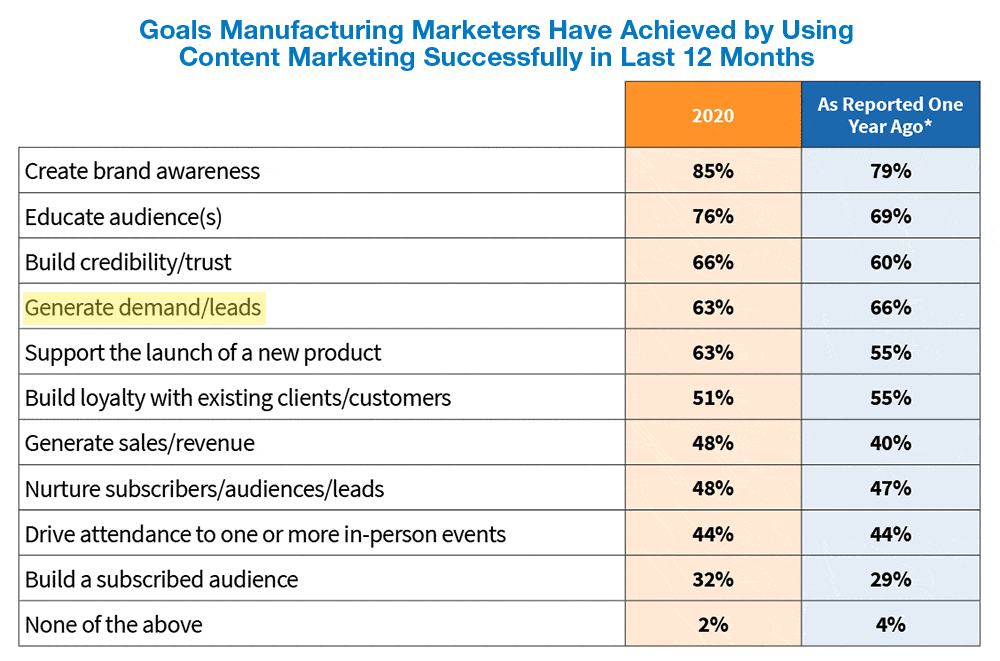
    Industrial lead generation is an important, if not the #1 goal of industrial marketers. Sure, there are other objectives of manufacturing content marketing as can be seen in this chart from the Manufacturing Content Marketing 2020 research report published by the Content Marketing Institute.

    Even though “Generate demand/leads” is at #4, generating high quality leads is closely related to the top three goals.

    Industrial lead generation with manufacturing content marketing

    Industrial lead generation is complicated

    Your Sales team and more importantly, upper management want Marketing to generate leads that turn into RFQs/RFPs and sales opportunities.

    Here’s where things begin to get complicated and start to fall apart. Not all leads are created equal, especially in long sales cycles with many stakeholders involved as is typical in industrial sales.

    No, this post is not about quantity vs quality of leads.

    MQL and SQL definitions

    I’ll approach the definitions from the perspective of industrial content marketing since most manufacturing marketers are using this inbound marketing strategy to successfully generate leads these days.

    A Marketing Qualified Lead (MQL) is someone who has shown some interest in your content and may even be willing to give up their basic contact information in exchange for gaining access to more valuable content. These are top of the funnel (ToFU) leads.

    A Sales Qualified Lead (SQL) is someone who has shown an interest in your product or service and not just in consuming your content. These prospects are further along in their buying journey. These are middle of the funnel (MoFU) leads who may be ready to have a conversation with your sales team.

    The biggest mistake made by Marketing is that they tend to hand off MQLs to Sales to qualify and close. Marketing’s job doesn’t end with generating MQLs. There is a lot more work to be done.

    It is critical to understand the differences between a Marketing Qualified Lead (MQL) and a Sales Qualified Lead (SQL). Otherwise, you’ll reinforce the biggest complaint that I’ve heard from Sales, “Marketing generates crappy leads.”

    Converting MQLs into SQLs

    So how do you turn MQLs into SQLs? The conversion doesn’t happen in one magical step, it’s a process that begins long before you start a content marketing program for lead generation.

    Let me back up a bit first.

    BANT in industrial lead generationSalespeople have been using the BANT (Budget, Authority, Needs, and Timing/Timeframe) method for qualifying leads successfully for a long time. It is an efficient system without wasting time on prospects who don’t have the budget and/or the authority to make a buying decision.

    However, that strategy is not as effective today when industrial buyers prefer to remain invisible or anonymous for a large part of their buying journey.

    Let me give you an example to illustrate this point.

    Let’s say you are a manufacturer of industrial components, your part must be “designed in” by a Design Engineer before the Purchasing Department can issue a PO or send out a request for RFQ/RFP. The Design Engineer is the specifier who has no buying authority, but you are not going to get to the RFQ stage unless s/he specifies your part first. Such a lead wouldn’t fit into the neat definitions of BANT. (For more on this, see BANT May Not Work in Qualifying Leads for Industrial Sales).

    How SAL brings together Sales and Marketing

    Actually, there is one critical step between MQL and SQL. I refer to it as SALSales Accepted Leads (There are other acronyms for the same thing). SAL bridges the gap between MQLs and SQLs.

    You can find many articles online about Sales and Marketing alignment. I’ll stick with the approach of using manufacturing content marketing.

    SAL - role in industrial lead generation

    SAL is a three-letter word that is the key step in achieving Sales and Marketing alignment. How you ask? It would take up thousands of words to describe the entire process. Here are key talking points.

    • The two have to work together to come up with a unified definition of a qualified lead
    • Sales agrees to take follow-up action on these leads
    • Sales provides feedback to Marketing to refine these definitions and scores over time
    • This makes for a closed-loop lead generation system
    • Without SAL, Sales and Marketing will continue to point fingers at each other when things don’t go right

    Refer to my post, SAL is the Glue that Binds Sales and Marketing in Lead Generation for additional details.

    BTW, I had published that post back in 2010 and it is still the second most popular posts among the 300+ posts that I have published here. Shows you the lasting power of industrial blogging.

    Email automation for nurturing MQLs into SQLs

    As I’ve mentioned earlier, the conversion is a process and not something you can accomplish in one fell swoop. Once again Sales and Marketing have to work in tandem to come up with a uniform definition of a qualified lead and scoring criteria.

    Industrial email marketing continues to be the most effective way to nurture engineers and technical professionals by feeding them relevant content that will move them forward in their purchase decision in a logical manner. Content must address the challenges faced by various stakeholders at different stages of their buying journey.

    Note, I’m not referring to email blasts or as it is commonly known as “batch and blast.” You need to carefully segment your list, create supporting content assets for lead nurturing, send out personalized emails and measure the results. That’s the only way you’ll convert MQLs into real SQLs.

    Some call it “drip” marketing whereas others refer to it as email automation. You’ll need some form of marketing technology to make this process efficient and effective. To learn more about industrial email marketing, refer to article “Why Email Marketing for Manufacturers is the Cornerstone of Industrial Marketing.”

    This post should give you a good understanding of MQLs vs SQLs and their respective roles in industrial lead generation.

  • How Industrial Distributors Can Use Content Marketing

    How Industrial Distributors Can Use Content Marketing

    Content marketing for industrial distributors can be very challenging. The biggest problem I’ve seen is that there is very little differentiation between distributors serving the same niche. Their competitors show the same line cards and unless they sell online directly, site visitors can’t see prices, nor do they have any idea about the lead time.

    Yes, I understand some distributors use this as a strategy to force people to call them, but it usually isn’t very effective. I say that based on my experience working with industrial distributors. Here’s what I’ve seen or heard:

    • “We quote our best prices, but never hear back from them”
    • “We don’t want to compete on price or be the lowest bidder”
    • “We don’t want our competition to undercut our prices”

    You can see the disconnect here; the only content on your website is product descriptions, features and may be some benefits which come straight from your principal manufacturers. This content is exactly the same as your competition. Your customers have no way to differentiate you other than on price.

    Content marketing for industrial distributors helps your customers make informed decisions

    Industrial buyers are in self-select and self-serve mode these days, they don’t want to or need to talk to your sales team just to get product information, pricing and lead times. They have access to countless online sources to get that information. Content marketing for distributors can go a long way in setting you apart and bringing out some of the key selling points. In other words, set the table for your salespeople to have more productive conversations that go beyond pricing.

    Examples of effective content for distributors

    • Highlight your experienced salespeople who are much more than just order takers. They help your customers find difficult to find parts, unusual materials or sizes
    • Bring to the forefront your USP – Are you a stocking or a master distributor?
    • Provide online resources that your visitors can use to find the exact part number from your extensive inventory based on their parameters
    • Give them access to cross-reference guides to locate equivalent products that you carry of discontinued or end-of-life components
    • Describe the engineering or technical services offered by you that add value to your customers both before and after the sale
    • Create an online resource of user manuals, Material Safety Data Sheets (MSDS) and how-to videos
    • Provide valuable time savers such as downloadable CAD files and easily searchable online catalogs
    • Talk about “lunch and learn” training that you may provide or online webinars
    • Create an online technical forum where customers can share their own experiences and ask questions
    • Set up a blog where your in-house subject matter experts can talk about unique applications and/or problems solved

    Value added services is a very strong differentiator and will help distributors sell a complete solution instead of just hardware. This doesn’t necessarily have to be about services, you could also talk about how you help your customers make a more informed buying decision.

    I can list many more content ideas to add to this list, but you get the picture. I have come across many distributors, both clients and others who are using content marketing to differentiate themselves from the competition. Check online, you’ll find many good examples of well-known distributors that are using industrial content marketing very effectively.

    What I’ve described here does require a commitment of time and money, but the payoff can be huge when it comes to generating sales qualified leads. If there is parity in value propositions, good content marketing for distributors that’s relevant to your customers will establish your brand and earn you their trust which in turn will help to sell more of your industrial products.

  • Industrial Lead Generation for Sales – It’s Complicated!

    Industrial Lead Generation for Sales – It’s Complicated!

    Industrial lead generation is the lifeline for manufacturers, distributors and engineering companies when it comes to accelerating their pipelines and growing sales. However, turning new leads into sales is not straightforward or simple. Just like the hit movie, it’s complicated!

    There are many reasons for the failure of industrial lead generation to convert into wins in long and complex sales cycles. Before I go into those, let me give you three real-life examples of conversations that I have had with industrial companies.

    Example #1: The Head of Business Development for a manufacturer of compressed air dehydrators said to me, “My sales team can tell if a lead is qualified or not within five minutes of talking to someone.”

    The problem was that his sales team wasn’t receiving enough of those calls and they were having a hard time getting in front of the right decisionmakers to make that qualifying decision. Sales were down as a result and they needed to fill their pipeline with more leads.

    Example #2: The North American Sales Manager of an engineering company that designed custom-engineered skid-mounted modular process systems for the upstream Oil & Gas industry said, “We don’t talk to leads until we receive an RFQ/RFP.”

    He didn’t want to sell on price because the company’s strength was in providing engineered solutions. Unfortunately, it was too late for his team to start talking about their expertise because the buyer had already reached the final stage of his/her buying decision. S/he wanted all vendors to conform to a given set of specifications so it was easier to do an apples to apples comparison of bids based on price and lead-time.

    Example #3: The President/Owner of a Leak Detection and Repair (LDAR) services company that primarily targeted refineries and petrochemical companies, emailed me to say, “I want to meet the right people and if necessary, jump on a plane to go anywhere, but I don’t know who to meet.”

    This client had tried email blasts to rented lists and telemarketing companies to set appointments. Neither of those tactics produced results for him. He was desperate for new leads.

    (more…)

  • Use industrial content marketing to enable sales

    Industrial content marketing plays an important role in driving sales for manufacturers and engineering companies. Of course, going from publishing content to growing sales is not as easy as going from point A to point B.

    If you are a manufacturer of custom-engineered systems, you know that it is nearly impossible to generate Sales Qualified Leads (SQLs) without first having one or more conversations with the right people. To get to that point requires more than publishing a few blog posts and/or sending out emails.

    Many of these industrial companies already know their limited pool of prospects who are qualified to buy their equipment and services. They don’t want to wait for these people to find them; they want to reach out to them proactively.

    The fact is your target audience of engineers and technical professionals are in self-select and self-serve mode. They want to learn as much about you and your solutions before they’ll engage with your sales team. Industrial content marketing aligns perfectly with how today’s self-educating buyers want to interact with their suppliers.

    (more…)

  • In Industrial Lead Generation, a Lead is a Lead, Right?

    Defining leads in industrial lead generationEvery discussion I’ve had with manufacturers and industrial companies starts with “we need more leads” or ends with “we need results.” I understand and accept the fact that the main goal of industrial marketing is to generate leads. I have no issues with that but do these companies know what a qualified lead is?

    That may sound like a dumb question to ask in industrial lead generation but in reality, you would be surprised by how fundamental and serious that question is. I’m not making this up or trying to be clever here.

    Let me explain with three excerpts from conversations I have had in just the past few months.

    (more…)

  • BANT May Not Work in Qualifying Leads for Industrial Sales


    Using BANT to qualify leads for industrial sales

    Sales people have been using BANT (Budget, Authority, Needs, and Timing/Timeframe) criteria to qualify leads and prospects for a long time ever since IBM first coined that acronym. It made a lot of sense from salesperson’s point of view because they want to know up front if the prospect has the money or can get the budget approved and has the buying authority. They don’t want to waste their time on unqualified leads. Nothing wrong with that!

    (more…)

  • Lead Generation for Industrial Companies is a Process not a Campaign

    I hear too many manufacturers and industrial companies talking about creating campaigns because they want to pump up their lead generation. That mode of thinking is outdated and simply doesn’t work today where you are dealing with mostly invisible and self-directed industrial buyers.

    Buyers are looking for information online and interacting with sales people on their own terms. Your industrial lead generation needs to evolve to meet their needs. Otherwise you are going to struggle generating qualified leads that turn into sales opportunities. That is a virtual certainty.

    Evolution of industrial lead generation

    The old ways of industrial lead generation have changed. Engineers and technical buyers do most of their research, evaluation and finally selecting a vendor very differently today than in the past. Complicating the process is the fact that the buyers do not usually go on a linear buying journey. There are many stakeholders involved in the buying decision, some of whom may never visit your website and/or meet your sales people.

    Now I know you’ve read/heard all this before so what exactly is different about lead generation today? Here’s a handy chart from Marketo that explains the differences between then and now.

    (more…)

  • Industrial Lead Generation Can’t Happen Without Conversations

    conversation for industrial lead generationWhat are the top two things my clients want from their industrial website redesign? It isn’t too difficult to guess, they are:

    1. Get found in Google (SEO)
    2. Get site visitors to call

    Only if it were that easy to get from point A to point B, we wouldn’t be having a conversation in the first place.

    (more…)

  • Take Industrial Lead Generation up a Notch with Marketing Automation

    Marketing automation technology is one of the areas where B2B marketers will increase spending in 2014 according to an article I read in the September 16 issue of BtoB Magazine. There are many more choices available today in Marketing Automation (MA) offerings and one can find the right fit at various price points. This post is not a product review or a comparison of different marketing automation packages. You’ll find plenty of such articles online written by vendors and independent marketing consultants. You can visit sites of different MA vendors and get the laundry list of all the features they offer.

    I’ll stick to my area of expertise – industrial marketing and the use of MA in this specific niche. I have used HubSpot for about four years for two different clients and am now using Pardot for another manufacturer. I want to zero in on two key benefits of using MA for improving industrial lead generation and conversions.

    1. Prospect Profiling
    2. ROI Measurement and Reporting

    (more…)